About valv8988

Welcome to my website covering the history, restoration and “personalizations” to my small collection of classic cars. Feel free to email me with questions, suggestions and/or comments. I would love to have your feedback! Cheers, Lin Rose linwoodrose@me.com

Remote Control Door Locks

Particularly since the MK2 is a four door sedan (saloon) I want to add the modern convenience of centrally operated electric door locks and while I am at it I might as well add a keyless entry feature.

These kits are quite inexpensive and I purchased mine from A1 Electric. https://www.a1electric.com/Merchant2/merchant.mvc?Screen=PROD&Store_Code=AEOS&Product_Code=W02F-712T This kit includes most everything that is needed. The locking part of the kit is advertised as being Swiss made.

This is an image of the contents of the kit:

W02F MES Central Door Locking Kit with Keyless Entry

This image illustrates the dimensions of one of the actuators:
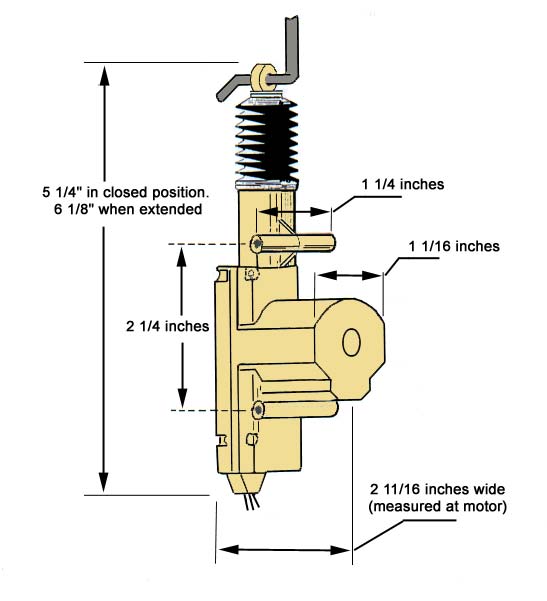
Actuator Dimensions

These are the installation instructions provided with the kit:W01F & W02F MES Central Door Locking Kit Installation Instructions

Mounting the Actuators to the Rear Doors

I began the installation of the four lock actuators with the RH rear door. Because the door window and lock hardware were not mounted to the door, I first installed these components. I did so to be sure that the actuator did not conflict with the operation of the window. Information on the installation of the window and lock components is provided in the “Door Handles and Locks” website entry https://valvechatter.com/?p=6027 and the “Doors and Windows” website entry https://valvechatter.com/?p=5485

The kit incorporates mounting hardware including a yellow zinc bendable strap and the necessary screws. These images show the location of the rear door actuators (both doors are the same).
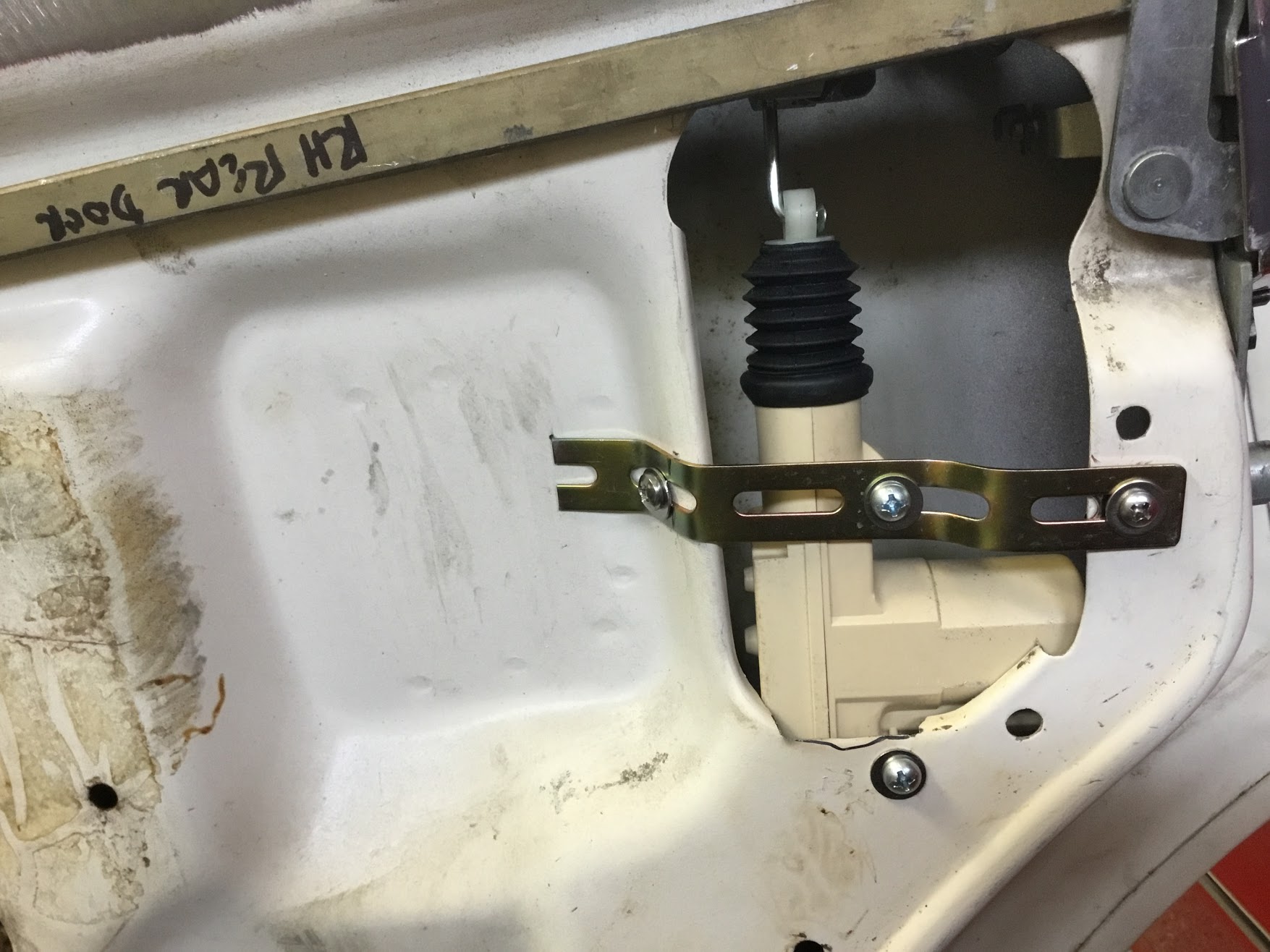
Lock Actuator RH Rear Door

Lock Actuator RH Rear Door

It was necessary to drill three holes in the door: two for the strap and one for the actuator body.

Connecting the Actuators to the Rear Door Locks

Connecting the actuator to the door lock is not difficult, but it is a little complicated to explain. The schematic diagram provided in the Service Manual on page 450 N.24 is helpful.
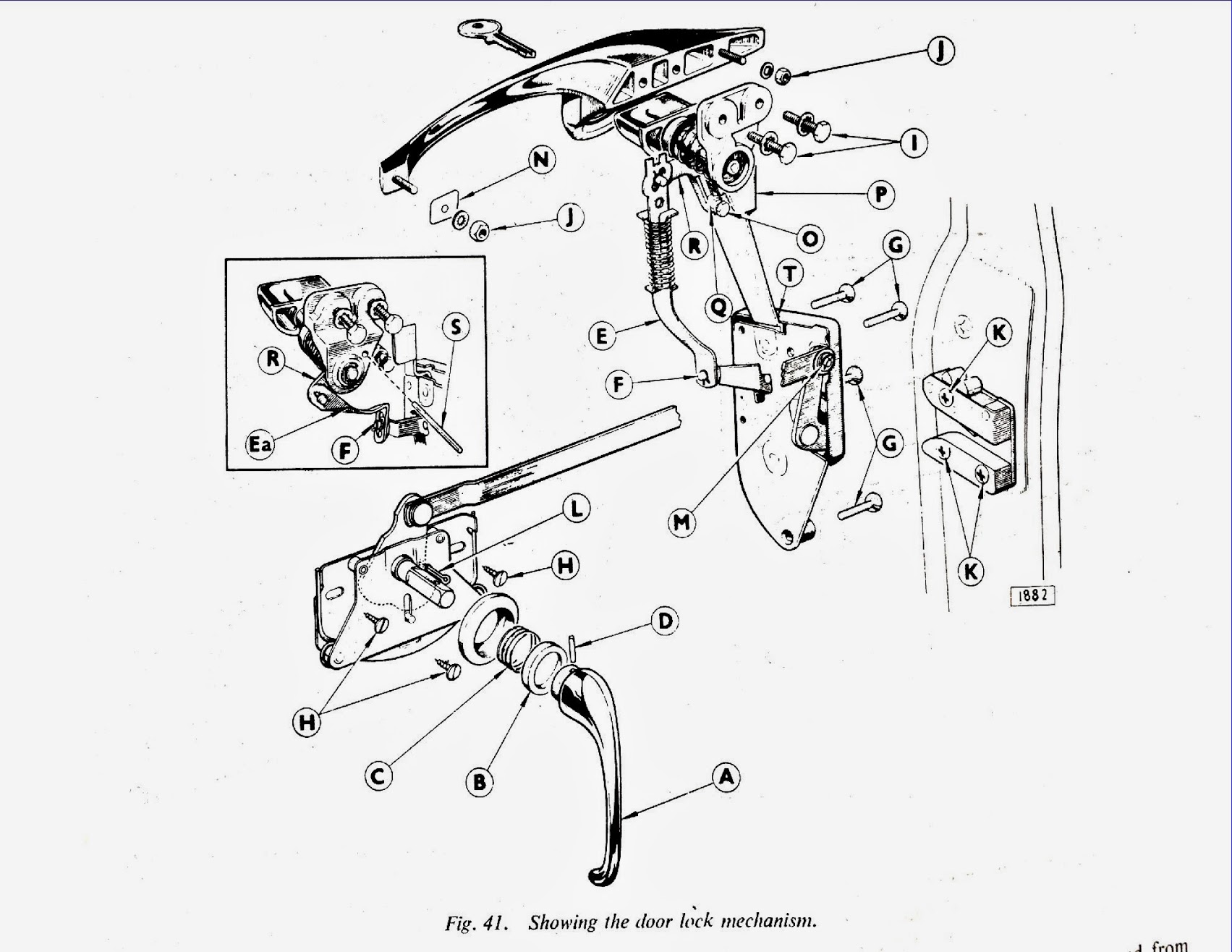
Jag MK2 Door Lock Mechanism Schematic

While most of the mechanism for the front and rear door are the same, there are some distinctions. The rear door components are shown in the small enclosed box in the diagram above. The connecting link (E) with a spring in the diagram is for the front door and the connecting link (Ea), without a spring, shown in the box and in the image below is for the rear doors.
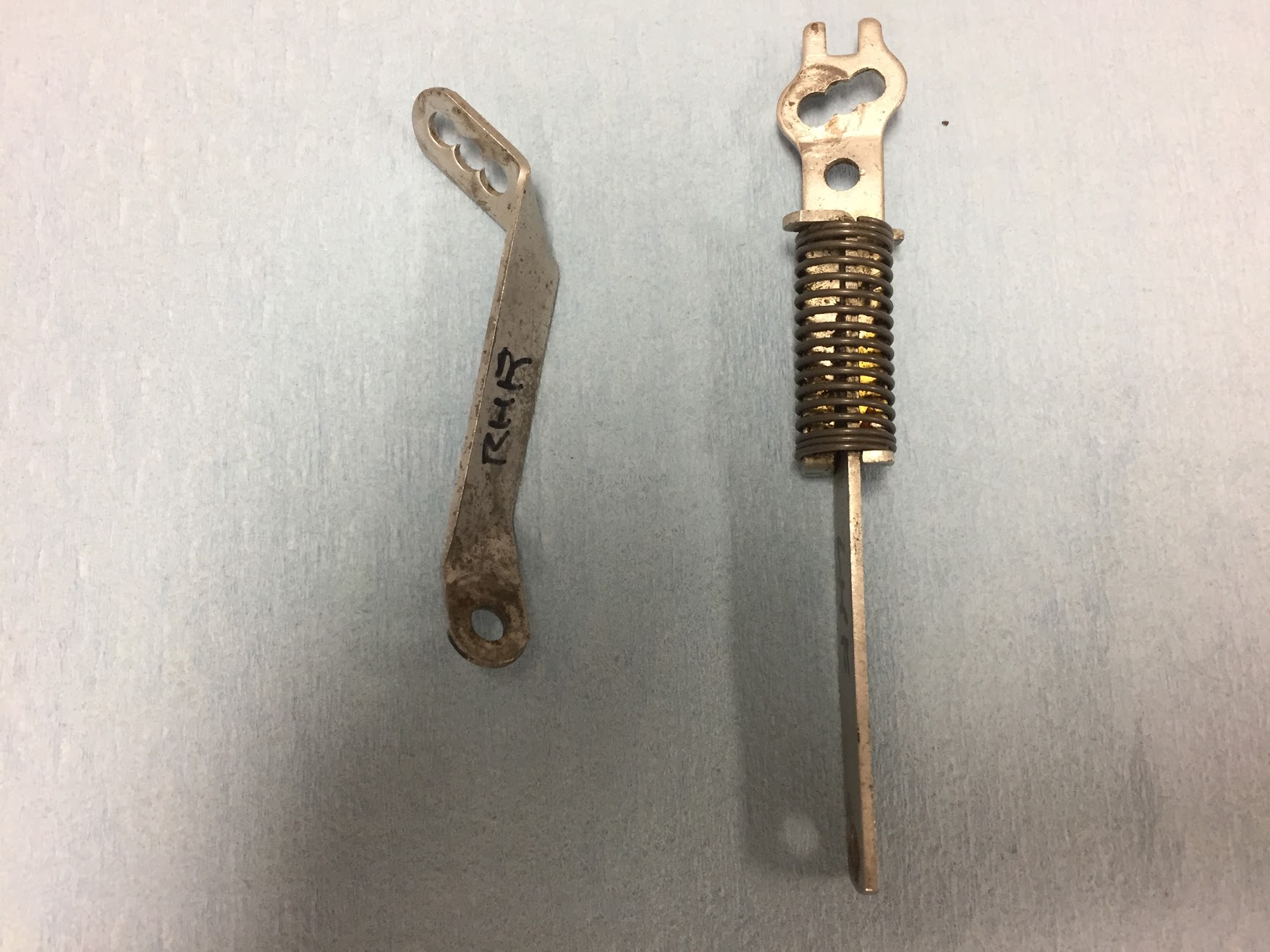
Lock Connecting Links Front and Rear

These connecting links do what their name implies: they connect the door handle locking mechanism and the remote control to the door lock and striker plate.I use the connecting links for both front and rear doors to connect the actuator rod, supplied in the kit, to the car’s locking mechanism. This is accomplished through the use of a small rod clamp that is provided in the kit.

Actuator Rod Clamp

The clamp has two set screws – one to attach the block to the connecting link (The factory lock rod in the diagram) and the other to connect to the actuator’s rod.
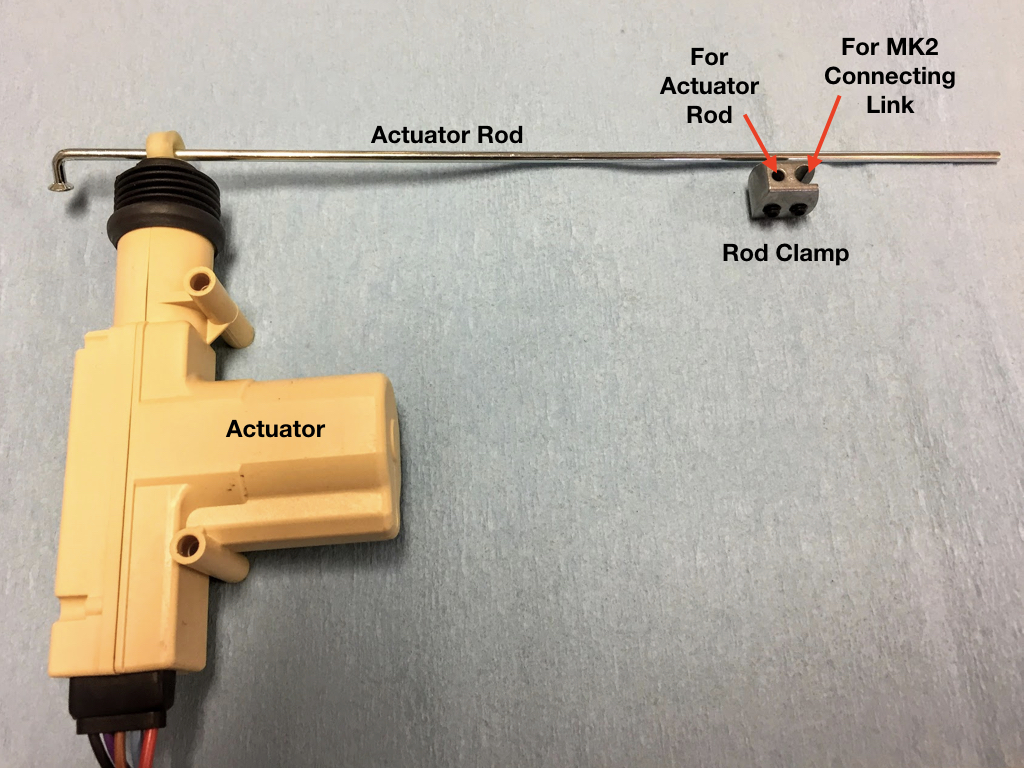
Actuator, Actuator rod and Rod Clamp

For the rear doors, to facilitate connection of the components without interference with the window frame, I chose to disconnect the connector link at the dowel (F) shown in the diagram at the top of the page. This will mean that the rear doors will not be locked and unlocked using the door handles which is of no matter to me since the actuators will be doing the job.

I then straighten the connecting link (removed the bends) and used it for the new connection to the connector block. To make the connection, the Actuator Rod needed to be bent slightly.

After installing the actuators in both rear doors, I tested them with a power source and was satisfied that they both operated effectively. The photos below show where the rod clamp attaches to the rod and to the connecting link. The position will be important when final assembly occurs.
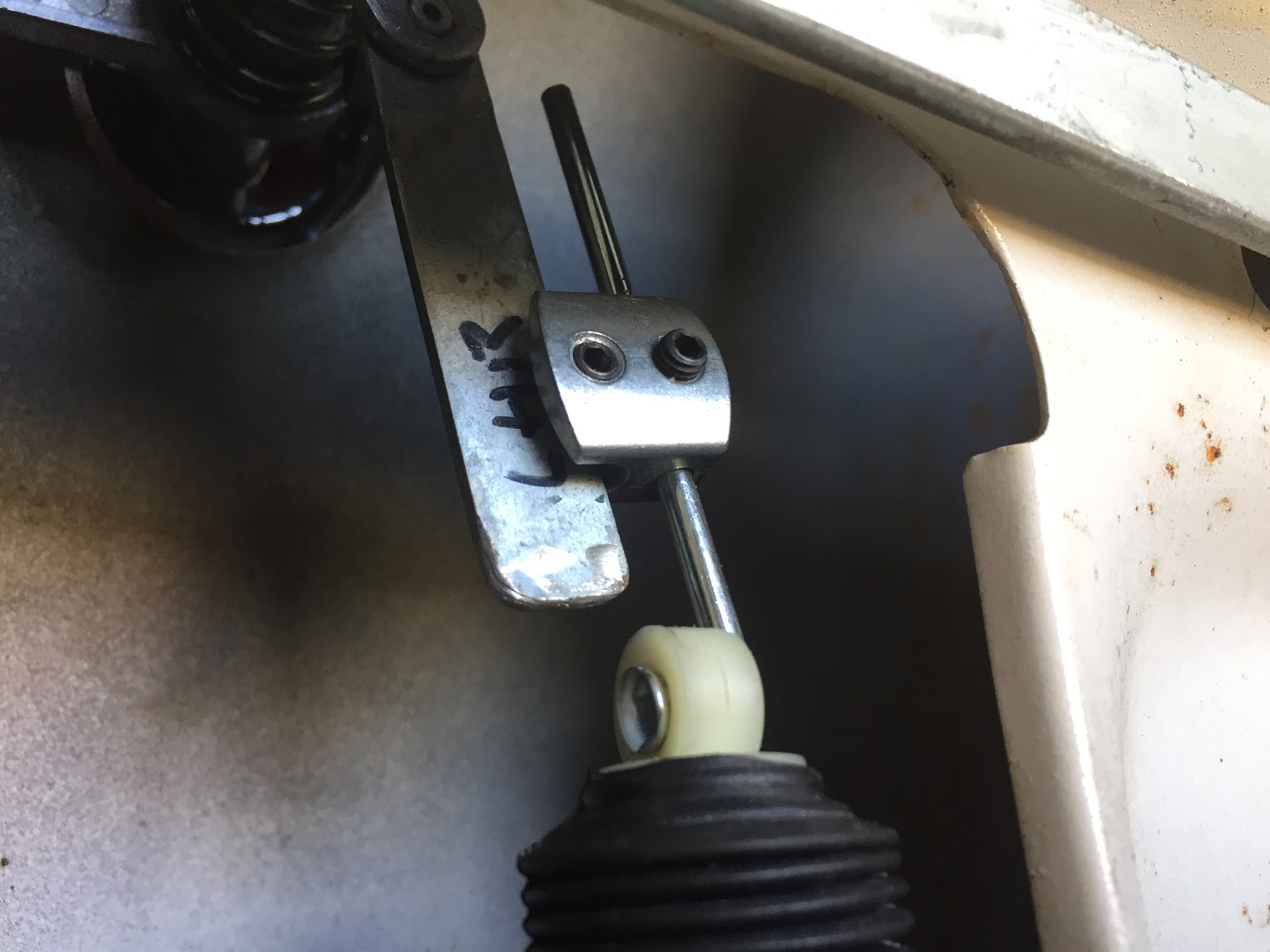
LH Rear Door Lock Connecting Link
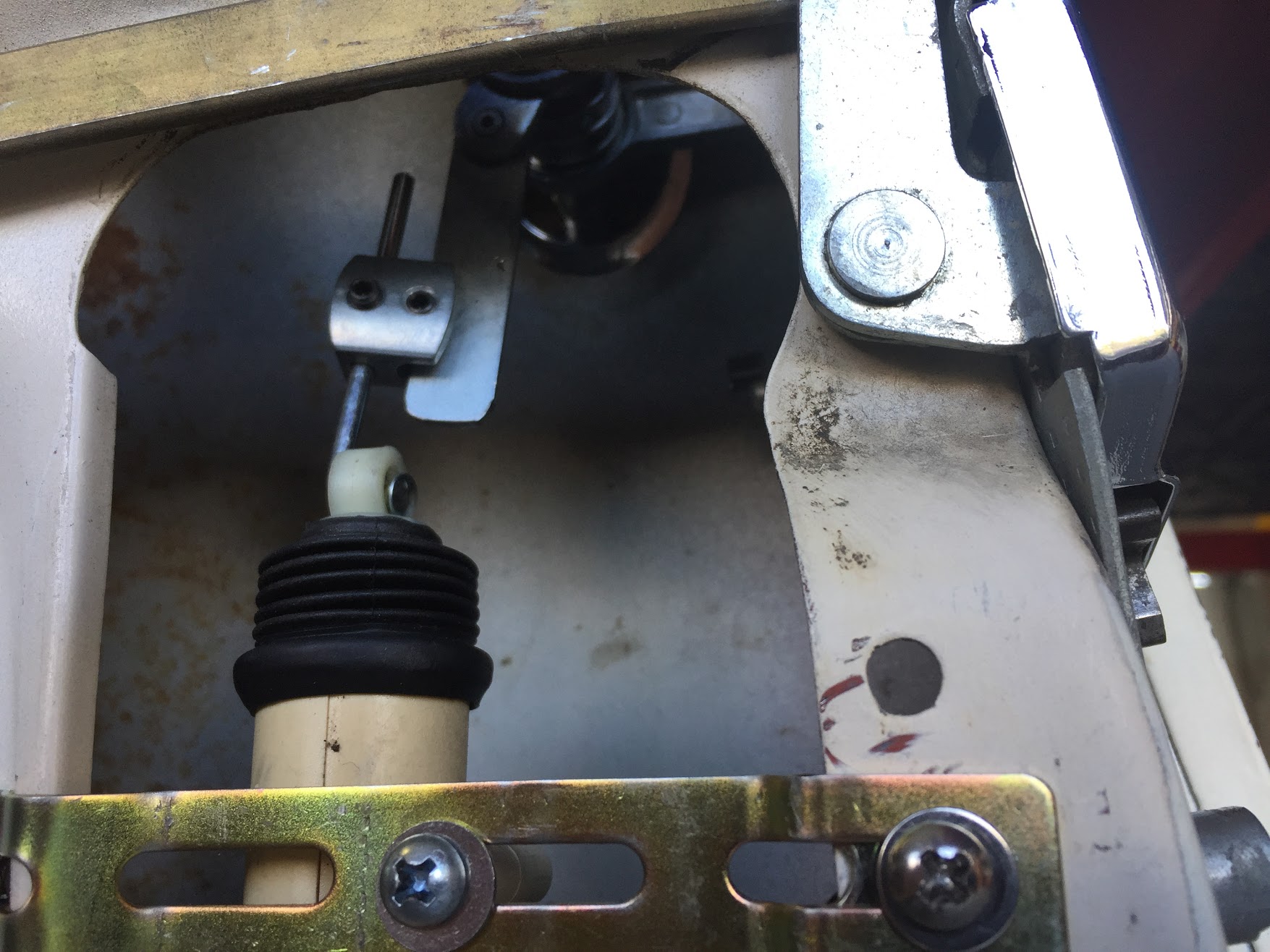
RH Rear Door Lock Connecting Link Position

Mounting the Actuators to the Front Doors

Because the door window and lock hardware were not mounted to the door, I first installed these components. I did so to be sure that the actuator did not conflict with the operation of the window. Information on the installation of the window and lock components is provided in the “Door Handles and Locks” website entry https://valvechatter.com/?p=6027 and the “Doors and Windows” website entry https://valvechatter.com/?p=5485

The front doors are a bit more of a challenge when contrasted with the rear doors.

To keep the actuator in a vertical position, I decided to open a hole in the door interior face. The hole can be seen in the following image:
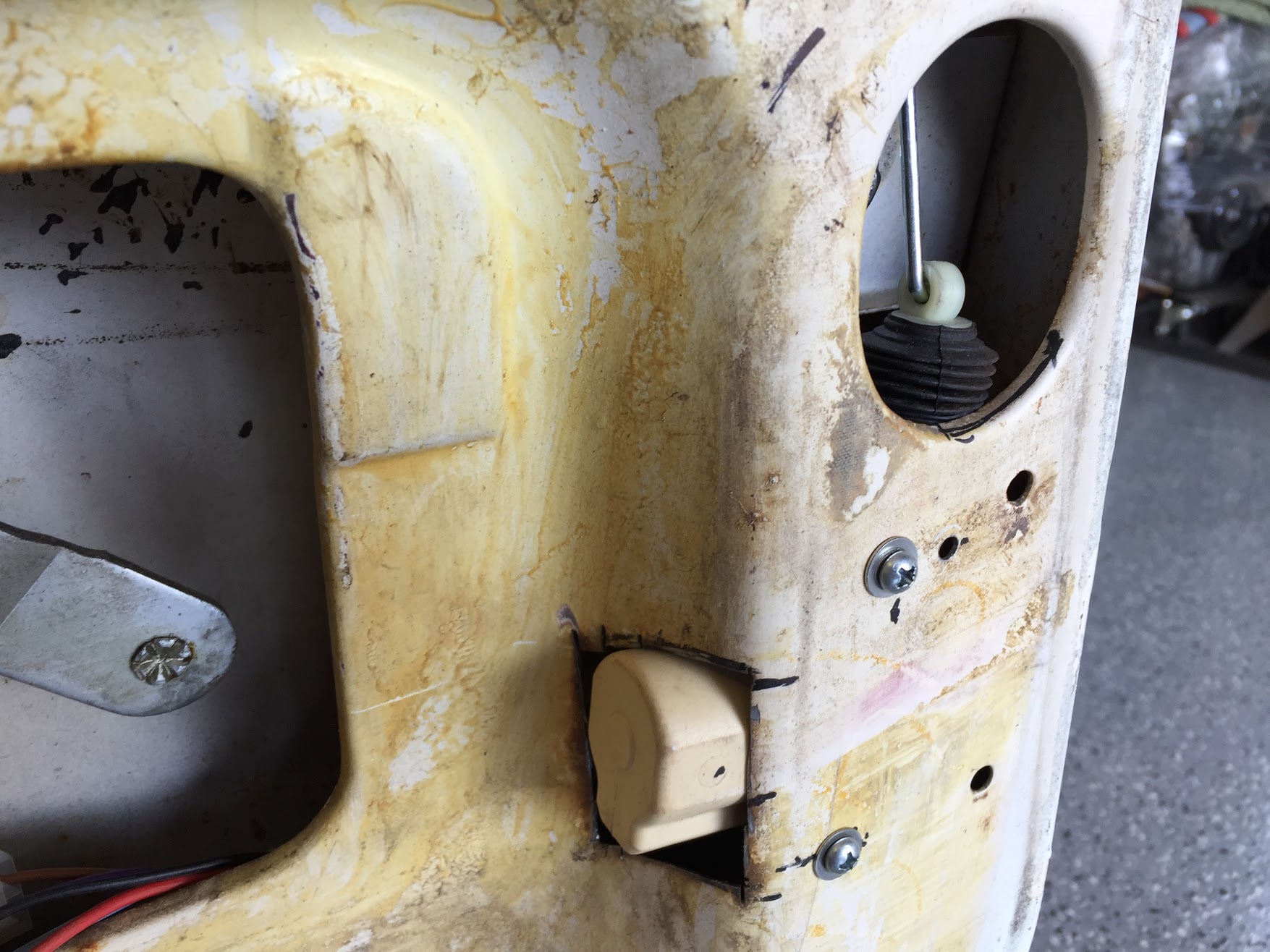
RH Front Door Modification for Actuator


As with the rear door actuators, the front actuators are mounted to the door with two, kit provided,  1″ self tapping screws.

Connecting the Actuators to the Front Door Locks

Unlike the rear doors, I want to use the interior door handle to activate the lock/unlock mechanical mechanism so I kept the original connecting link secured to the lever on the dowel on the door lock (F) in the schematic above. As suggested in the Service Manual I mounted the connecting link in the center position. But, after some experimentation. I found that the most forward position of the three worked best in my case. The photos below show where the rod clamp attaches to the rod and to the connecting link. The position will be important when final assembly occurs.

The kit directions make the following point: The alignment of the front door actuators (5 wire) on the MES lock kit is very important to proper operation. If the actuators are not properly aligned and centered it will cause the system to rapidly lock and unlock the doors or not allow you to lock or unlock the doors.
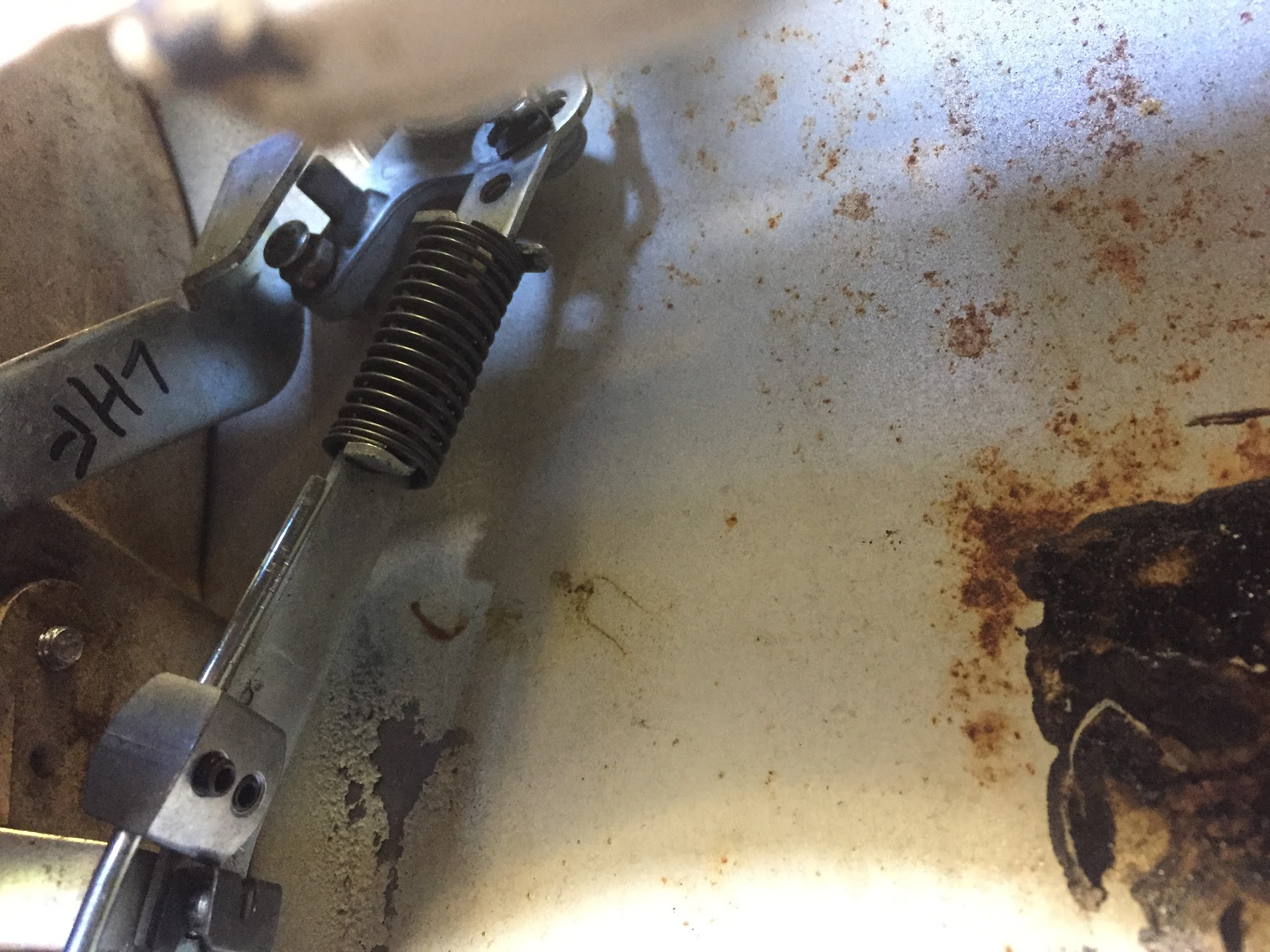
LH Front Door Lock Connecting Link
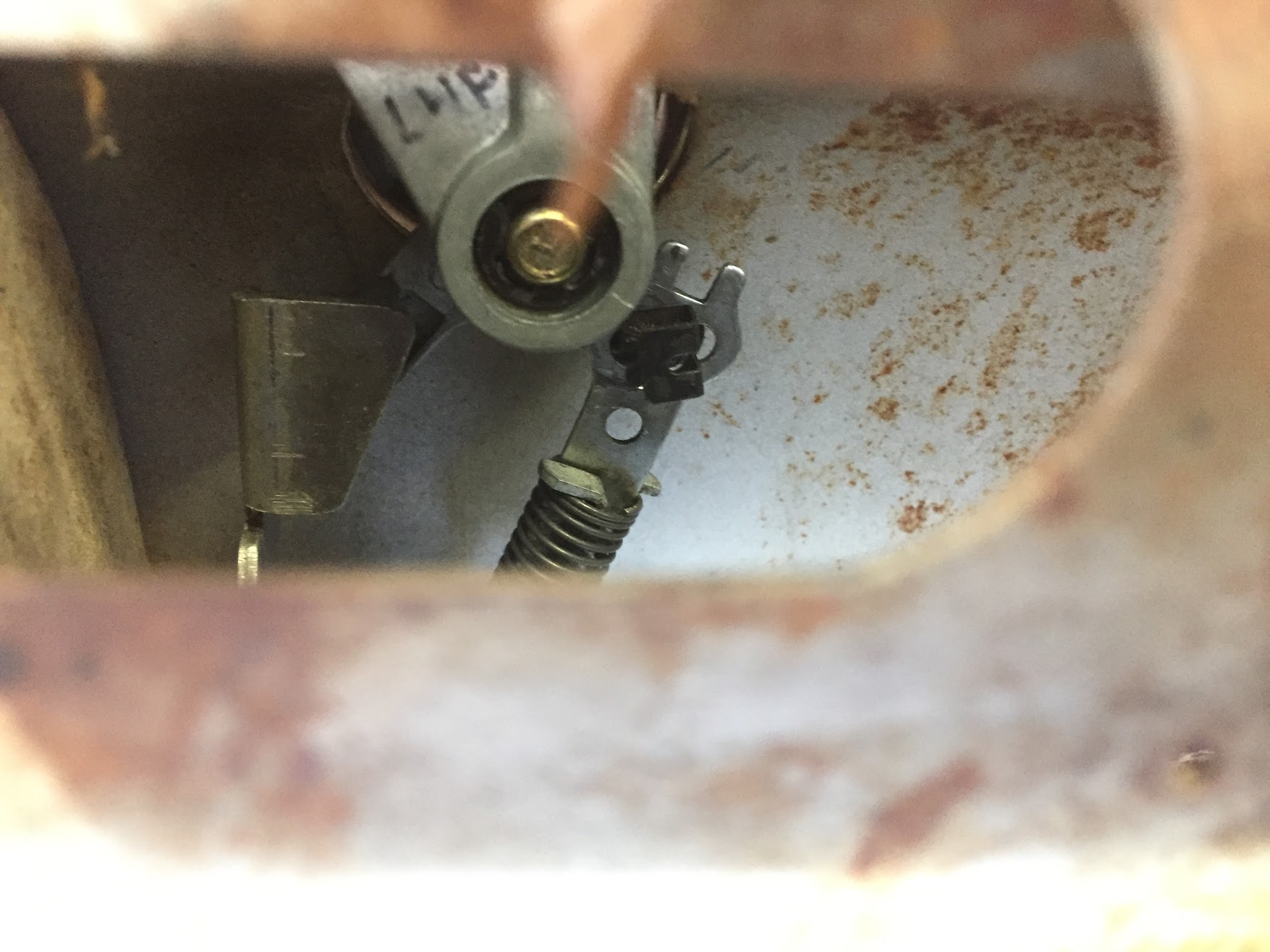
LH Front Door Lock Connecting Link Mounting Position
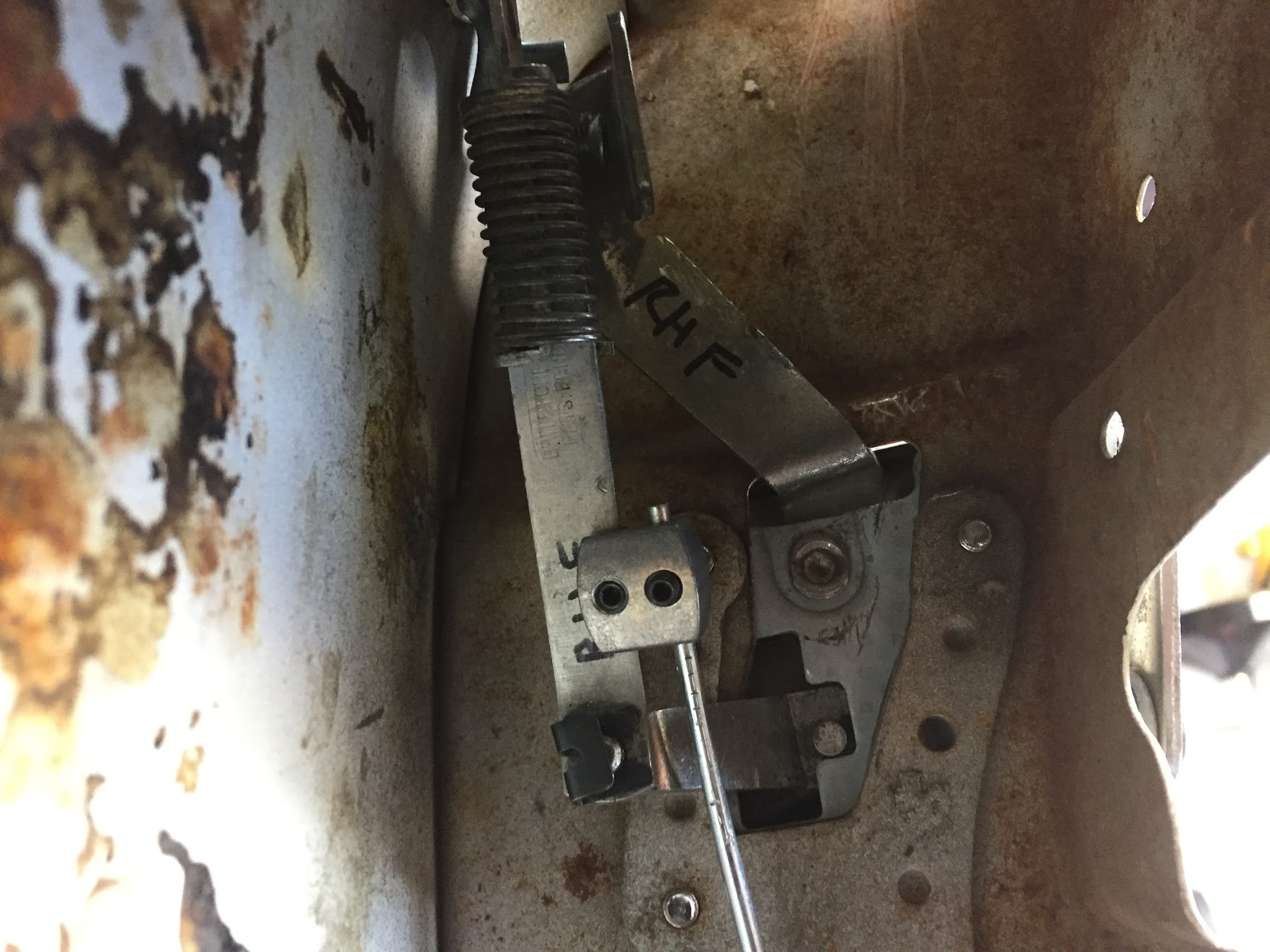
RH Front Connecting Link Mounting Position
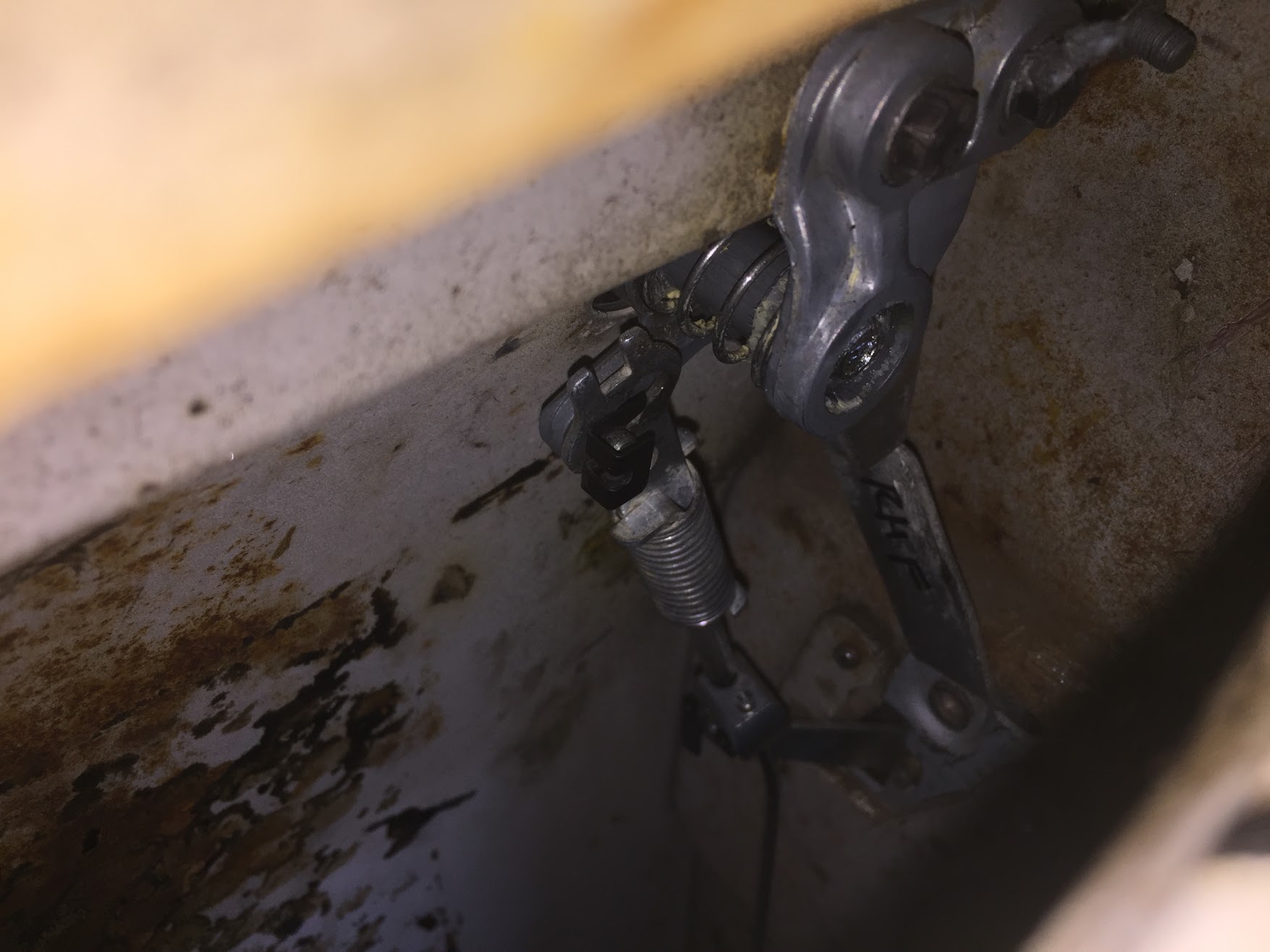
RH Front Door Lock Connecting Link Forward Mounting Position


It is necessary to drill holes in the “A” pillar, the rear face of the “B/C” pillar and in the face of each of the doors to facilitate the travel of the electrical wiring for the operation of the actuators. To protect the wiring and to yield a finished look, some type of wiring loom or boot is needed. I searched for some time trying to find a product that I liked. Hot Rodders often use a stainless loom such as the pair in the image below:
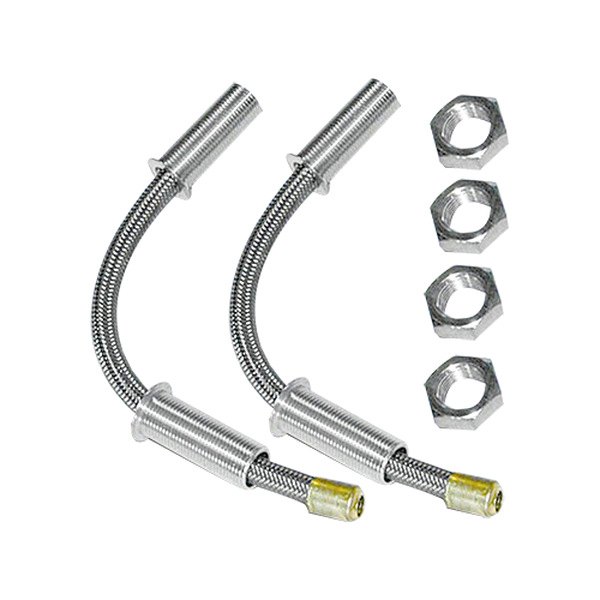
Stainless Door Wiring Loom

In reality, these are quite large and in my opinion just don’t look proper on the Jaguar. I was also concerned about these making a rubbing noise inside the doors when they were operated.

I never did find anything that was totally satisfying; however, I did locate some soft rubber looms that seems to offer the best option for me. They are very flexible and will compress and extend nicely. These came from Summit Racing but are produced by Electric-Life Power Windows and Accessories: https://www.electric-life.com/product/4301-70-011-58-diameter-flexible-inclined-rubber-tuber/  part number – 4301-70-011 5/8″ diameter Flexible Inclined Rubber Tube. To install it was necessary to drill a 3/4 hole in the pillar and the door at each location.
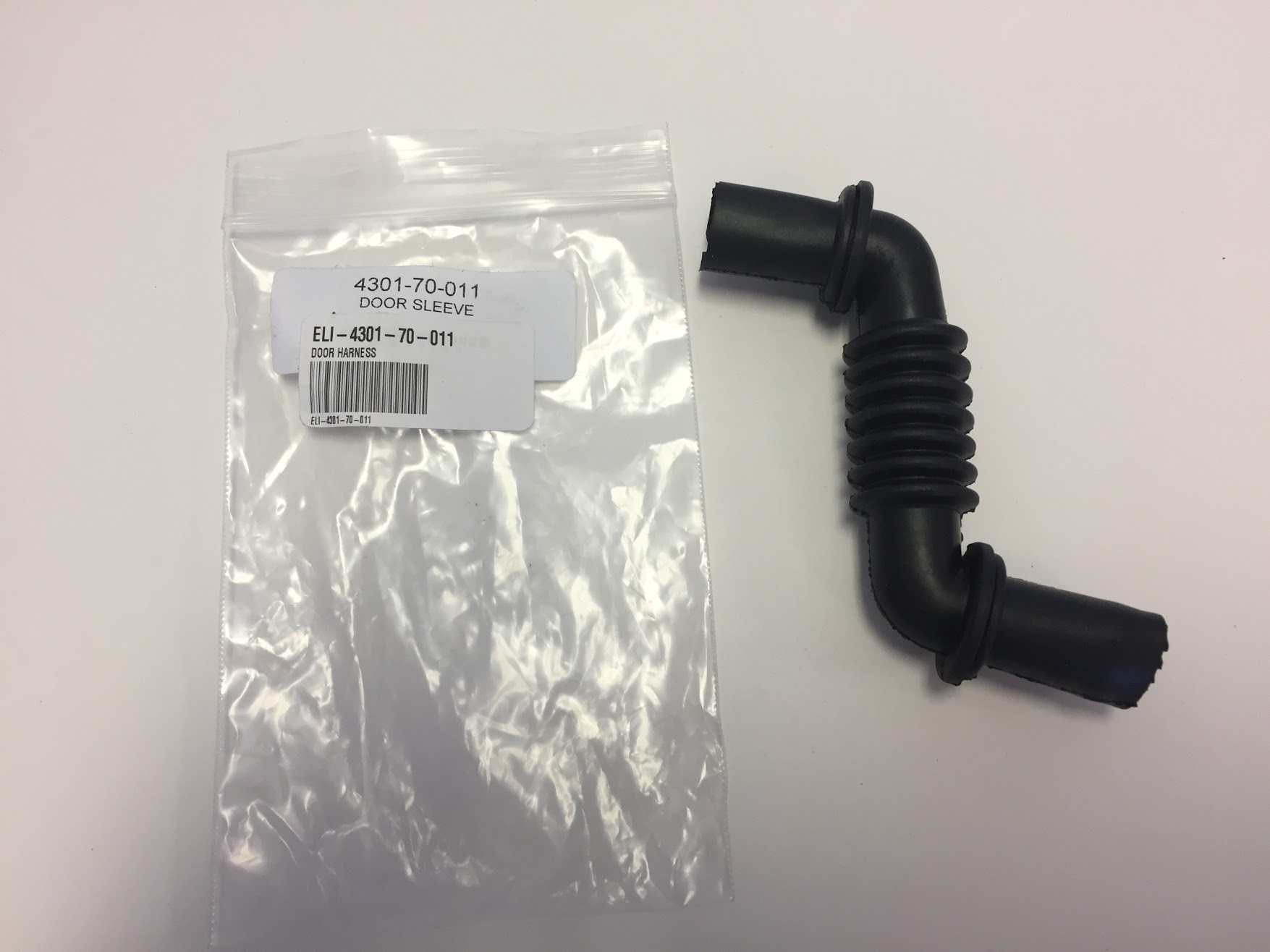
Rubber Door Loom

Rear Door Rubber Loom Installation

Front Door Rubber Loom Installation

Wiring

The electrical control circuit for the power locking system is comprised of two components. The first is the MES central locking system that will function properly without the addition of the wireless entry unit. In fact, the directions specify full installation and system testing of the MES central locking system alone. Only after the MES central locking system is functioning as it should, does one then add the keyless entry unit.

The MES control module is the turquoise blue box in the photo at the top of this post. A five way relay and a spade connector for ground wires is incorporated into the control module. I decided to mount the control module below the newspaper shelf and behind the radio. I installed several nutserts into the brace below the newspaper shelf to mount relays. The MES control module is secured with one #10-24 x 1/2″ machine screw and shake proof washer.
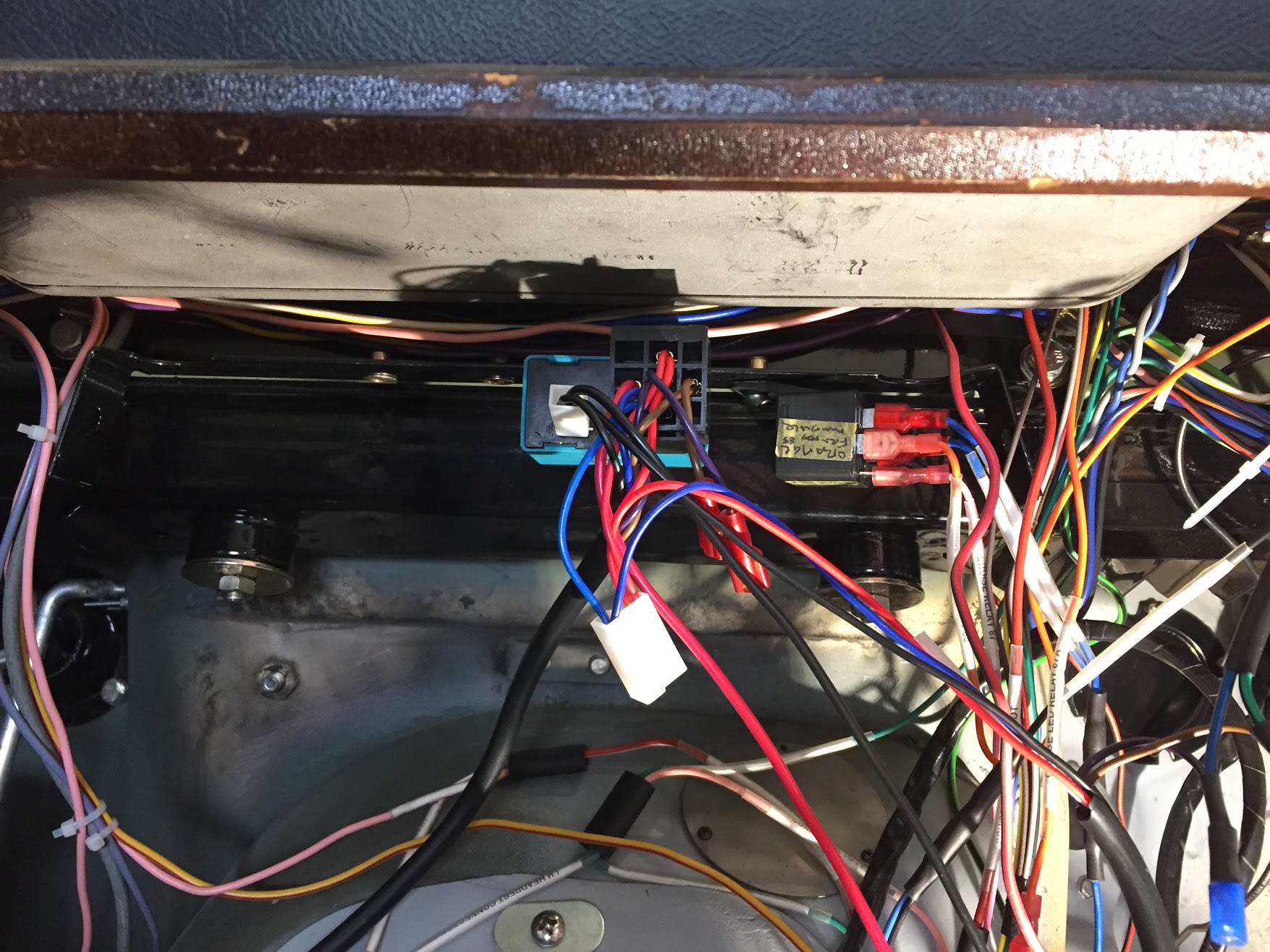
MES Control Module Mounting

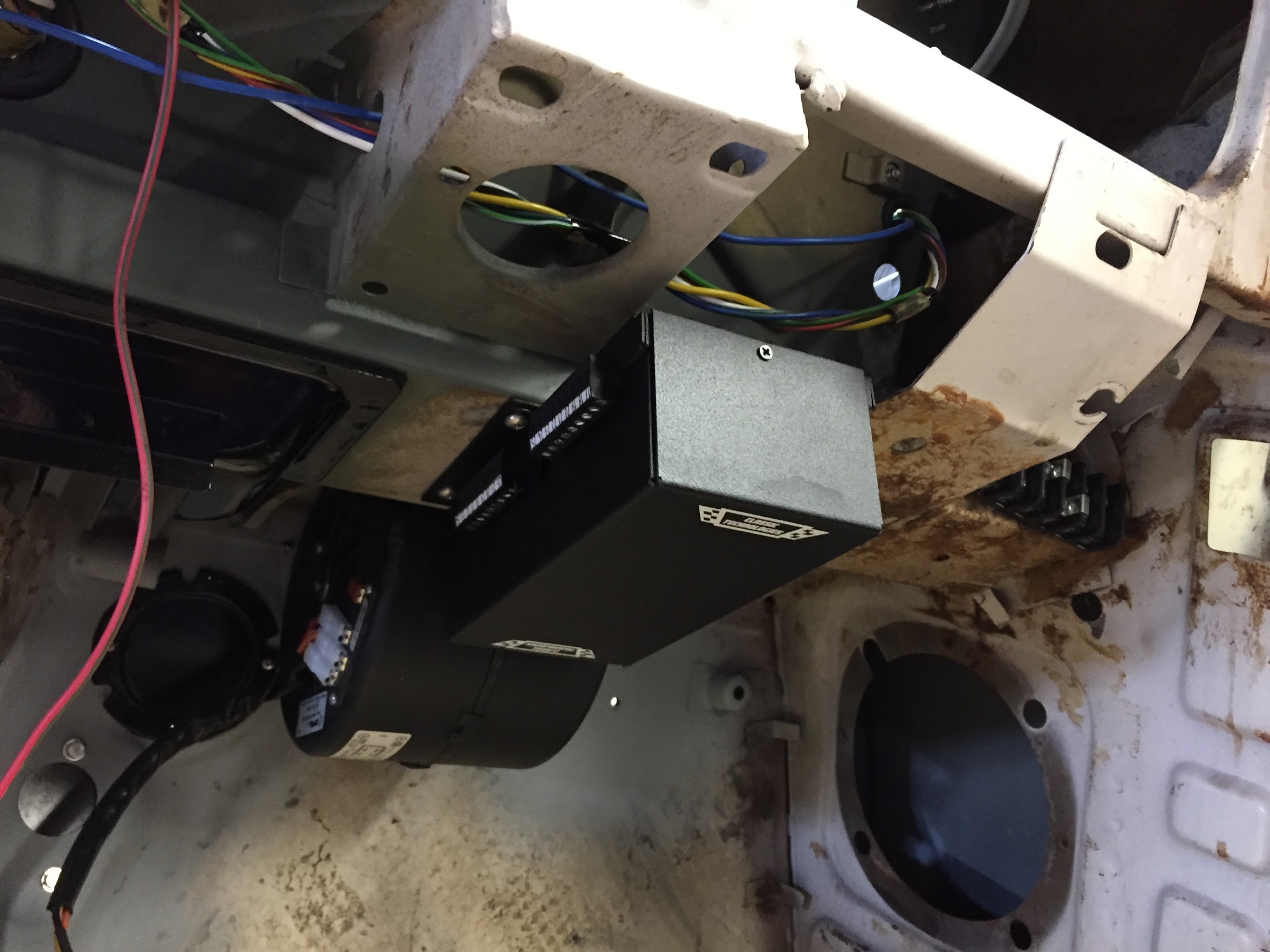
I chose to locate the AVITAL 2101/712T keyless entry module on the chassis brace behind and below the cubby box. This location is also directly above where I chose to locate the Classic Technologies Fuse Box. The AVITAL unit has four mounting tabs; however, it weighs next to nothing so I used only two of the mounts with two #10-24 x 1/2″ machine screws and shake proof washers. 

I apologize for the wiring mess in the photo. I will clean all this up upon final installation.
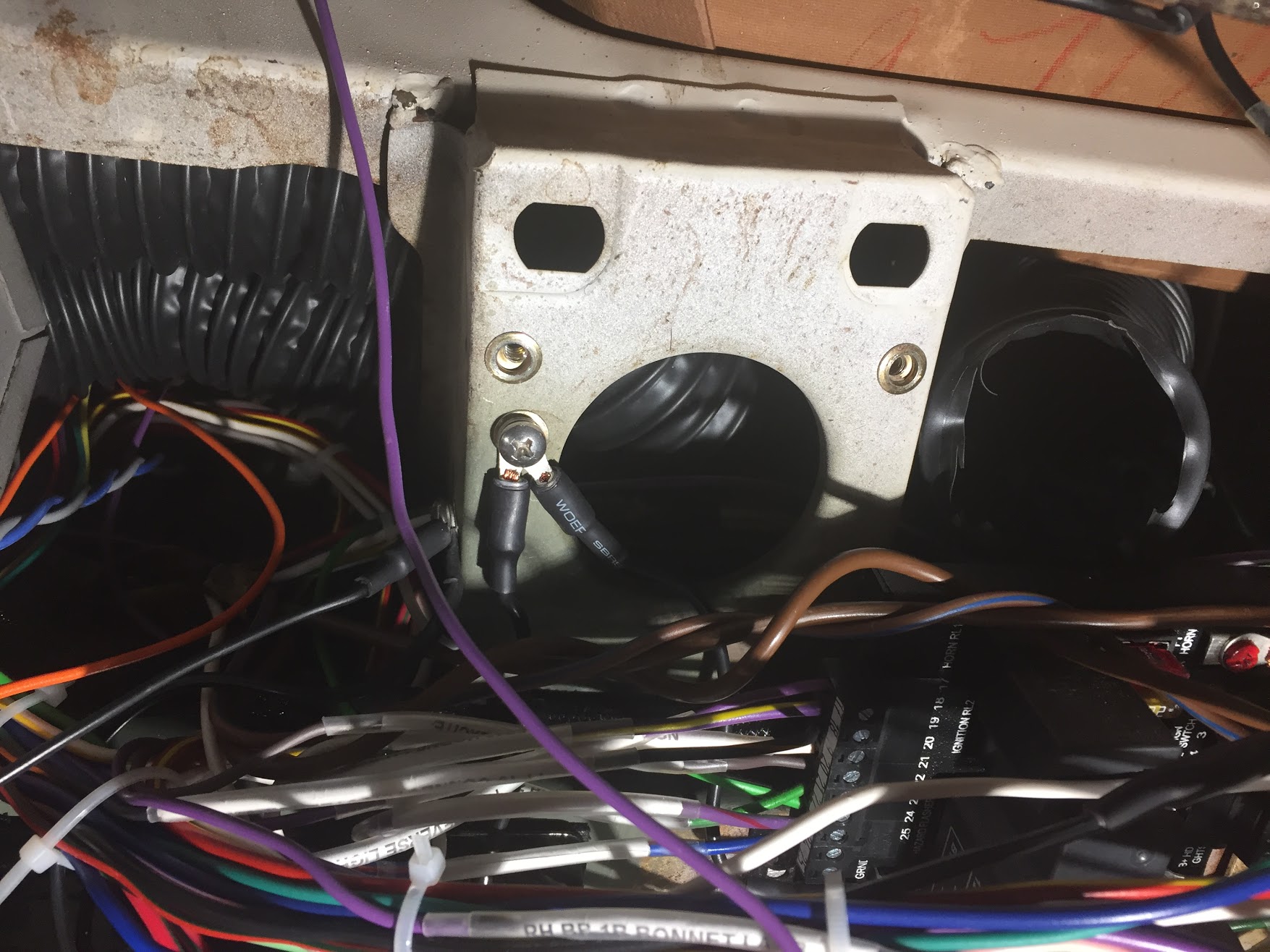
Nutserts installed to mount keyless entry module

AVITAL keyless entry module mounted

The actual wiring circuit for the central locking/keyless entry system may be found at the “New Wiring Harness Circuits” web site entry: https://valvechatter.com/?p=8114

The wiring for this project is fairly easy to install, however, because of the connections that must be made between the MES central locking system and the AVITAL keyless entry component, the schematic for the wiring does appear to be fairly complicated.

After installing the four door actuators and rod linkages, the two control modules, and all the wiring I energized the system and everything worked beautifully. I anticipate that this is one feature that I will enjoy. Having to lock and unlock the rear doors by reaching into the car and adjusting the handle could be a bit of a nuisance. Modern cars have spoiled us (me).
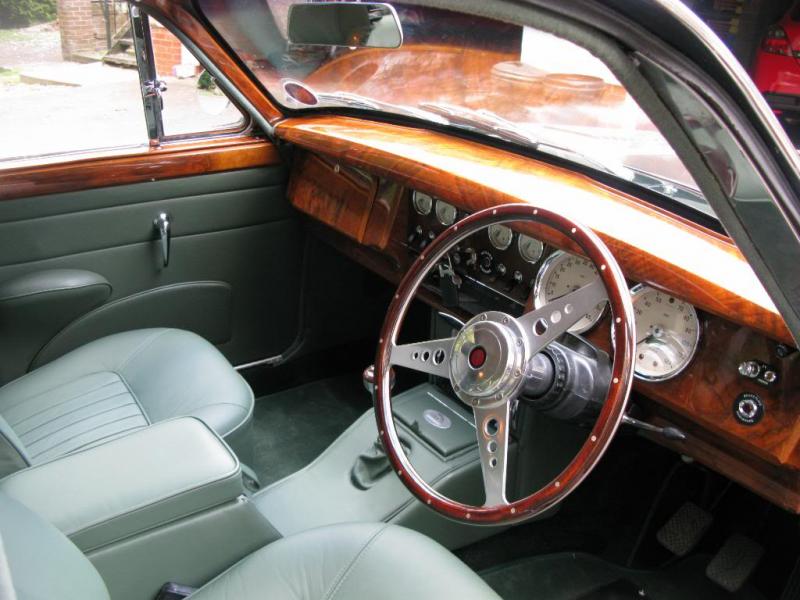
Center Console Arm Rest

Inspired by Kevin Moore’s MK2 center console arm rest modification, I endeavored to create my own. I knew that I wanted to use an arm rest pad that would not look home-made, and that would also house the controls for the power seats and a USB dual port. These are images of Kevin’s console/arm rest:

Kevin Moore’s Console/Arm Rest

Kevin Moore’s Console/Arm Rest

I think that Kevin’s execution is spot on and well done. I can only hope that mine turns out as well!

My project began with an arm rest pad/lid and storage tray that I purchased on eBay. I believe they were from a mid-eighties XJ6. The size and shape of the arm rest determined the ultimate measurements of the box I would build. The XJ40 electrically controlled power seats in my car mount slightly rearward of the original MK2 seats so I determined that I would add a couple of inches of sheet metal to the rear end of the original MK2 console/heater pipe cover. I should also mention that I am not using the heater pipes to the rear in my car. Moving the “box” rearward also gives more room for shifting the gearbox.

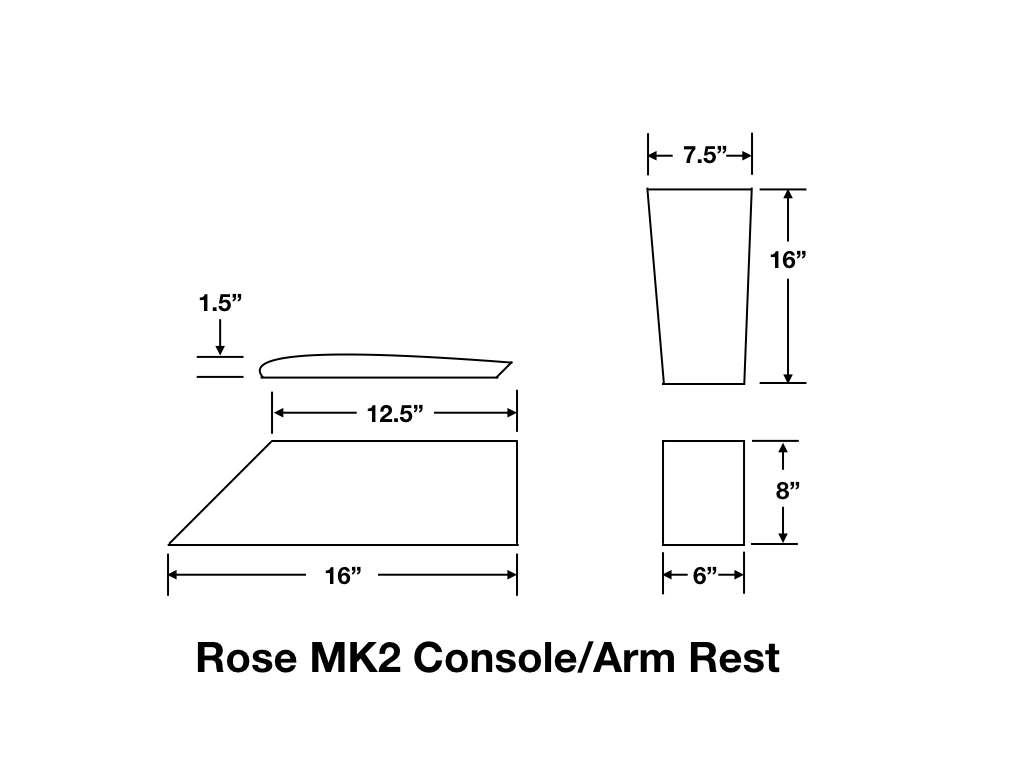
These are the outside dimensions of the “box” I constructed:

Rose MK2 Console-Arm Rest Dimensions

I constructed the “box” from a 1/2″ PVC panel. I chose the material primarily because it doesn’t absorb any moisture, but I also found that it is very easy to work with – much easier than plywood or some other composite material. A few 1-1/2″ poplar wood braces were also used for extra support. The panels of the box were all cut on a portable construction table saw, the holes for the seat switches were cut with a hand held saber saw, and the holes for the USB ports were cut using a hole saw.

My next step will be to cut matching panels from 1/8″ PVC. These will then be glued to the 1/2″ panels. This will completely cover all of the screw heads and mounting indentations and should produce a nice finished surface for the leather.  Ultimately, I will mount the “box” to the original heater pipe cover and to the prop shaft tunnel as Kevin did.

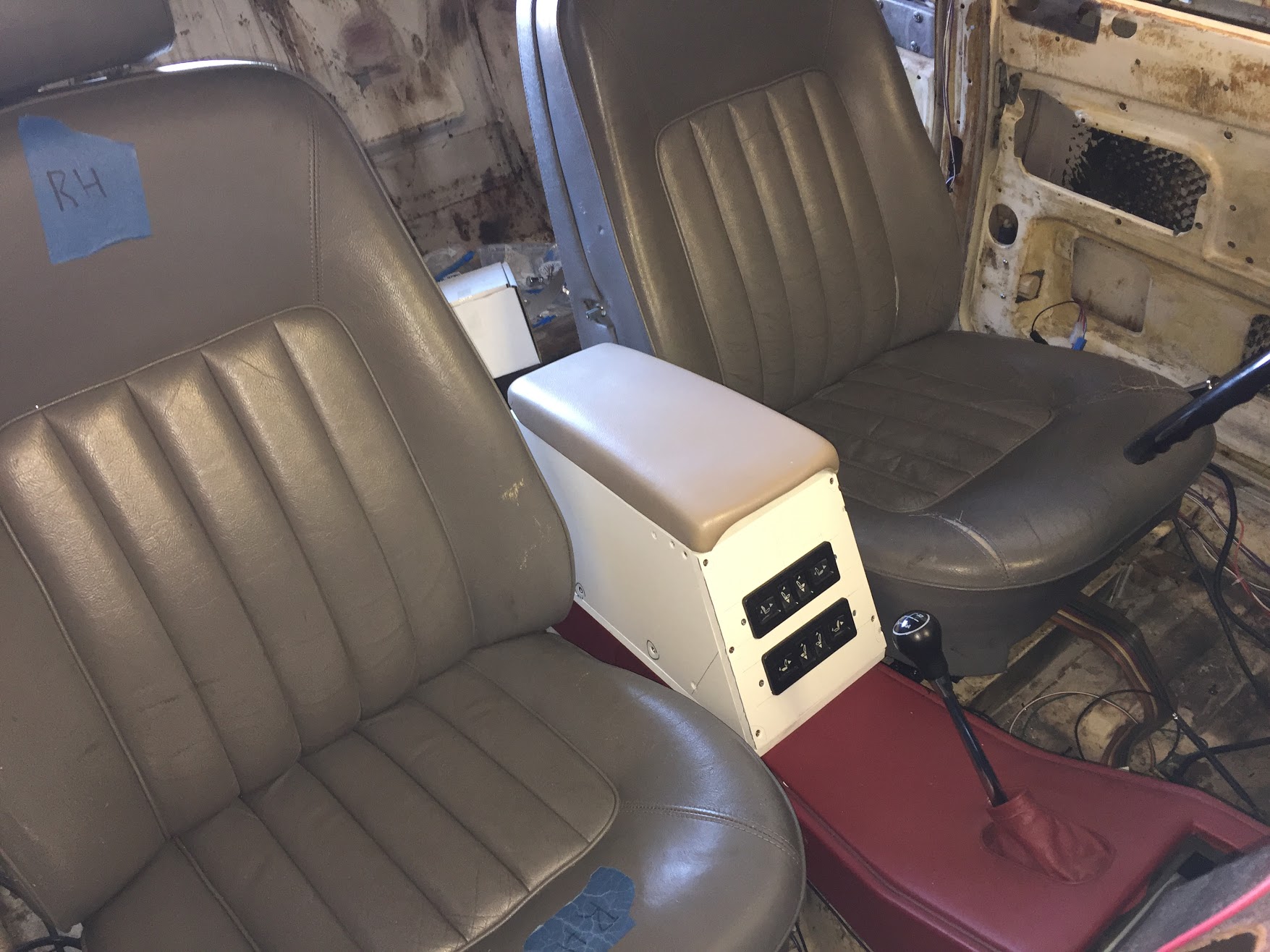
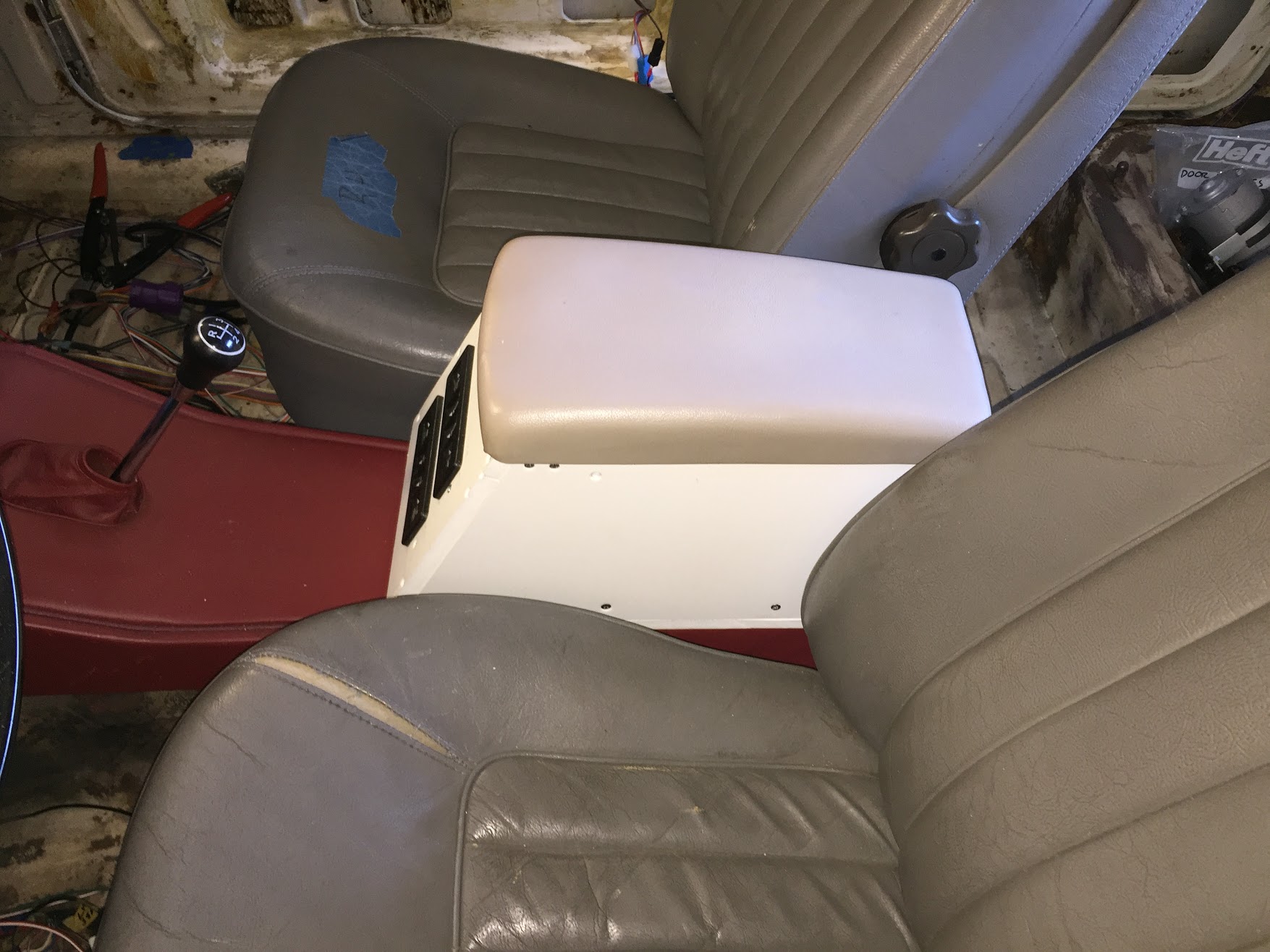
These are a few images with the “box” just sitting (not mounted) in position:

Console Arm Rest RH Front View

Console Arm Rest LH Front View

Console Arm Rest LH View

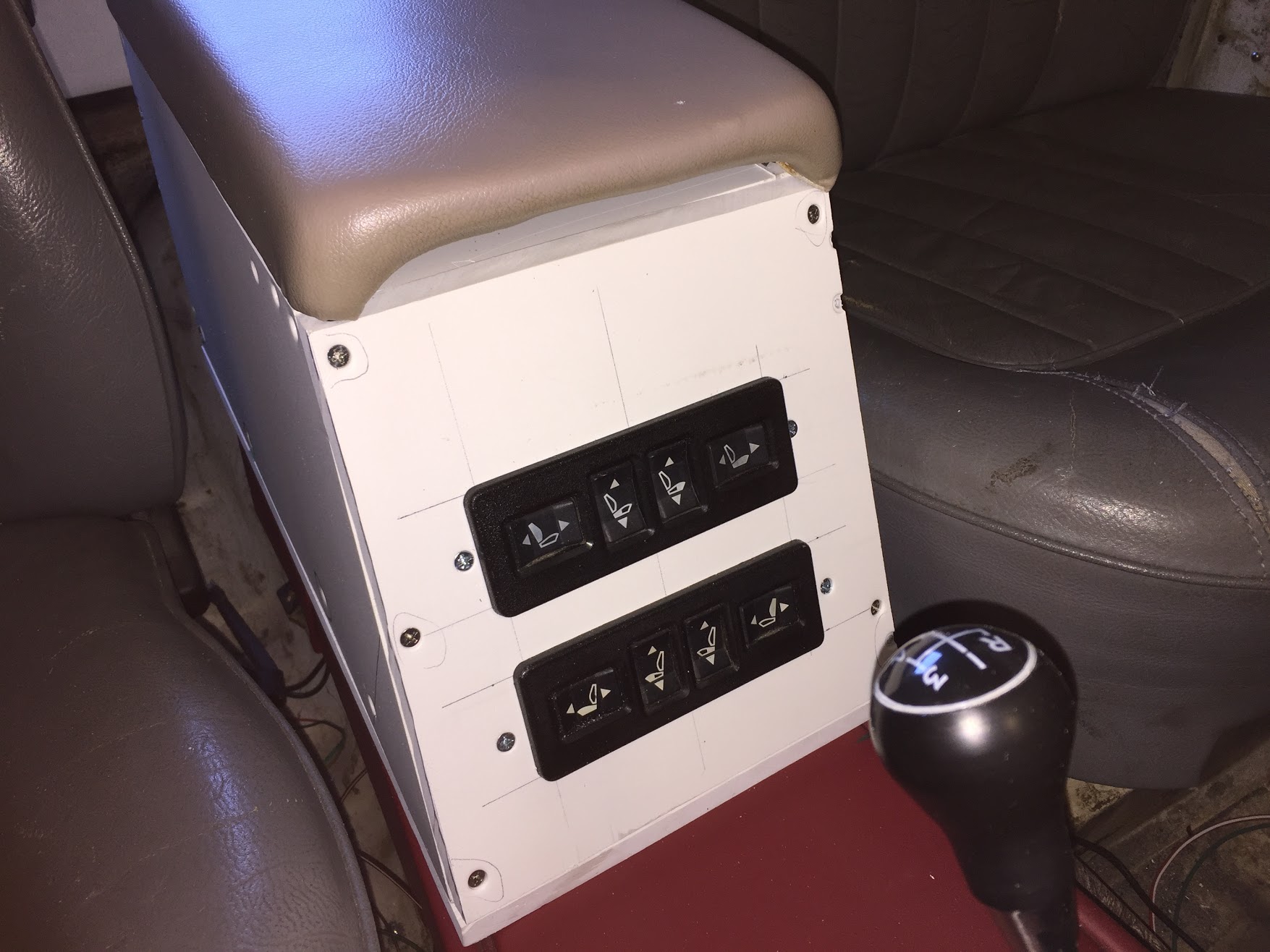
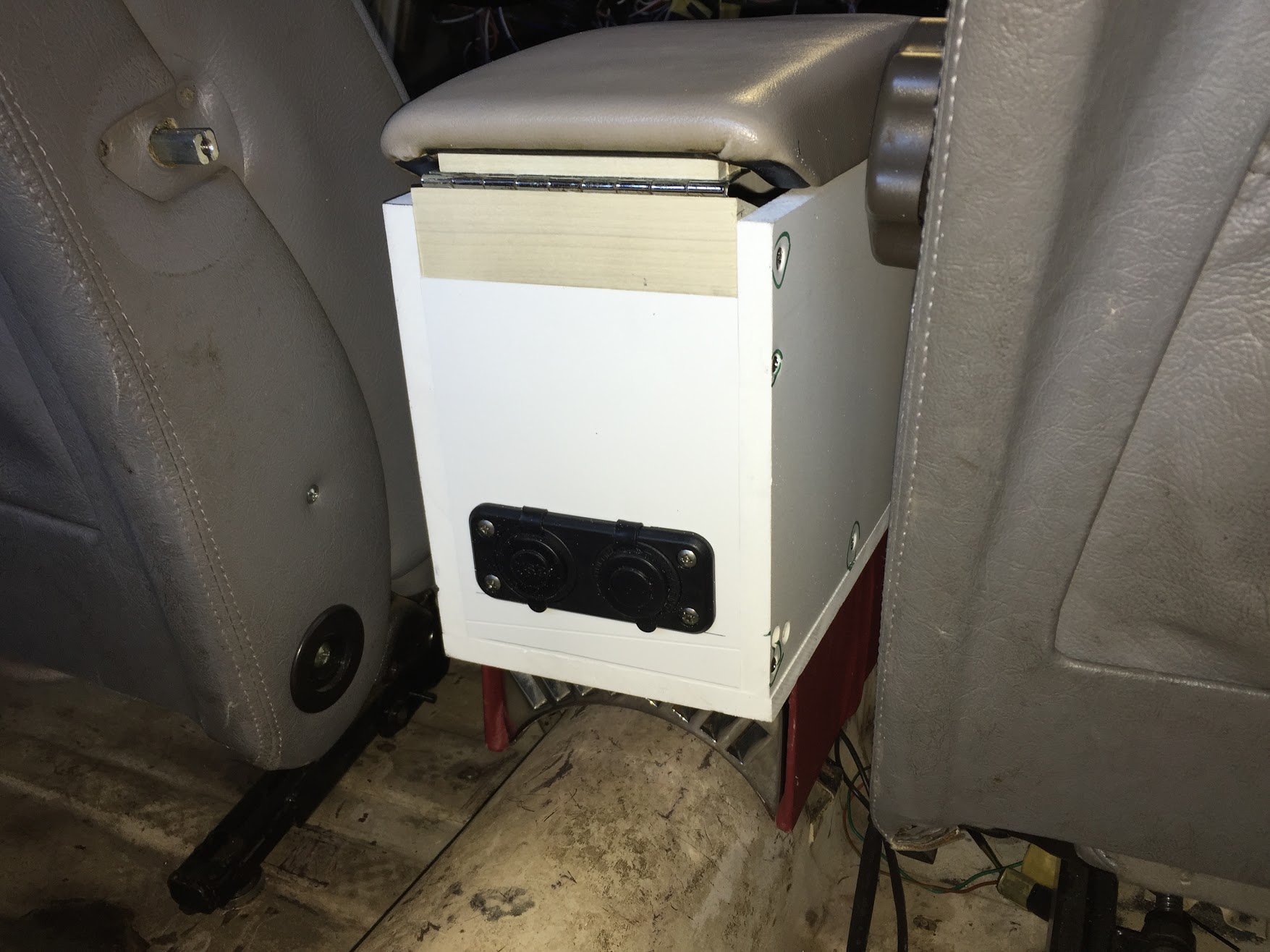
The following two images show the mounting of the electrical switches in the front and the twin USB ports in the rear. The screws in the face plate of the USB mounting bracket will be replaced with black screws. As I mentioned previously, additional sheet metal will be added to the end of the heater pipe cover so that it matches flush with the rear edge of the “box.”

Console Arm Rest Seat Controls

Console Arm Rest USB Ports

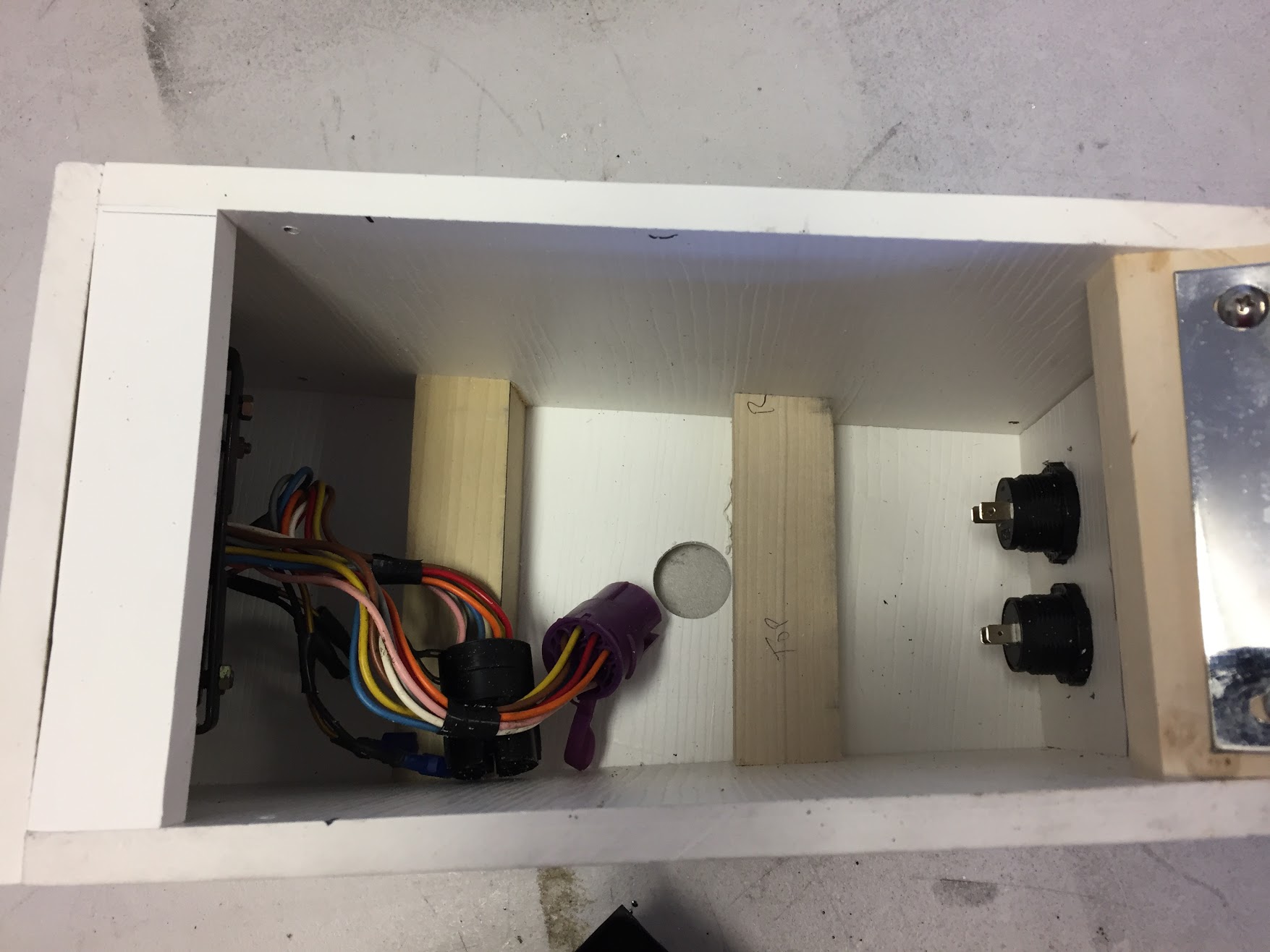
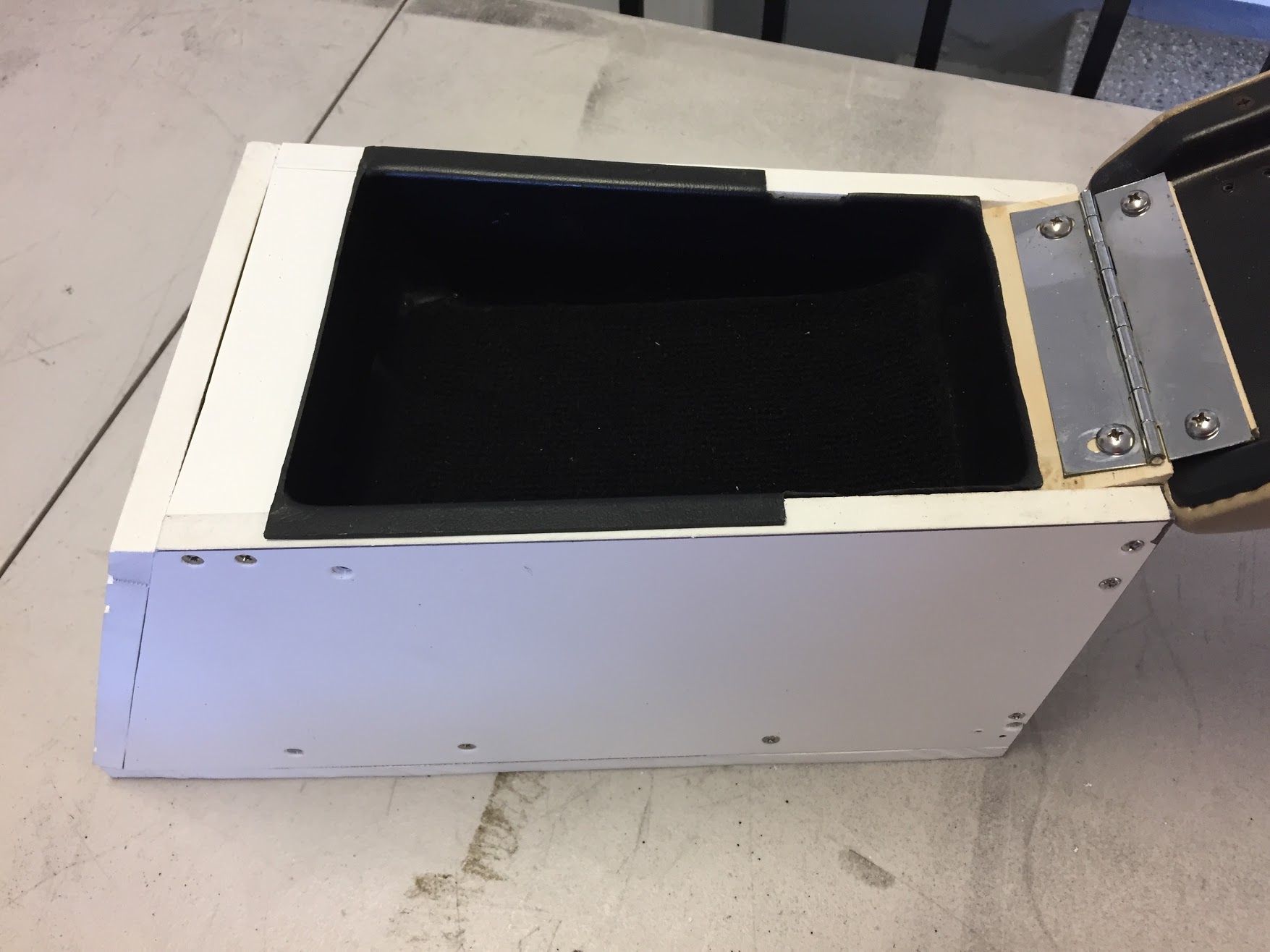
The last two images show the interior of the box with and without the storage tray:

Console Arm Rest Box Interior

Console Arm Rest Storage Tray

Of course, the beige arm pad, the grey seats and the red original heater pipe cover will all get reupholstered in a single color leather!


Power Steering Pump Cover

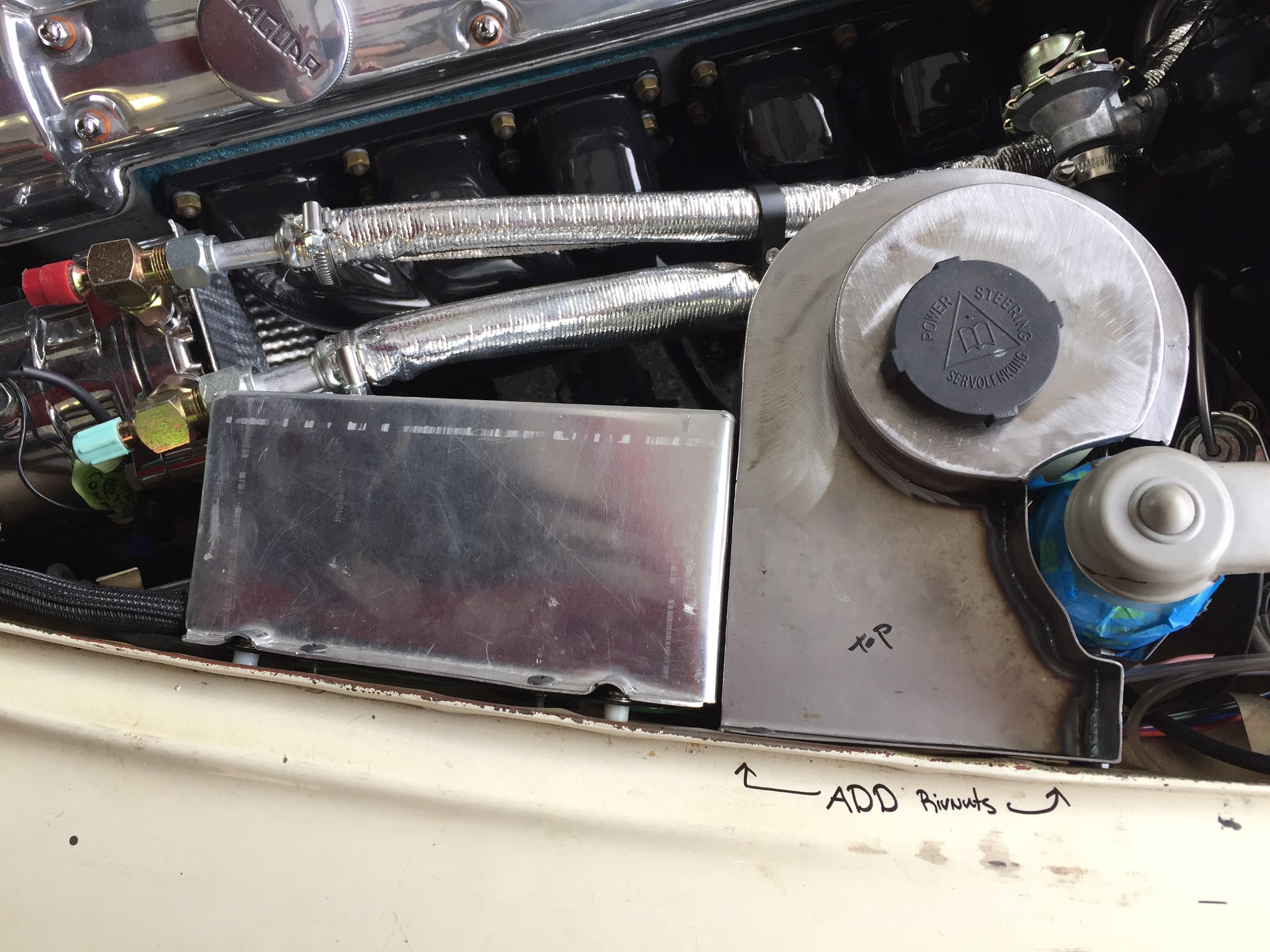
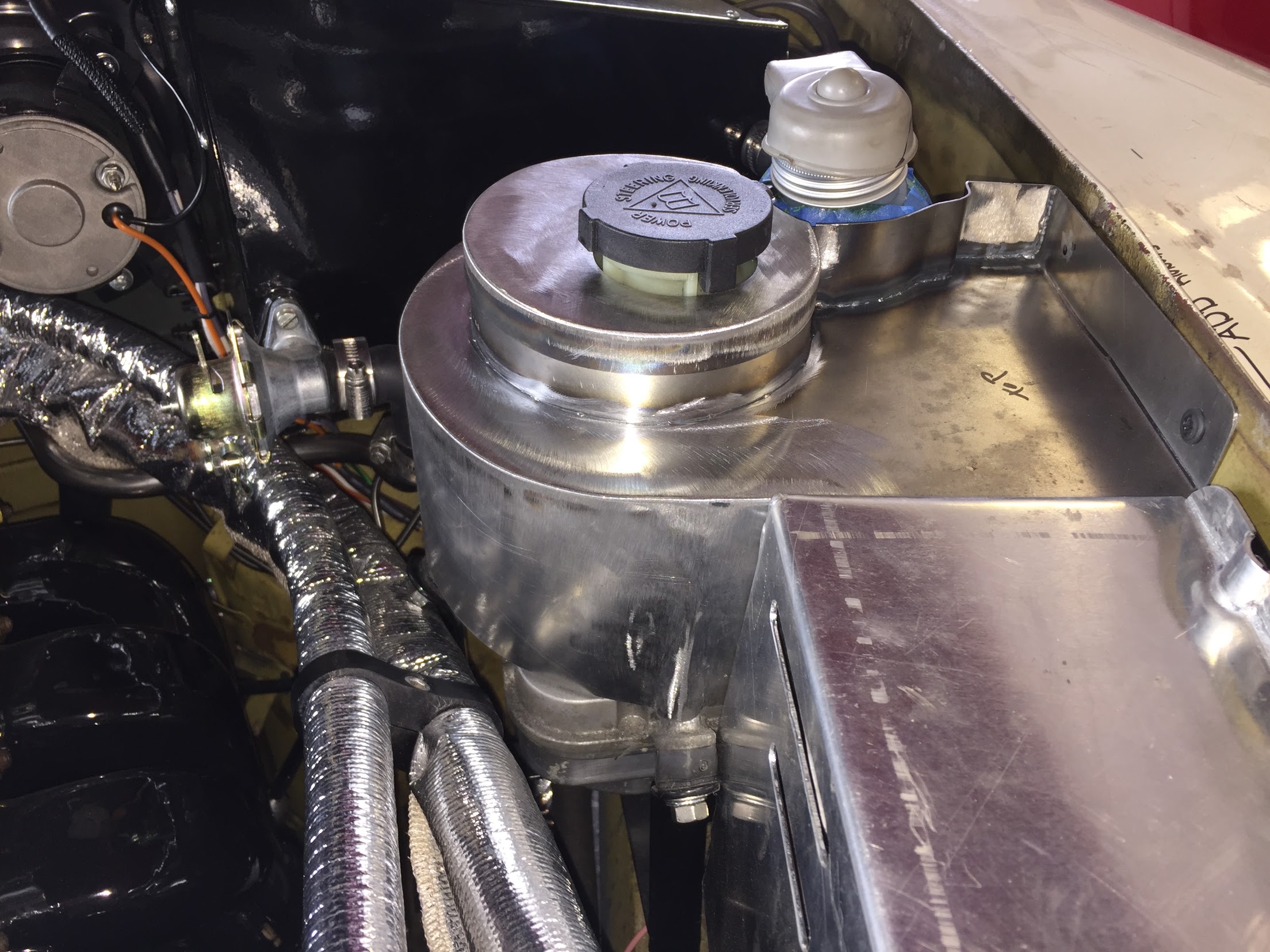
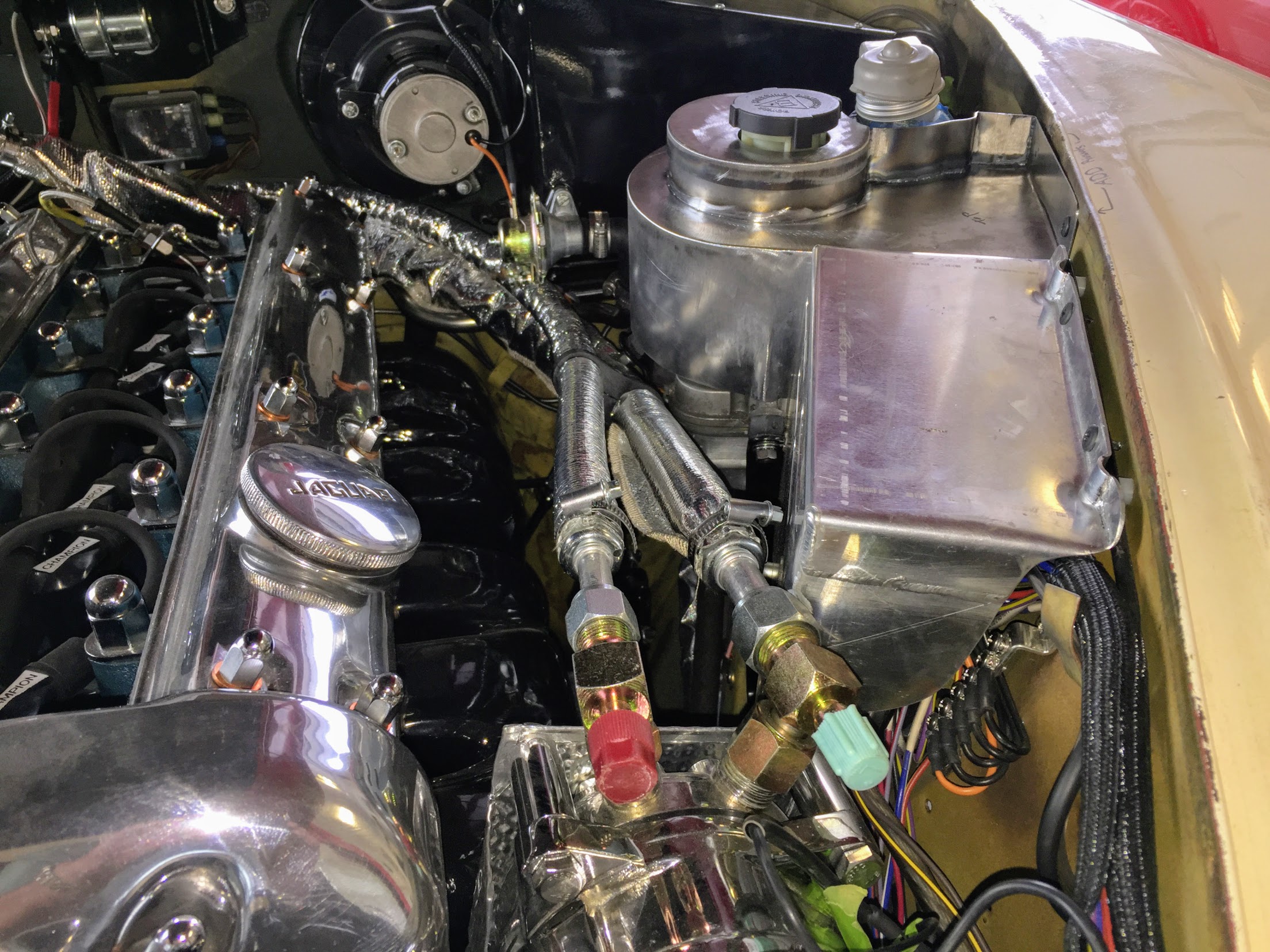
Although my MK2 could have had power assisted steering from the factory, it did not. I elected to add an electric power steering pump and rack and pinion steering to my car. The kit was purchased from M&C Wilkinson in the UK. http://www.mandcwilkinson.com The kit uses a combined power steering pump and reservoir that is mounted in a supplied bracket. It is frankly a bit unsightly sitting next to the polished cam covers and porcelain exhaust manifolds of the 3.8 Jag power plant! However, I was resigned to leaving it as it was until Mike Gassman, owner of Gassman Automotive http://www.gassmanautomotive.com, convinced me that a cover should be made.

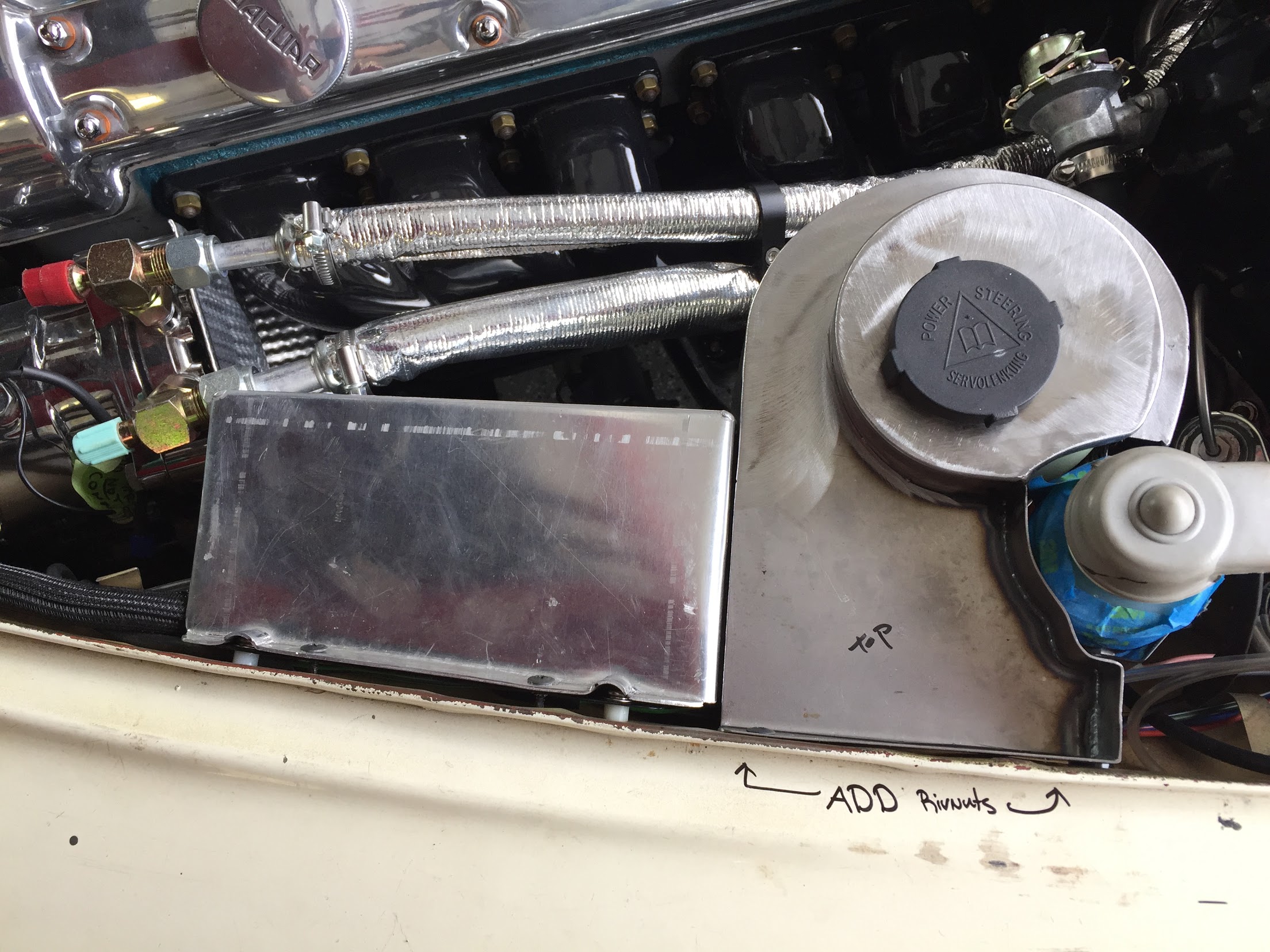
Make and his welder/fabricator Brandon Tyree designed and fabricated the cover seen below. It mounts to the LH engine bay valance with only two 10-24 x 1/2″ machine screws. One simply unscrews the two screws and removes the reservoir cap then lift away the cover. It will be painted gloss black to match the heater box.

I have to say that as usual Mike was correct and Brandon’s cover came out quite nice in my view! 

Electrical Connections Box and Power Steering Pump-Reservoir Cover

Power Steering Pump/Reservoir Cover

This is a short video showing the removal and installation of the cover:


Seating

Front Seating

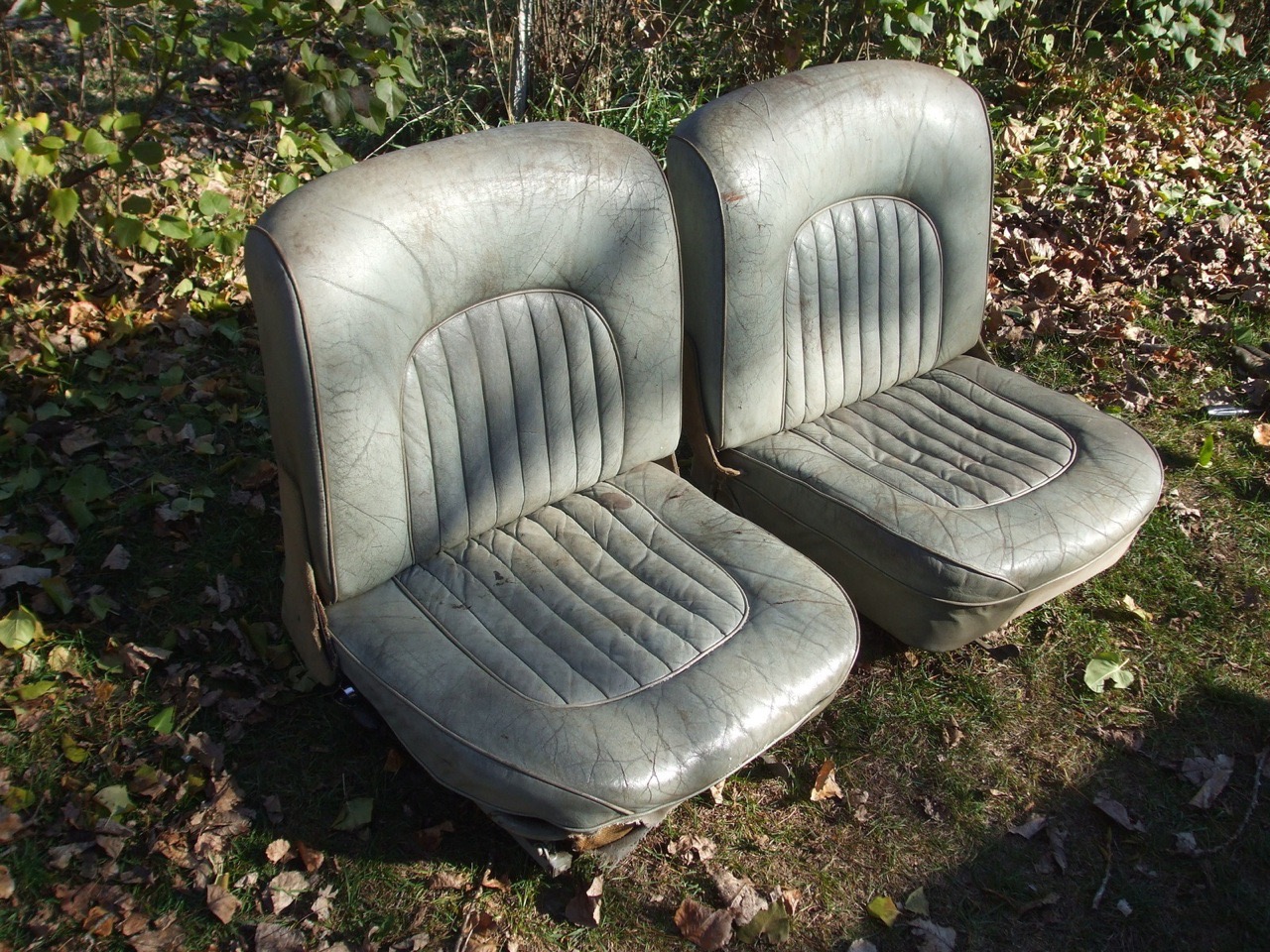
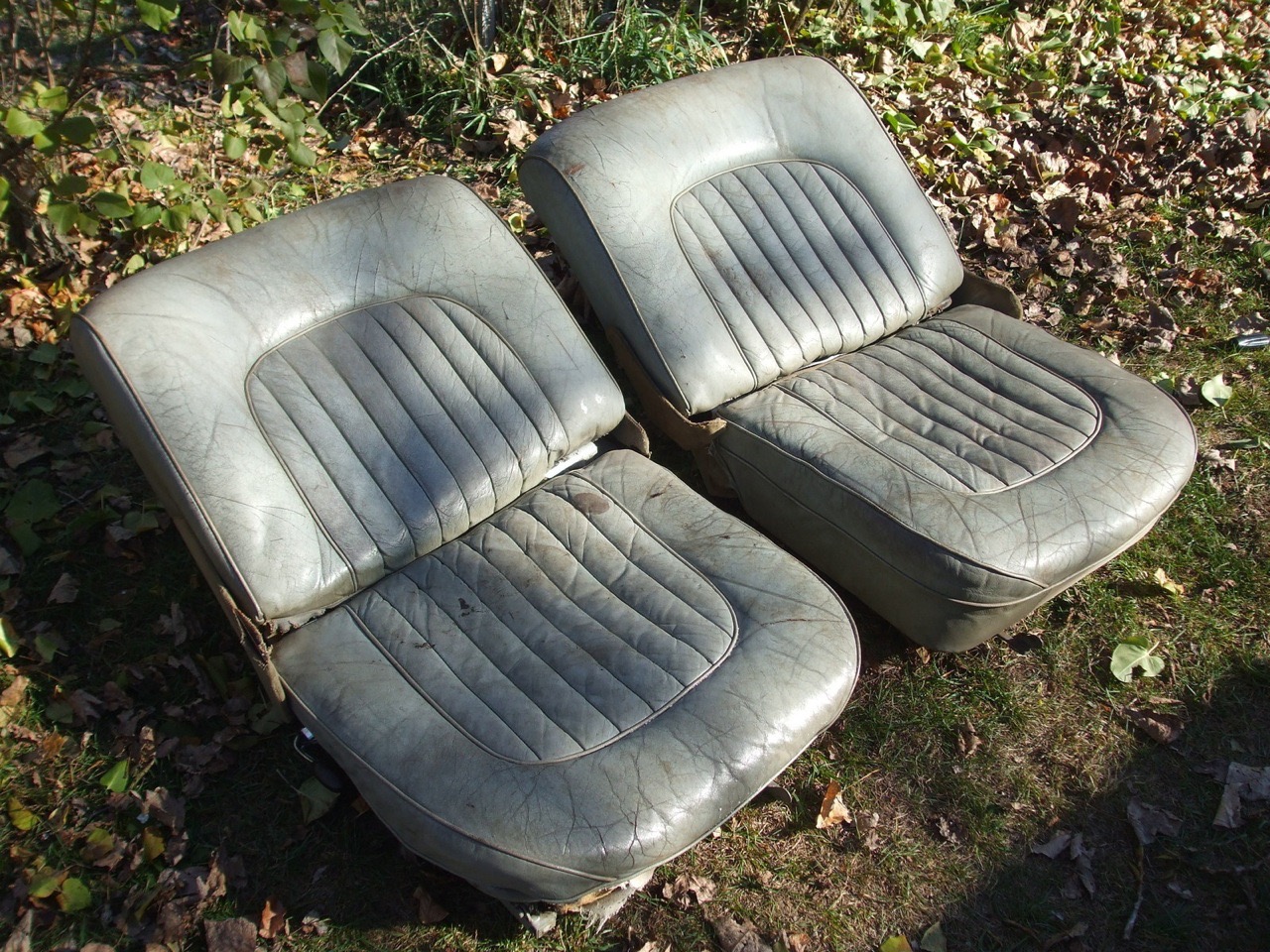
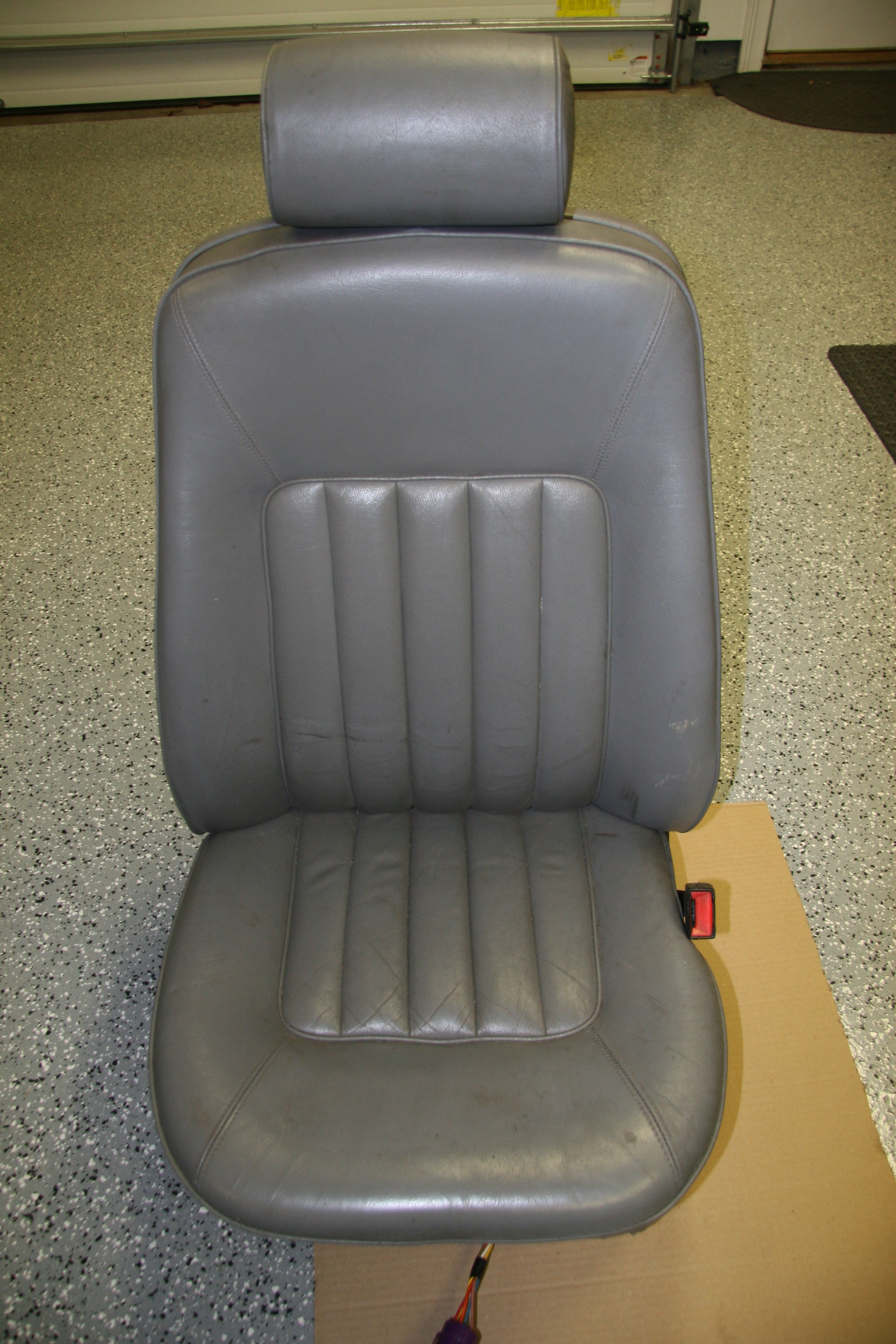
Following considerable thought I have decided to install front seats from a later model Jaguar in my MK2. At first I pursued the original tilting seats that were available from Jaguar as an option at the time. I actually found and purchased a pair. they were in rough shape, but the frames were just fine and that was all I was really after.

Jag MK2 Optional Tilting Seats

Jag MK2 Optional Tilting Seats

Jag MK2 Optional Tilting Seats

Jag MK2 Optional Tilting Seats

However, after seeing the installation of Daimler seats in Ton Tulleken’s restored Jaguar MK2, I decided that I must have the same seats for my restoration! Ton’s site is in Dutch but the photos work in all languages.

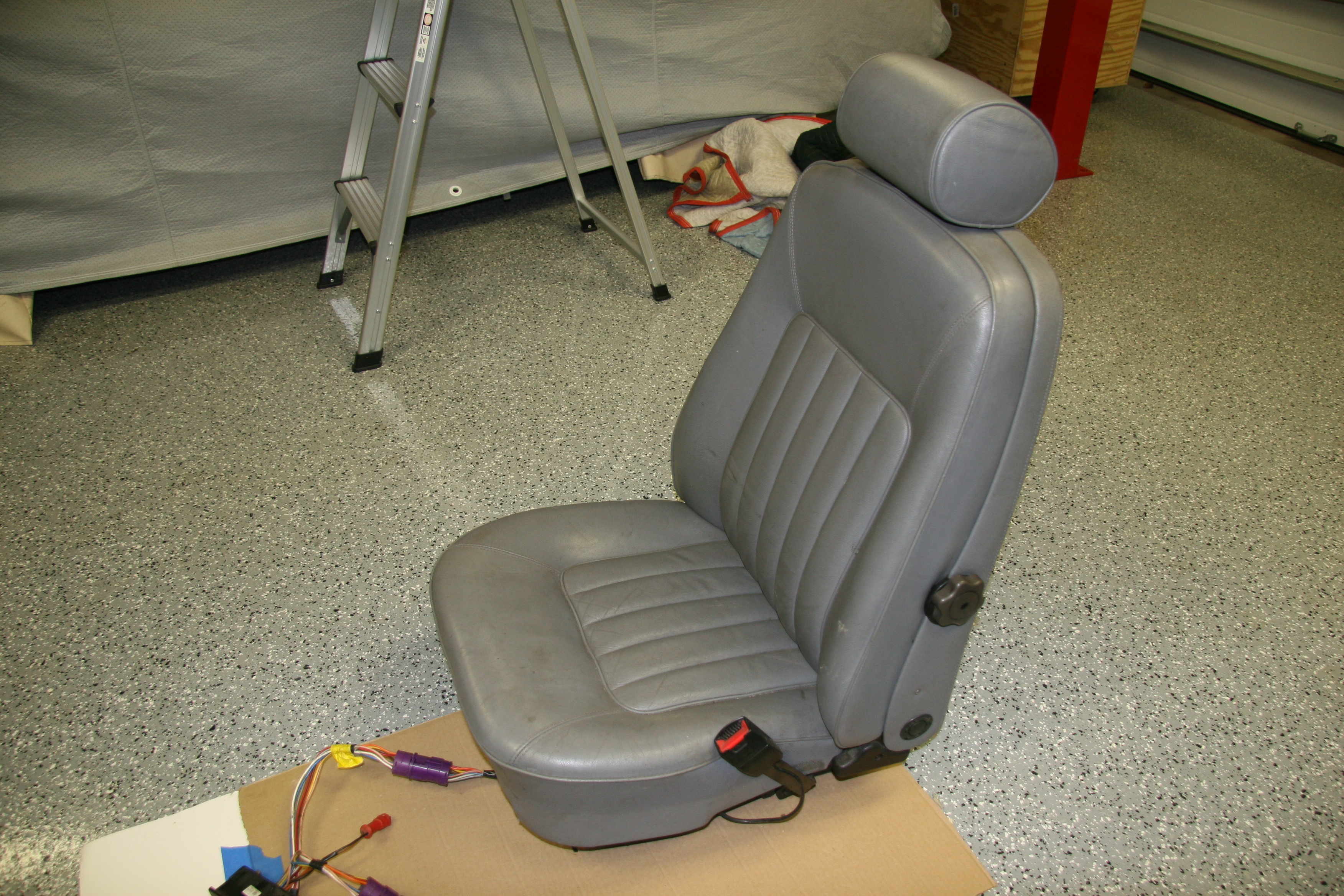
I could not locate any Daimler seats in the U.S. so I turned to Ton who is from the Netherlands and he was able to help me. Hendrikus Alkema who runs and owns New and Used Parts Jaguar Daimler in the Netherlands had a full set of 1990 Daimler seats available. I ordered the two front seats as well as all four headrests from the car. The seats came complete with the wiring harnesses and switches.

The seats arrived two days after the order was placed! DHL had them on my doorstep. On one of the seats the lumbar support knob was broken in transit, but Hendrikus sent a replacement to me right away.

1990 Daimler Front Seats

1990 Daimler Front Seats

1990 Daimler Front Seats

1990 Daimler Front Seats

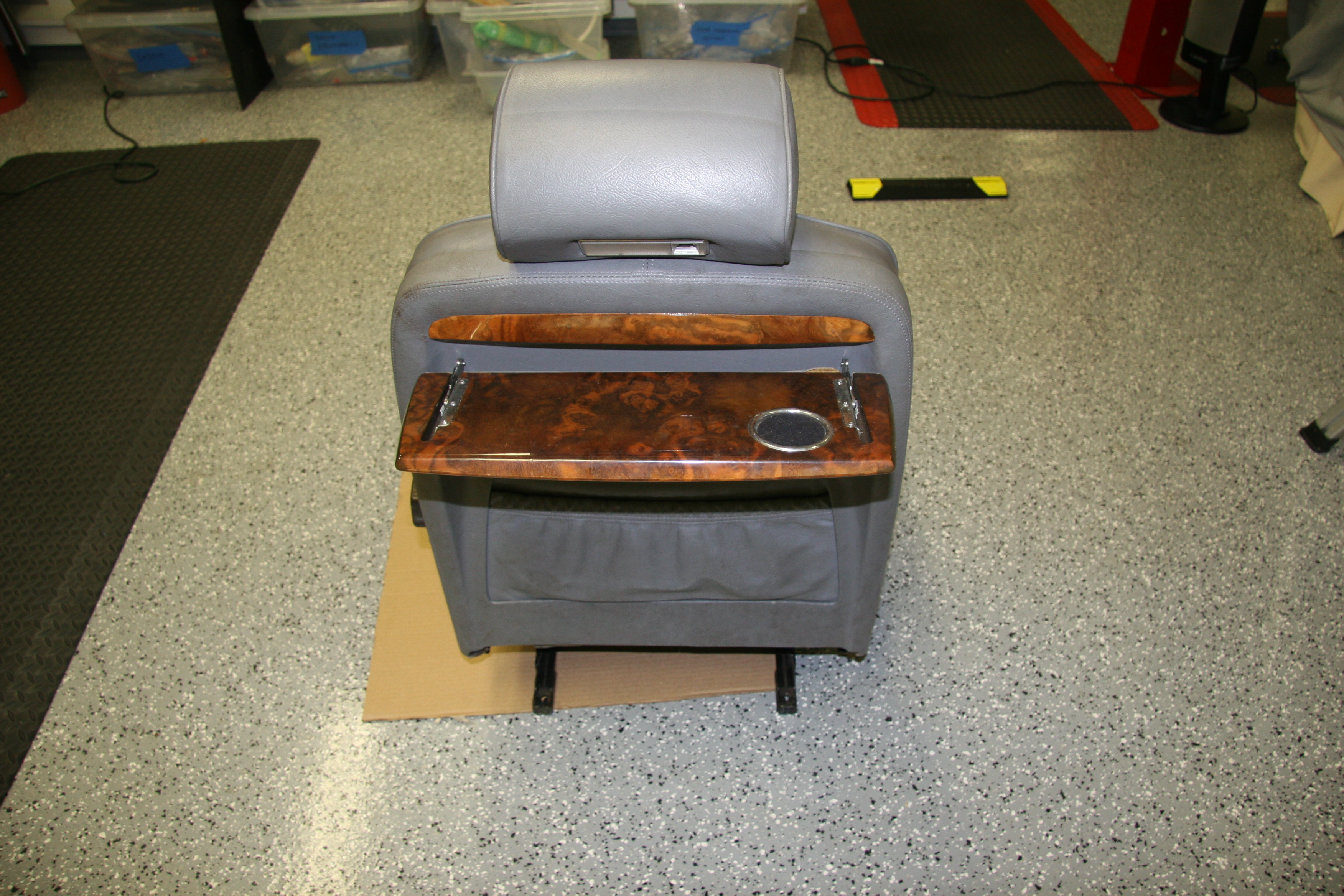
The picnic tables on these seats are particularly nice and much more functional than the ones on the MK2 seats.

1990 Daimler Front Seat Picnic Table

1990 Daimler Front Seat Picnic Table

1990 Daimler Front Seat Picnic Table Open

1990 Daimler Front Seat Picnic Table Open

The seats I purchased are slightly different than Ton’s as my headrests are not adjustable. I will have the seats recovered over new seat foams when the time comes.

Of course, the primary advantage of these seats is their adjustability. Each seat has four motors. Two for the lower and two for the upper cushion. The seats also have seat heaters (non-functional apparently) and the driver’s seat has a memory function.

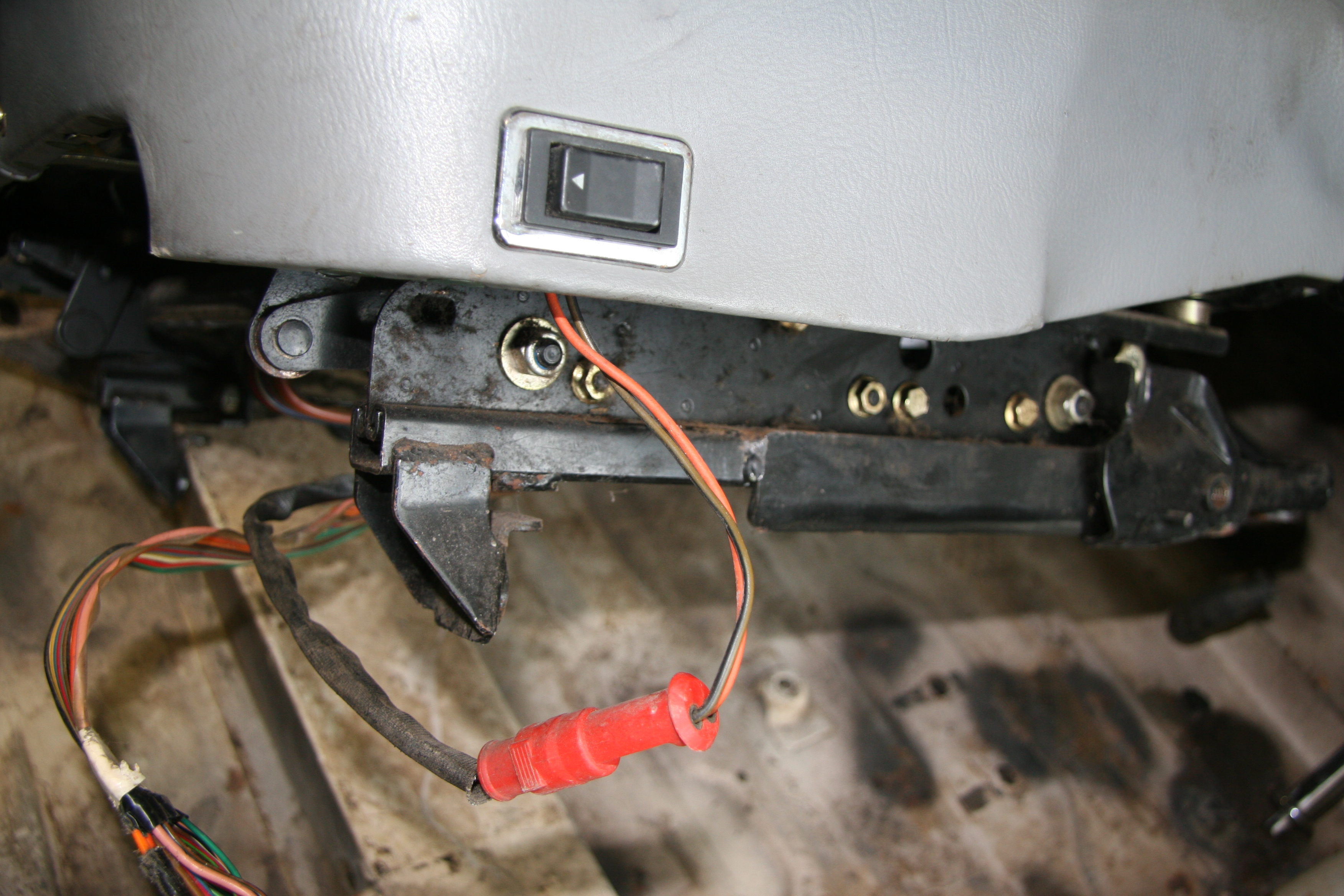
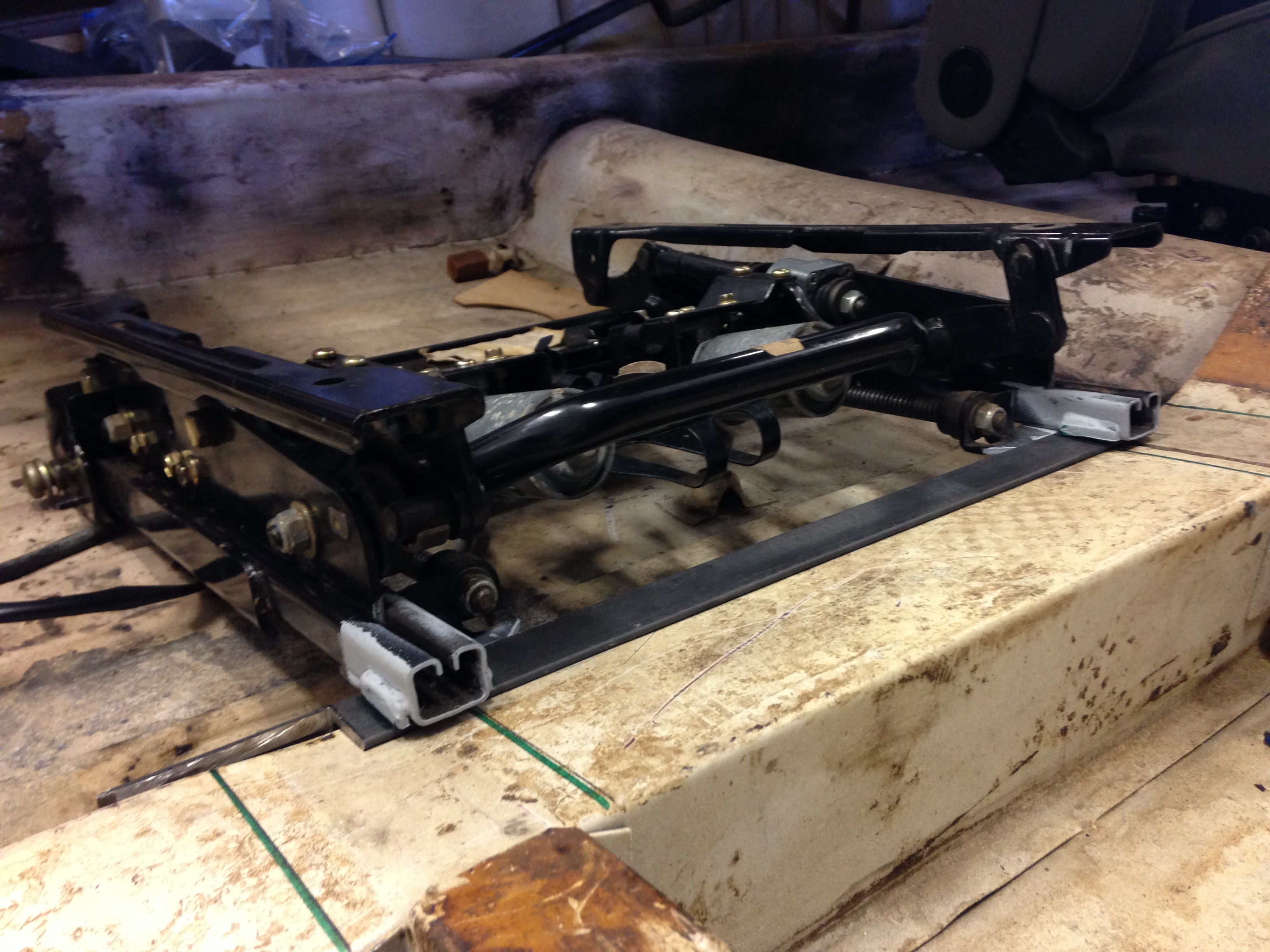
Most folks cut down the height of the floor brace in the interior to install the modern seats; however, Ton did not do that and I am going to at least try it this way before cutting them back. I like the idea of being able to go back to the original seats if I, or another owner, decided to do so in the future. As Ton did, I made a brace for the seat frames from angle iron and had them welded to the frames. I will then drill them for mounting through the original holes of the seat supports into the floor brace.

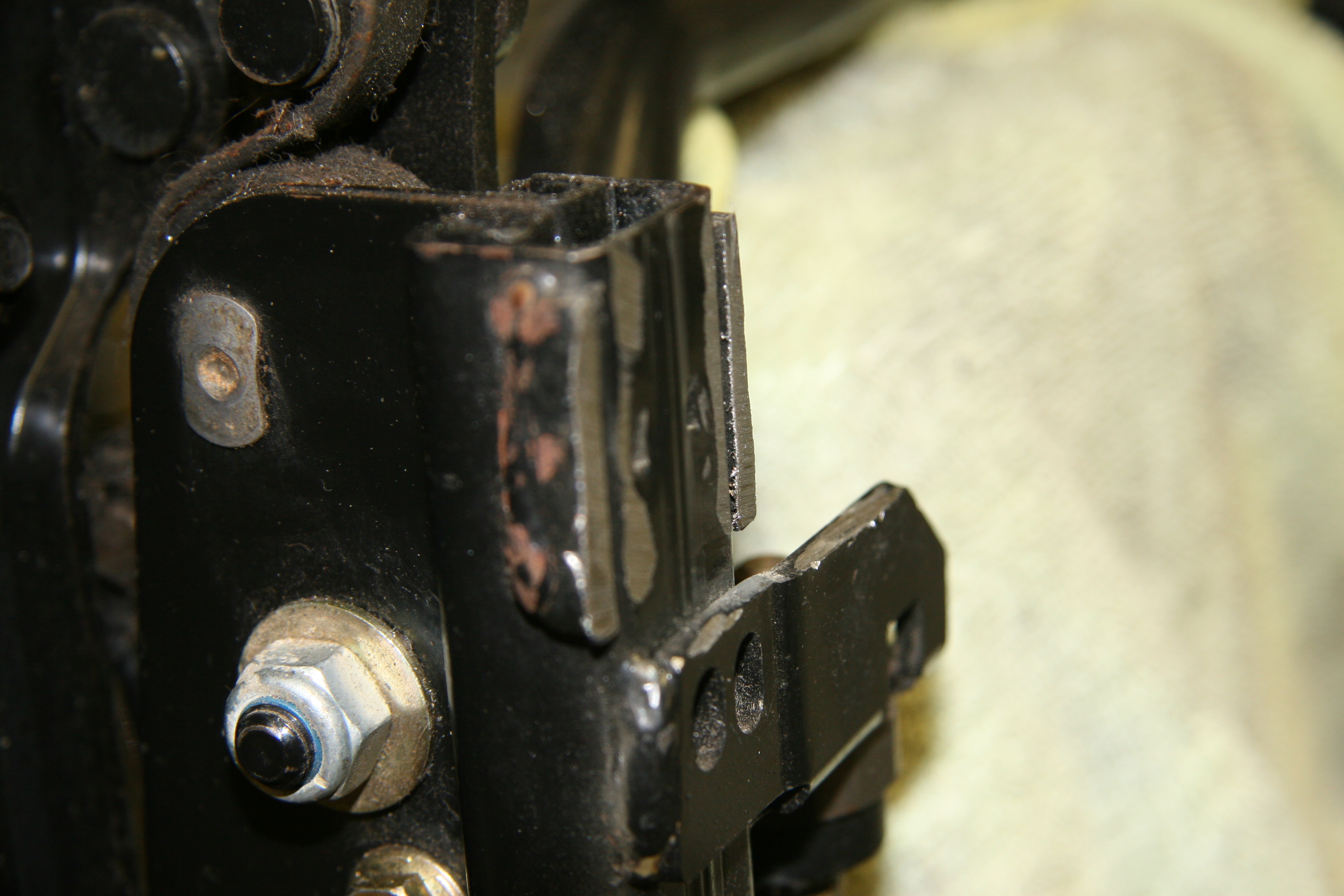
Front Foot on XJ40 seat frame

Front Foot on XJ40 seat frame

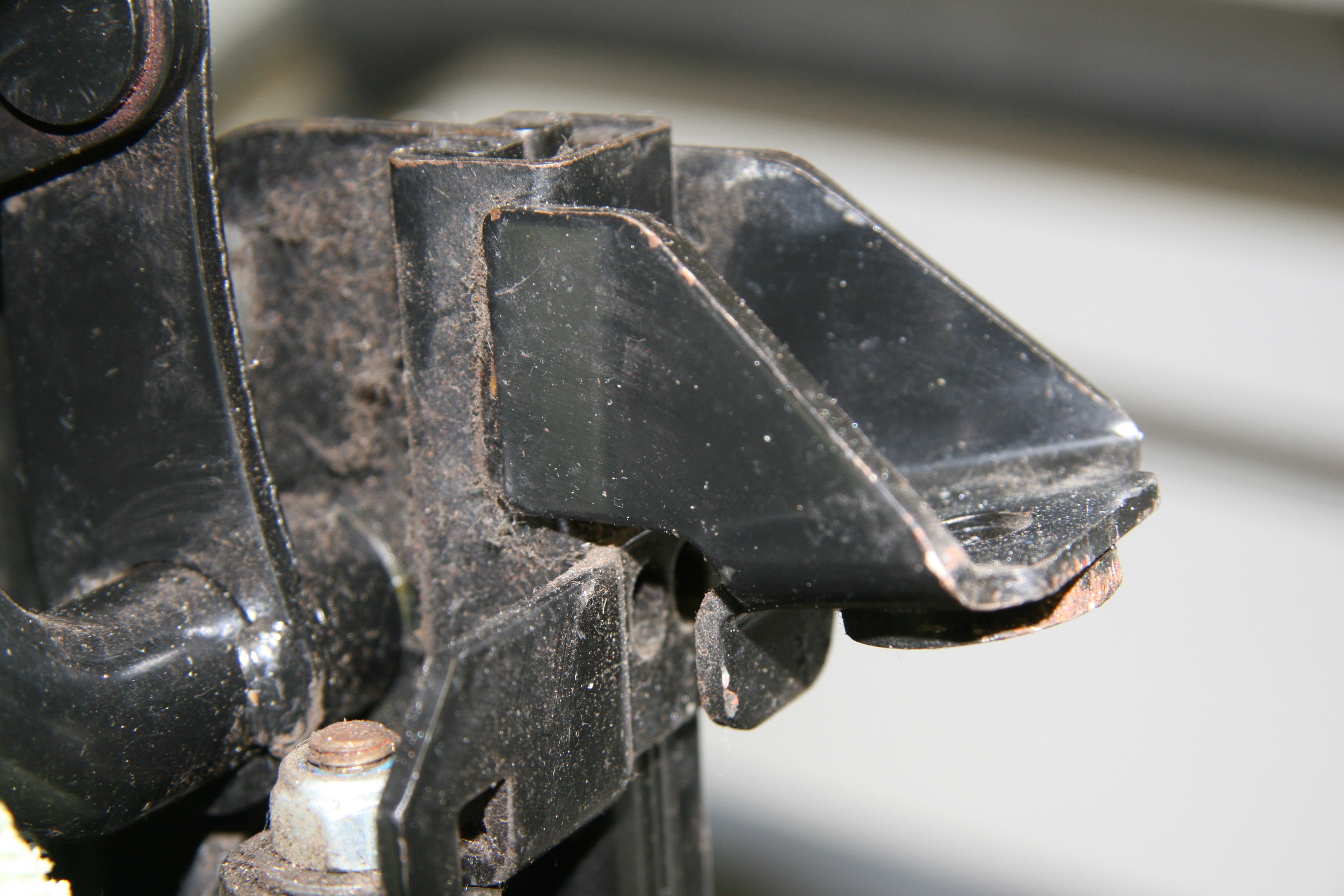
XJ40 seat frame front foot

XJ40 seat frame front foot

XJ40 seat frame front foot removed

XJ40 seat frame front foot removed

The front foot shown in the image above must first be removed.

New front mounting bracket in place with front foot removed

New front mounting bracket in place with front foot removed

The image above shows the new bracket in place prior to welding to the seat frame.

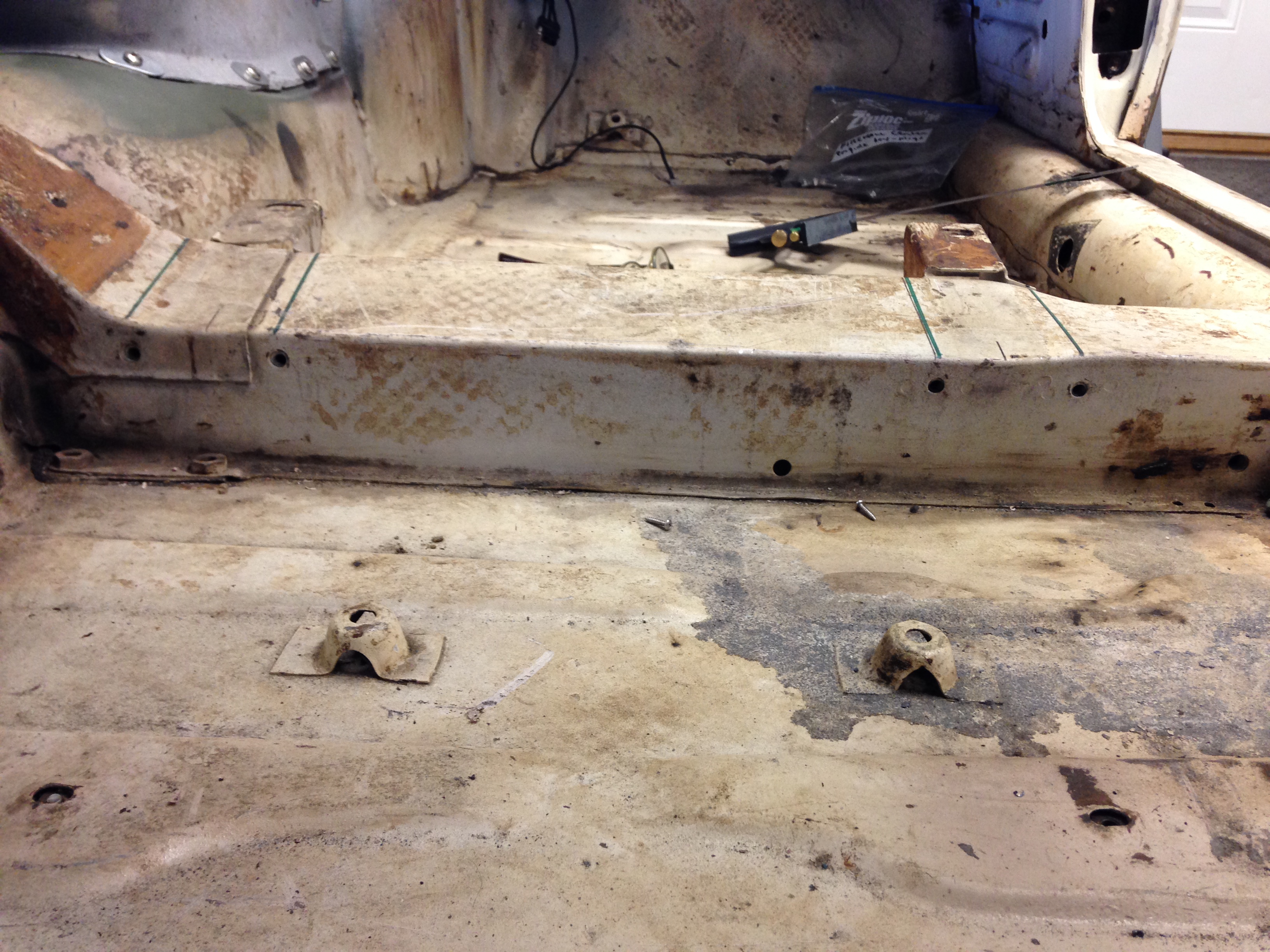
Floor Brace and seat mounting captured nuts

Floor Brace and seat mounting captured nuts

The image above shows the four holes with captive nuts in the floor brace that are used to mount the new seat frame to the floor.

The wiring had its own set of challenges. Details about the wing may be found in the “Building a Wiring Harness” post.

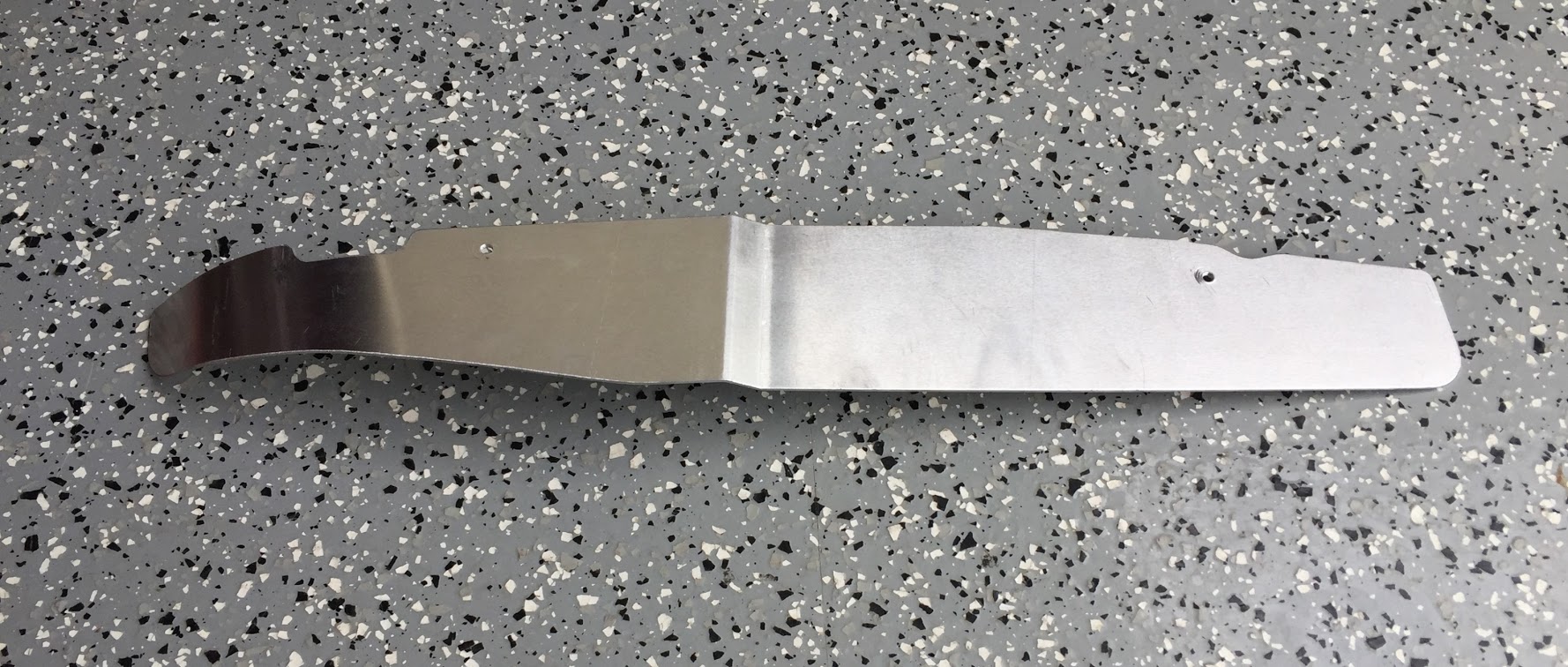
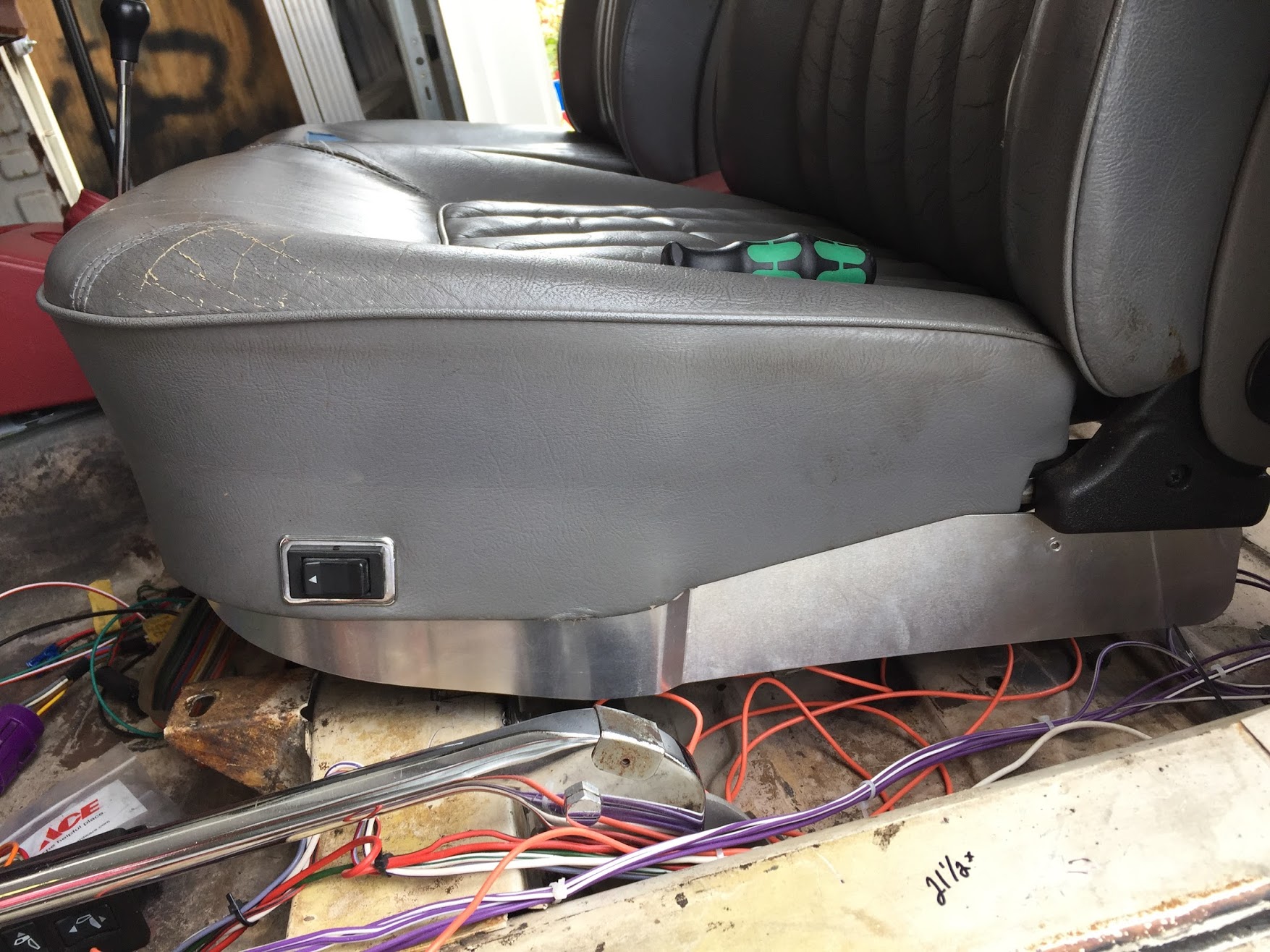
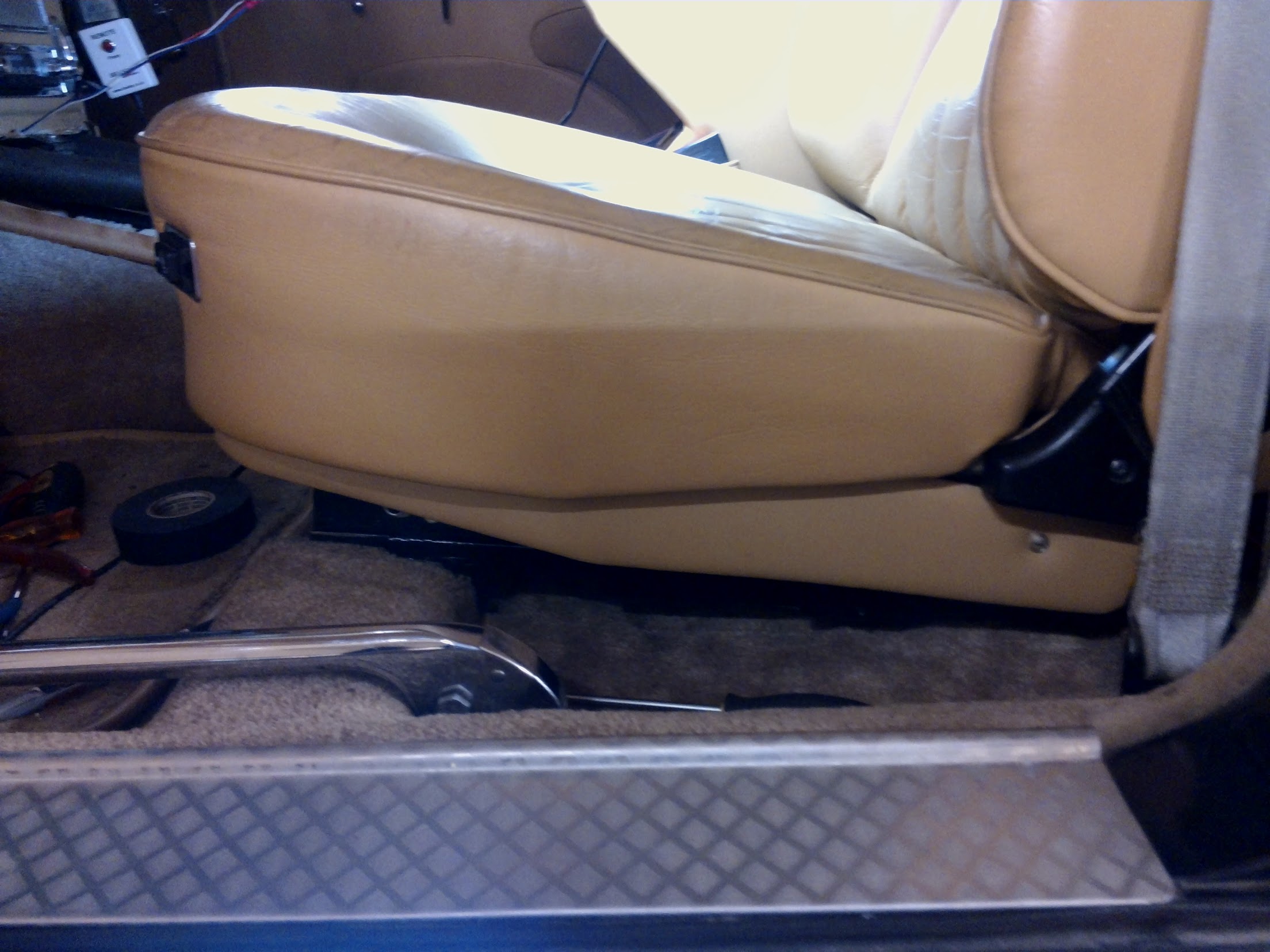
Ton suggested making “skirts” for the lower portion of the seats so that the seat mounting frames would not be visible when the door is opened. I followed suit. Brandon Tyree, metal welder/fabricator at Gassman Automotive, made the skirts from sheet metal for me. These will be covered with leather/vinyl when the interior upholstery is finished.

Brandon welded metal tabs to the seat frames so that the sheet metal skirts can be screwed to the tabs to mount them to the seats. These are designed so that the skirts will move with the seats when the power functions of the seats are used.

LH Side Front Seat Skirt

Locating Tabs for LH Side Front Seat Skirt

LH Side Front Seat Skirt Installed


This is an image of his finished product:

Ton Tulken’s Front Seat Skirts

Original Seat Mounting

Seat Supports

Details on the removal of the seat runner assemblies or seat supports may be found in the disassembly note, entry 45 https://valvechatter.com/?p=1803, and entry 6 https://valvechatter.com/?p=297.

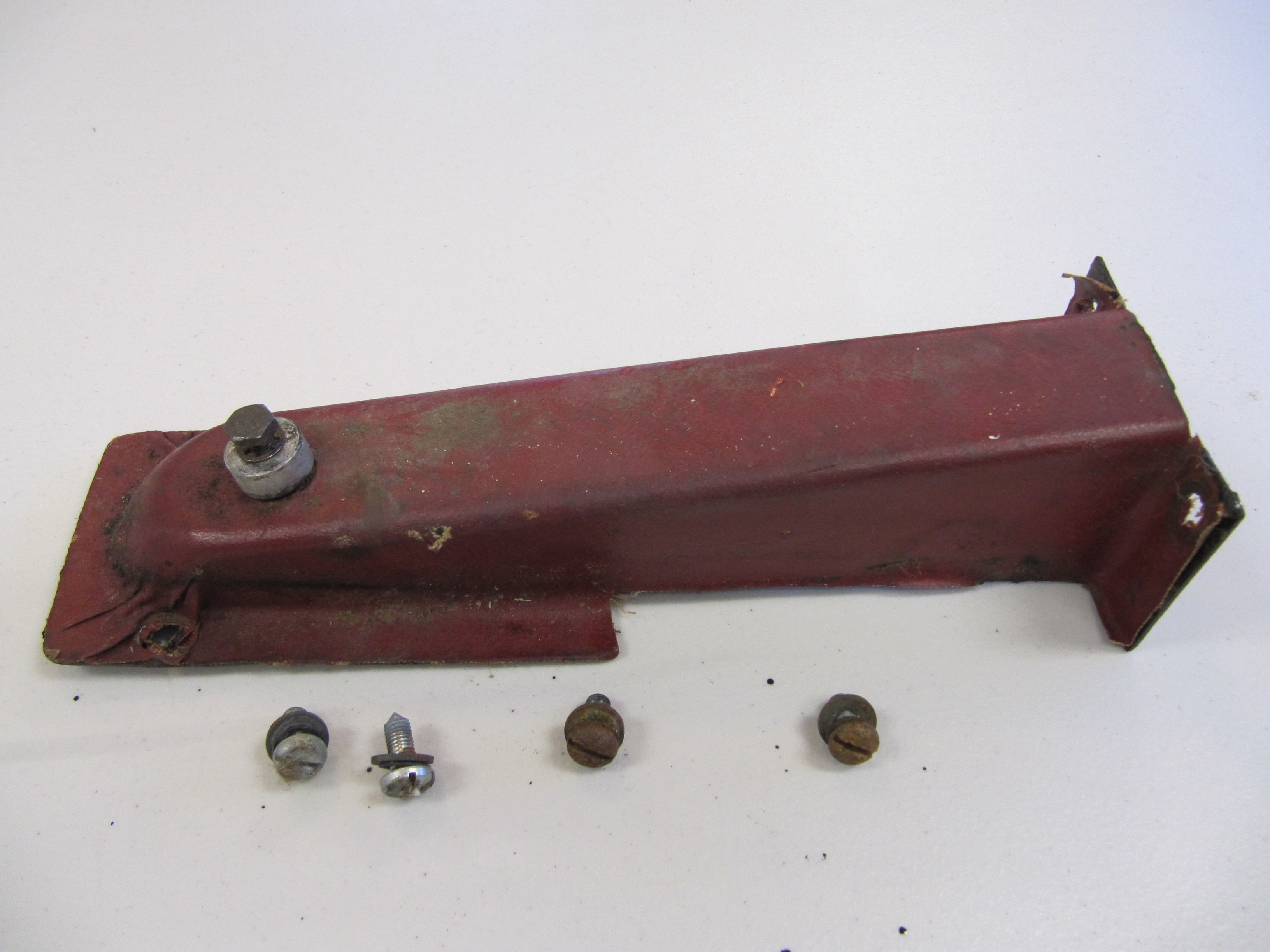
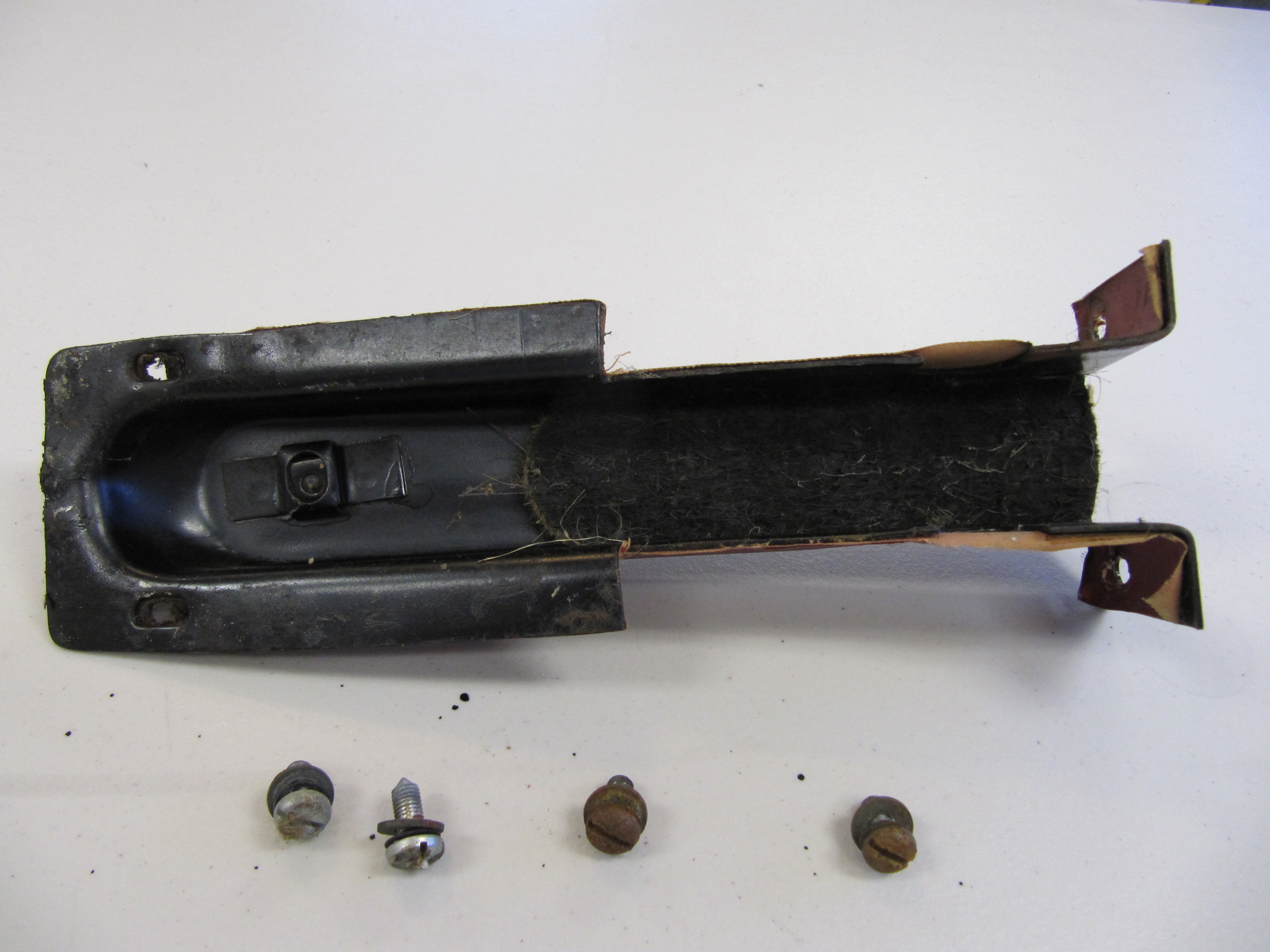
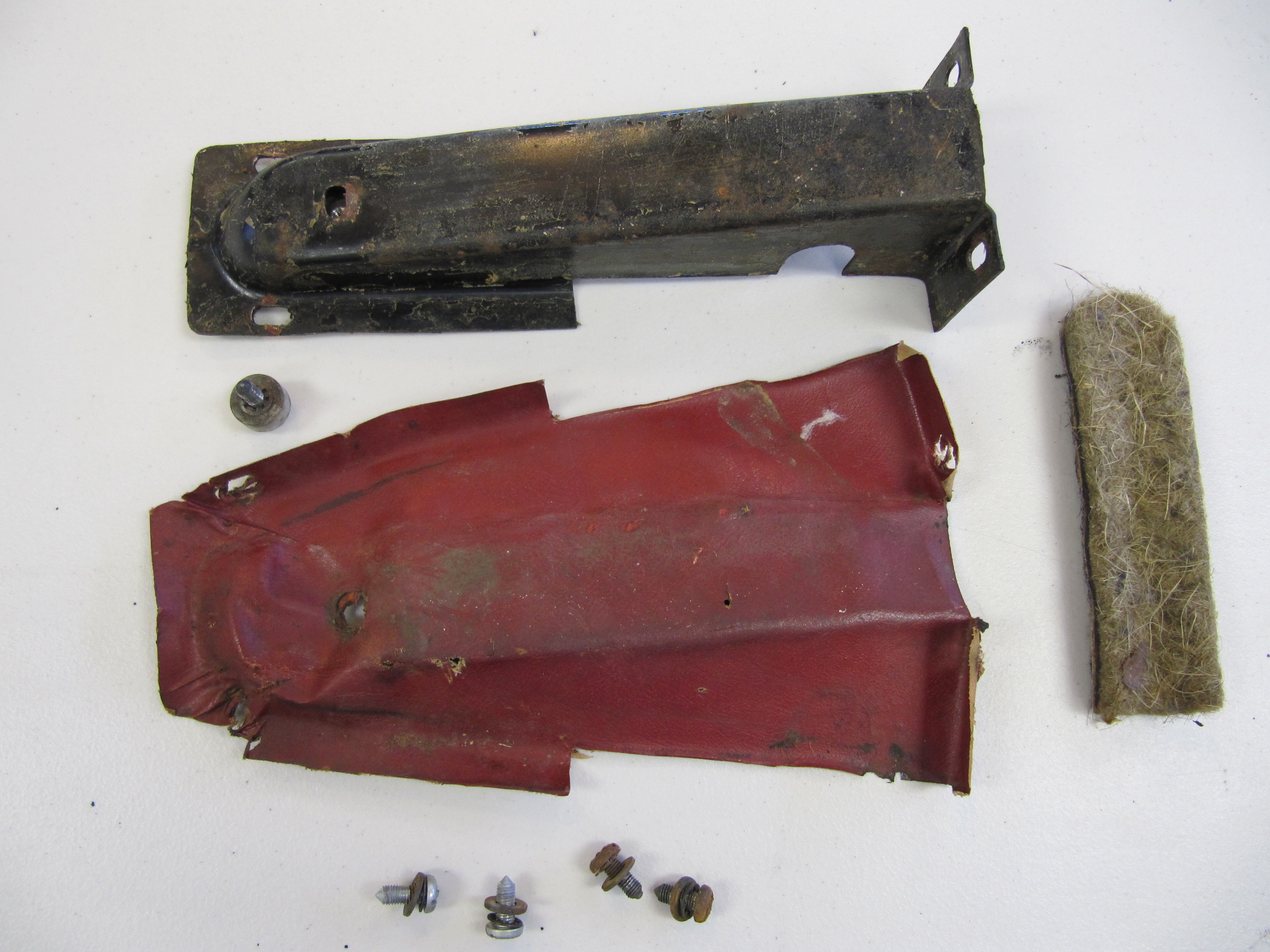
Each support is mounted to the floor brace with four 1/4″ – 28 x 5/8″ pointed tip, slotted machine screws with flat and shakeproof washers. The rear mount for the seat to the seat support is a 1/4″ – 28 x 1″ hex head bolt with shakeproof washers. An insulation pad was found cut to fit under each seat support.

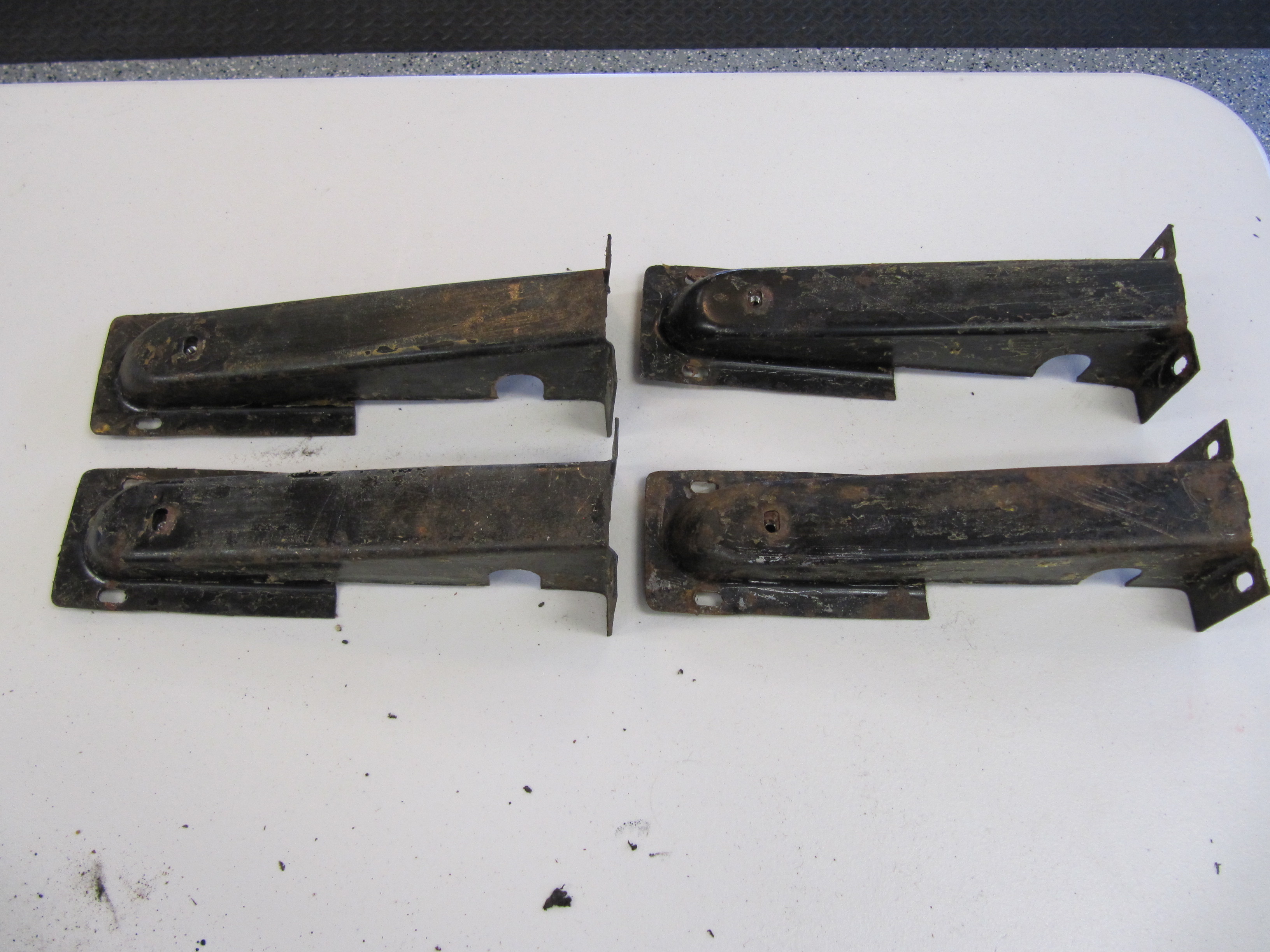
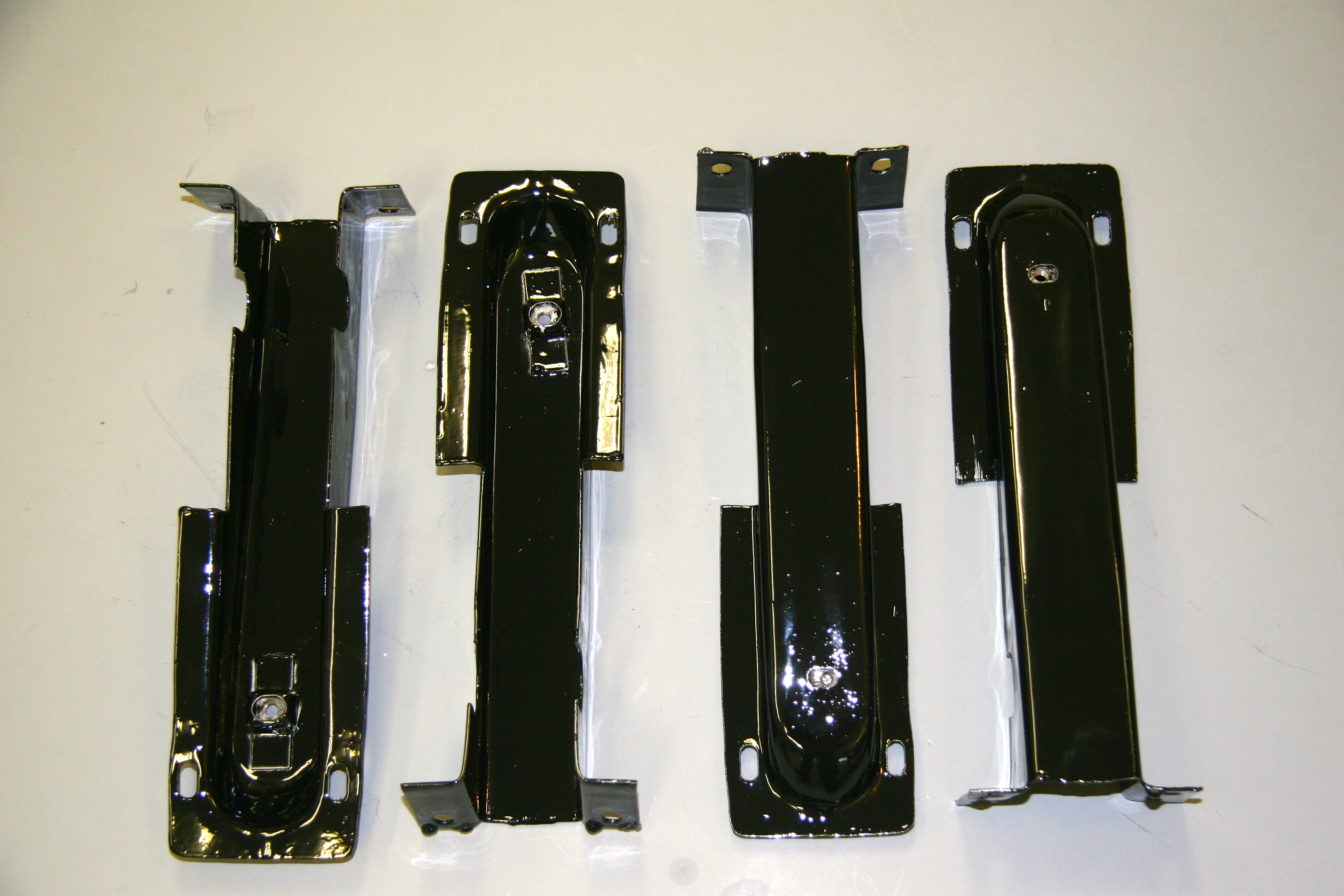
I removed the vinyl from each of the four supports, media blasted them  and painted with POR-15 to be covered with new vinyl later.

Seat Supports

Seat Supports

Seat Supports

Seat Supports

Seat Supports

Seat Supports

Seat Supports

Seat Supports

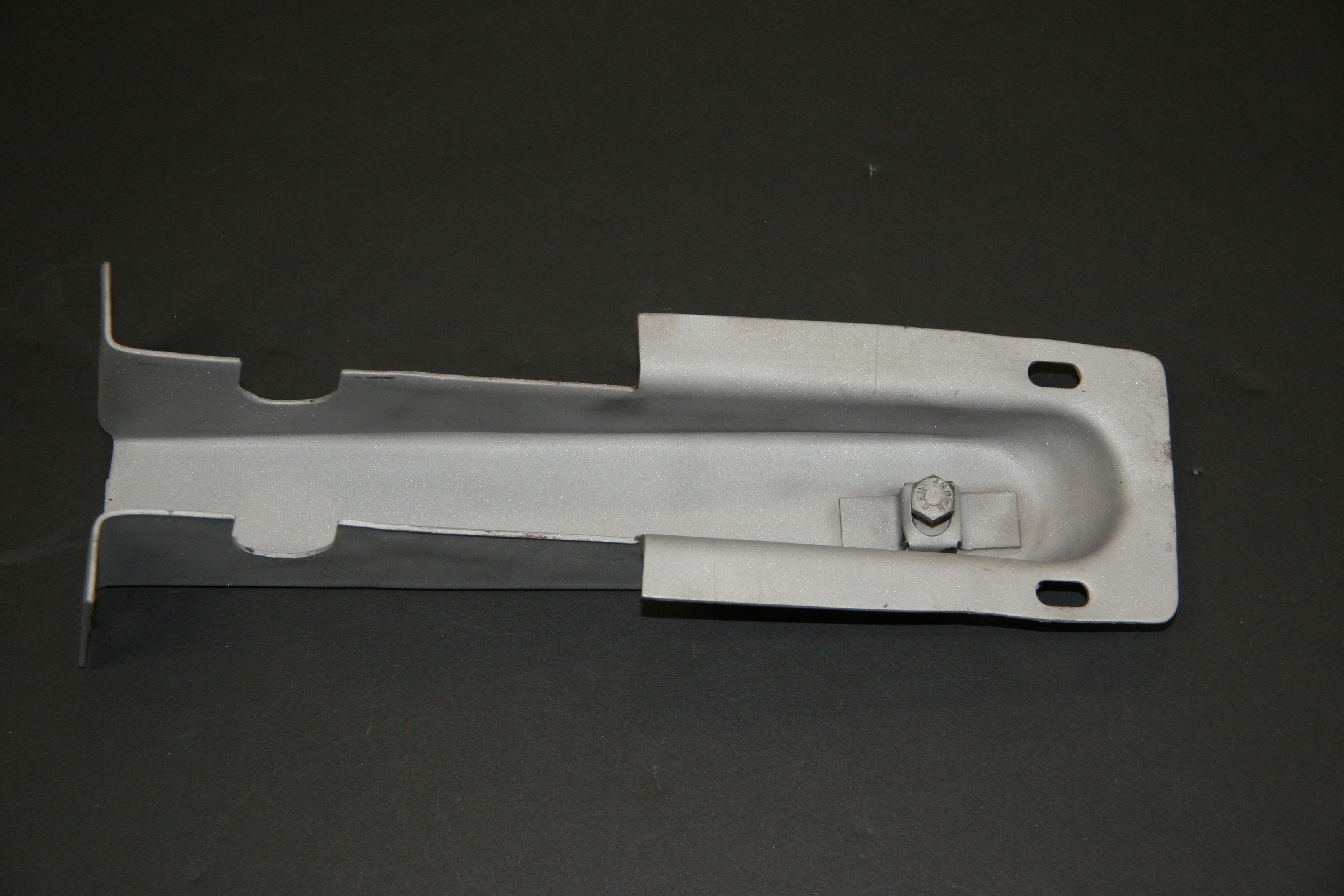
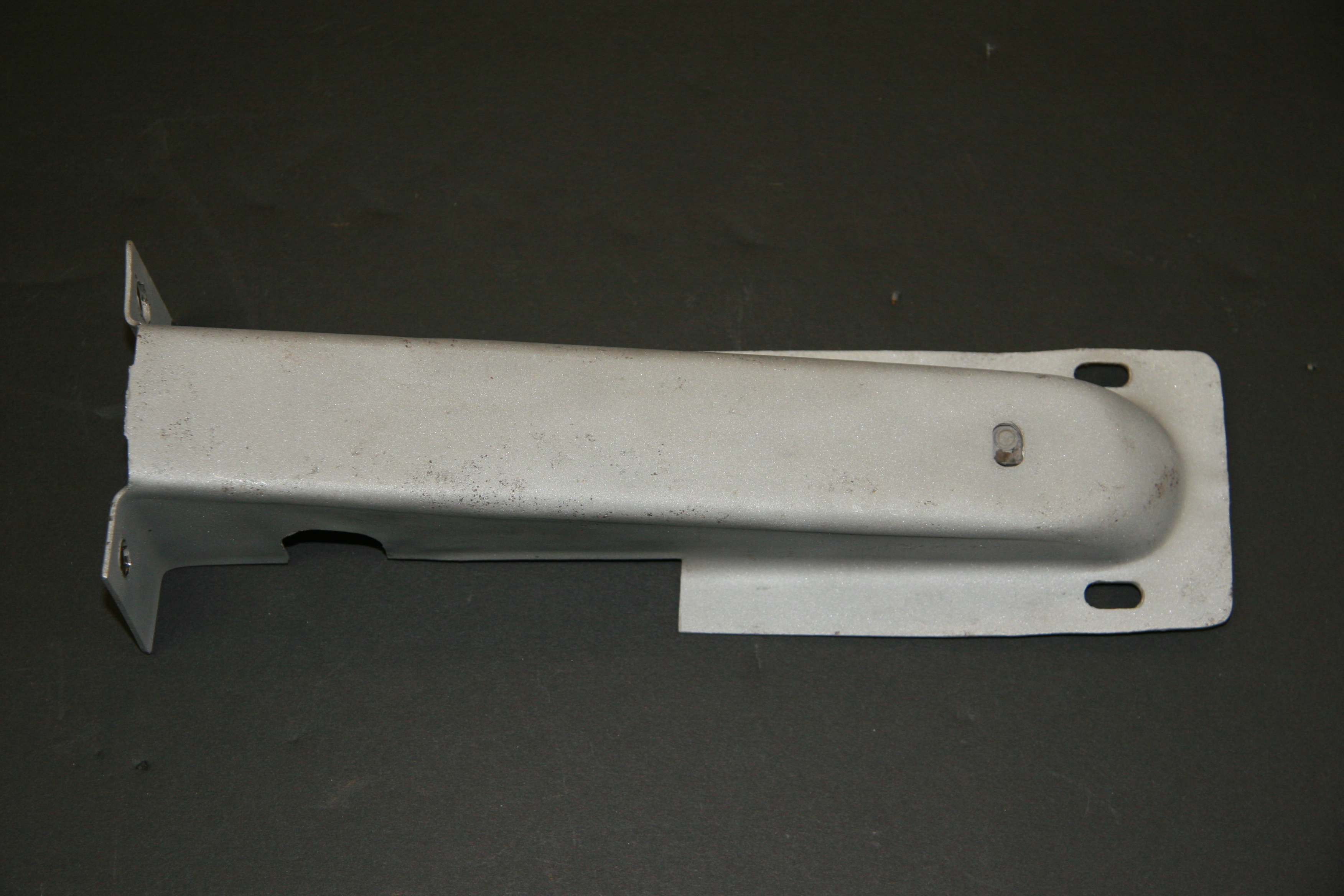
I media blasted the four seat supports and prepared them for painting:

Front Seat Support

Front Seat Support

Front Seat Support

Front Seat Support

Seat Supports Painted

Seat Supports Painted


Original Fuse Box Modification

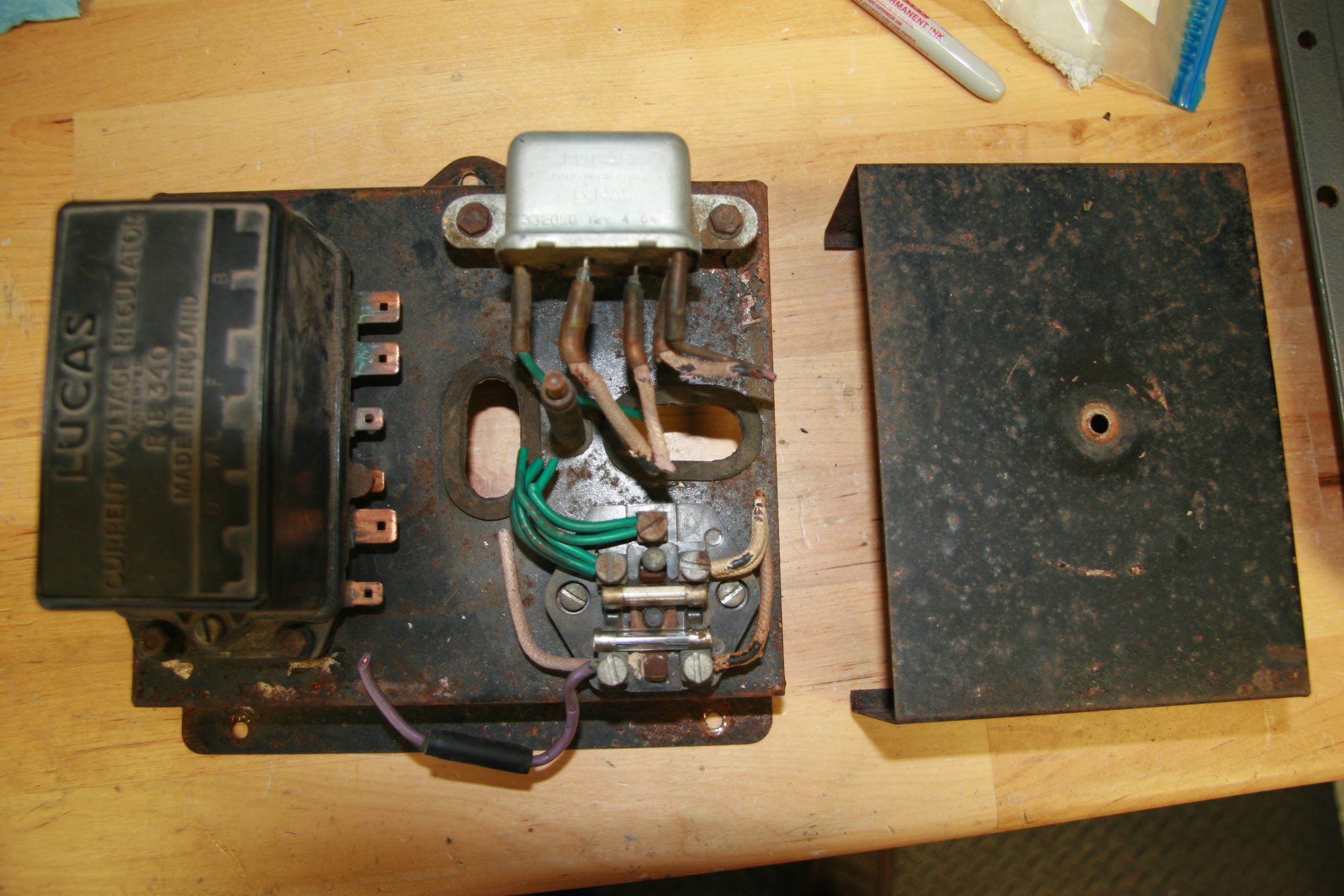
The original electrical system on them MK2 was protected by two fuses. The fuse block was located on the control box bracket assembly mounted on the LH engine bay valance. The voltage regulator and the horn relay were also located inside the control box. The bracket assembly had a metal cover secured by a thumb screw that protected the electrical connections to the relay and fuse block.

Original Control Block, Bracket Assembly and Cover

As explained in other electrical system entries to this website, I am using the Classic Technologies fuse/relay panel that provides for 15 fused circuits with 34 pin connectors, 7 relays including horn, ignition power, fog lights, high beams and low beams headlights, starter and accessory power and 2 flashers for the turn signals and hazard lights. The Classic technologies Fuse Box is located under the dash fascia on the RH side of the interior.

Classic Technologies Fuse and Relay Box

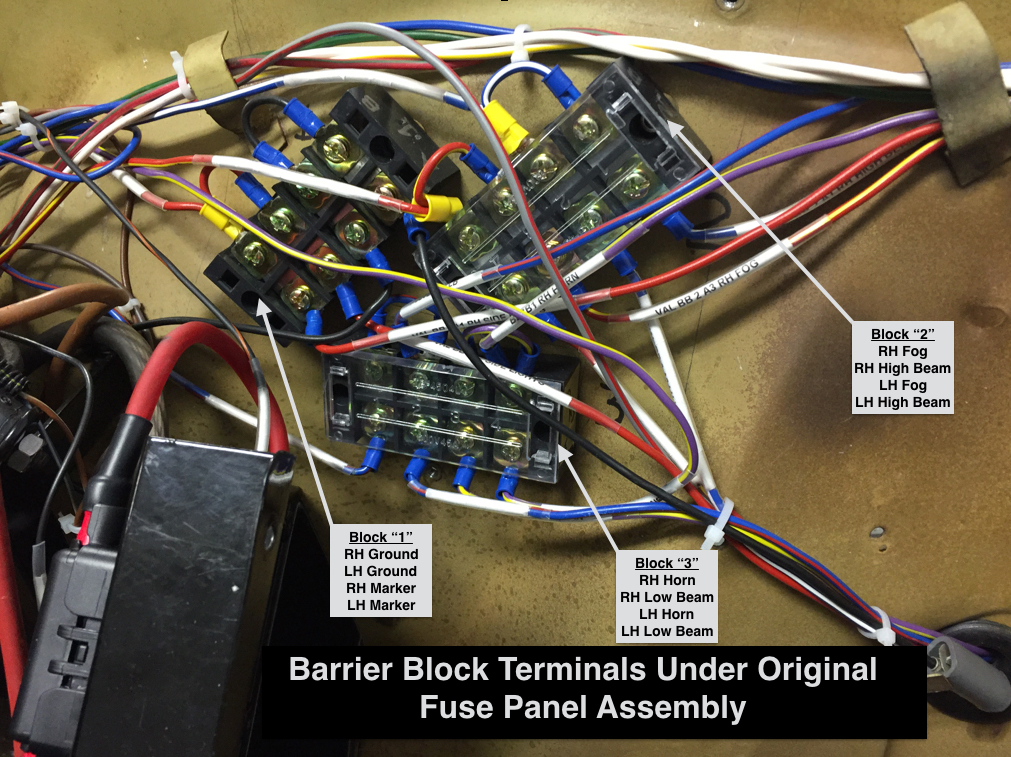
In my revised wiring system I used the bracket assembly as a cover for three barrier blocks used for wiring runs to the front of the car. I know the terminals and wiring appear a hodgepodge but it was necessary to configure them in this fashion to hide them all under the bracket assembly!

Barrier Block Terminals Under Original Fuse Panel Assembly

The top of the bracket assembly was then used to mount a number of other electrical connections:

Power Steering Pump Alternator Fogranger Wiring on Bracket Assembly

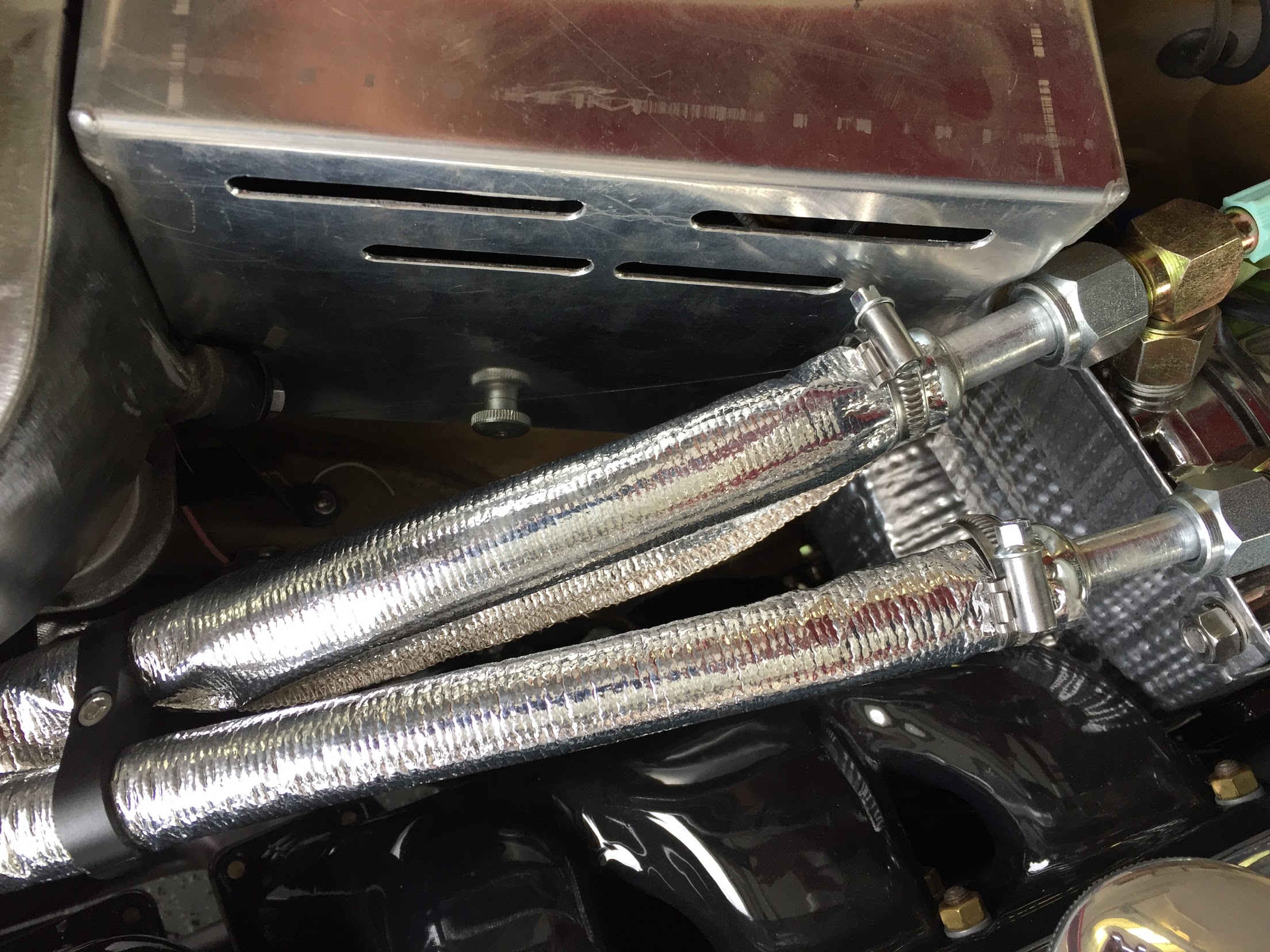
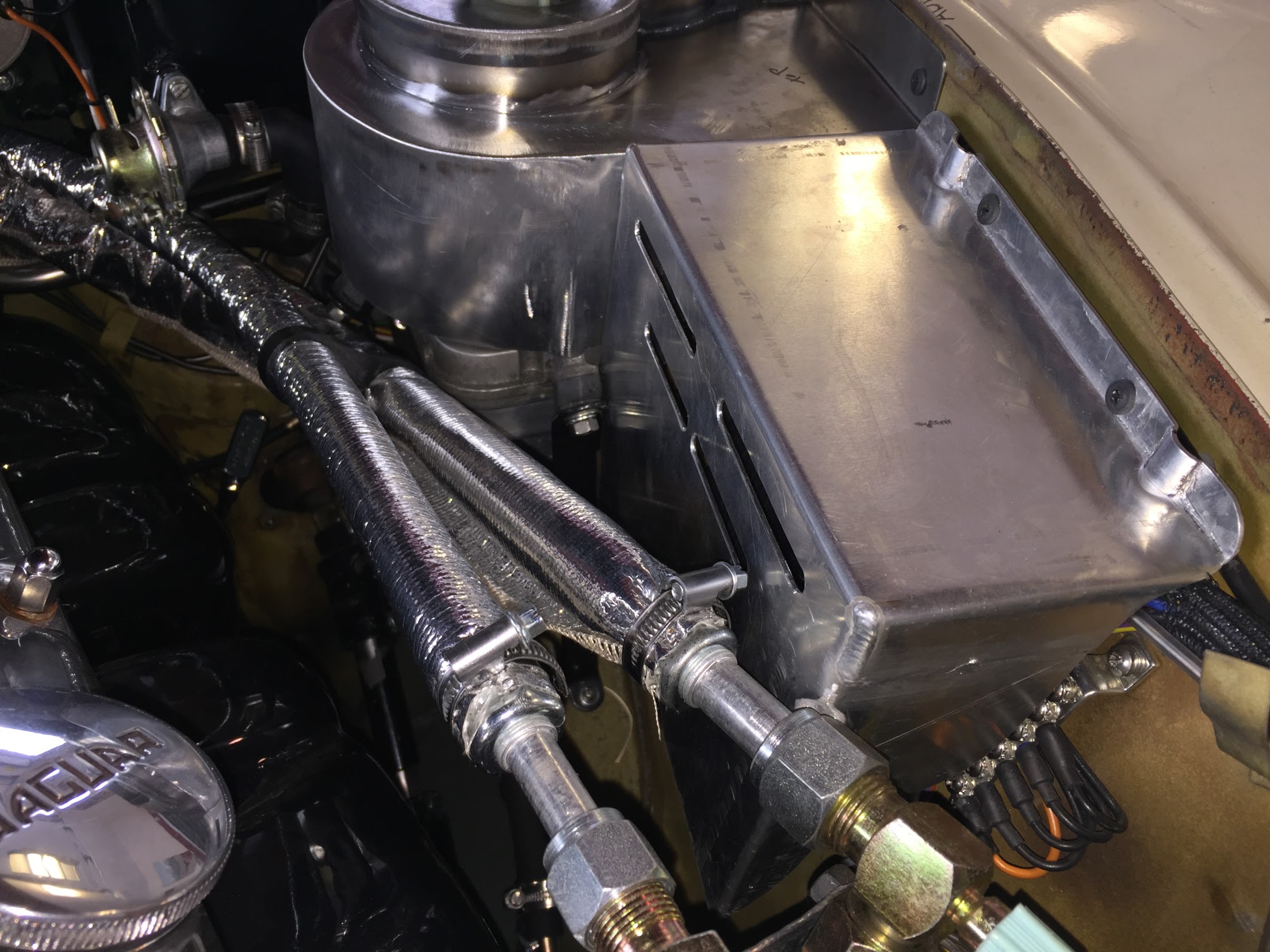
The original control box cover would no longer cover, nor fit, the bracket assembly. I turned to Brandon Tyree, welder/fabricator at Gassman Automotive http://www.gassmanautomotive.com to fabricate a new electrical connections box cover. The images below show the cover. In final form it will be painted gloss black to match the heater box. The box is mounted to the valance with two 10-24 x 1/2″ machine screws and the original thumb screw slightly repurposed. Four slots were designed into the face of the box to permit heat to escape. The box sits very close to the exhaust manifolds and I did not want it to collect the heat.

Electrical Connections Box and Power Steering Pump-Reservoir Cover

Electrical Connections Box and Power Steering Pump Cover

Electrical Connections Box and Power Steering Pump-Reservoir Cover

Electrical Connections Box Cooling Vents


Fuel System

Petrol Filter

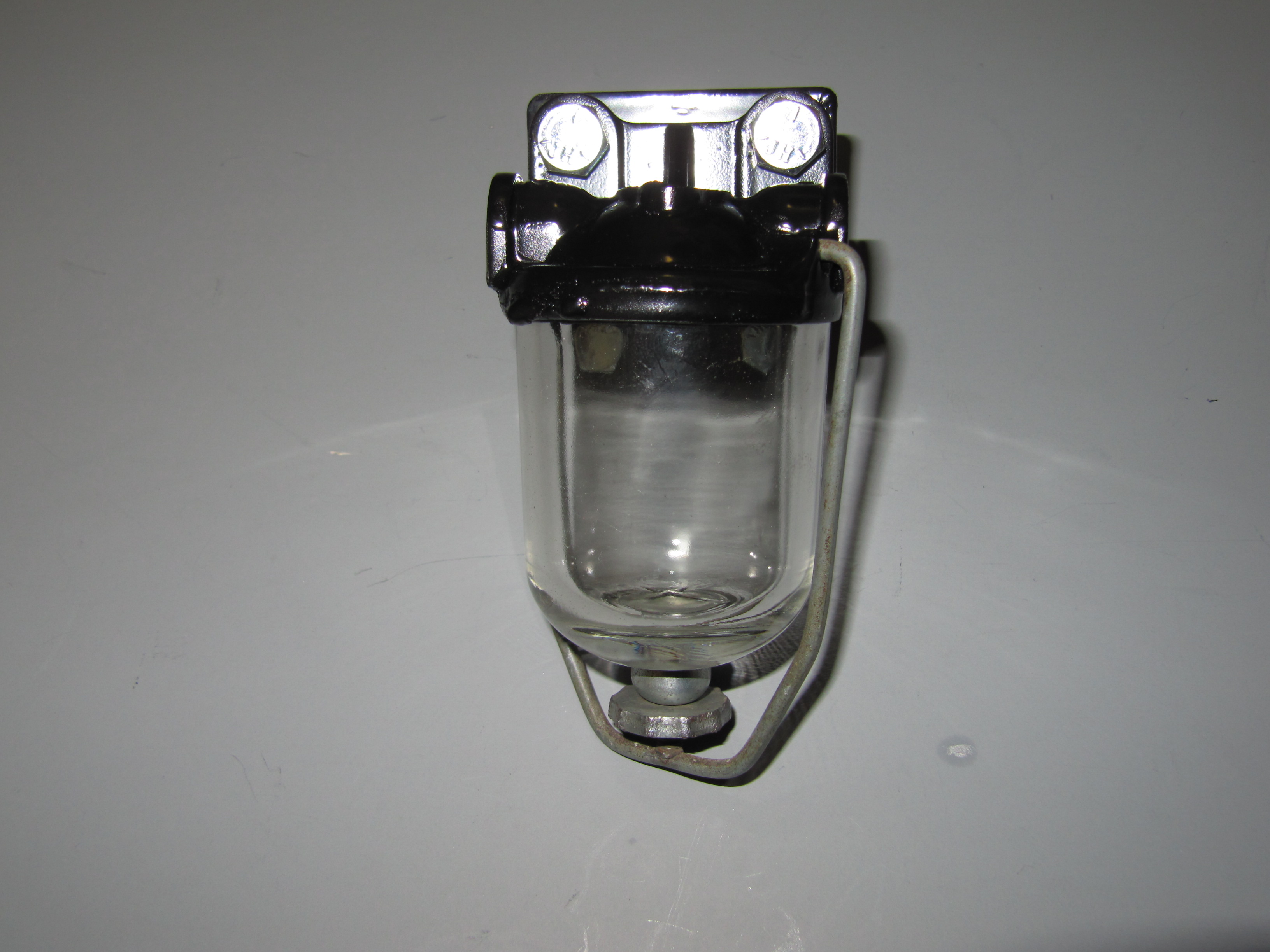
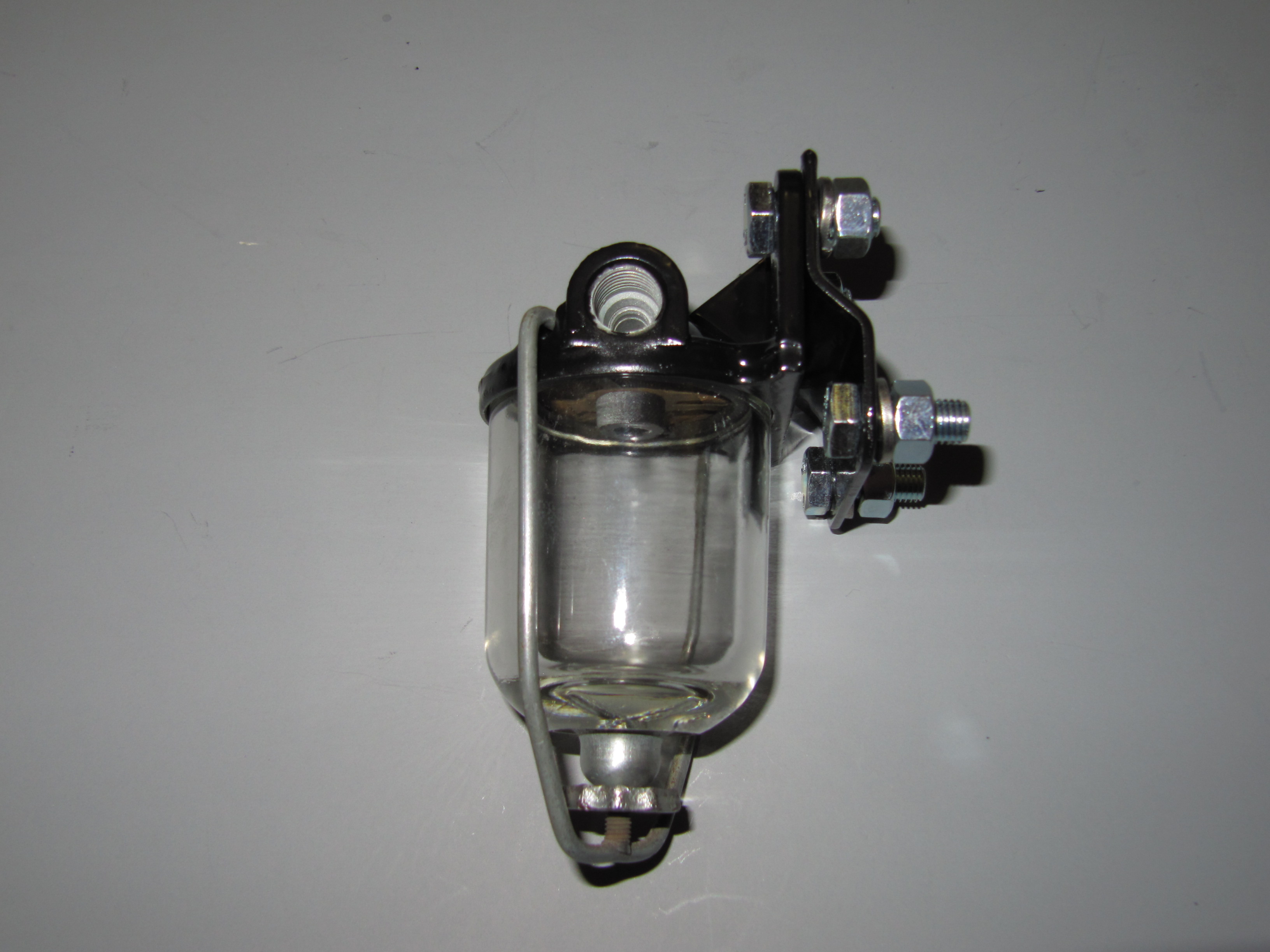
AC supplied the fuel filtration device for the Jaguar. My early version includes a filtration screen, but newer versions have a paper filter in the bowl.

The filter is bolted to a mounting bracket with two 5/16″ – 24 x 3/4″ hex head bolts, split washers and hex nuts. The bracket and filter are then mounted to the RH wing valance with two 5/16″ – 24 x 3/4″ hex head bolts, split washers and hex nuts.

Petrol Filter

Petrol Filter

Petrol Filter & Bracket

Petrol Filter & Bracket

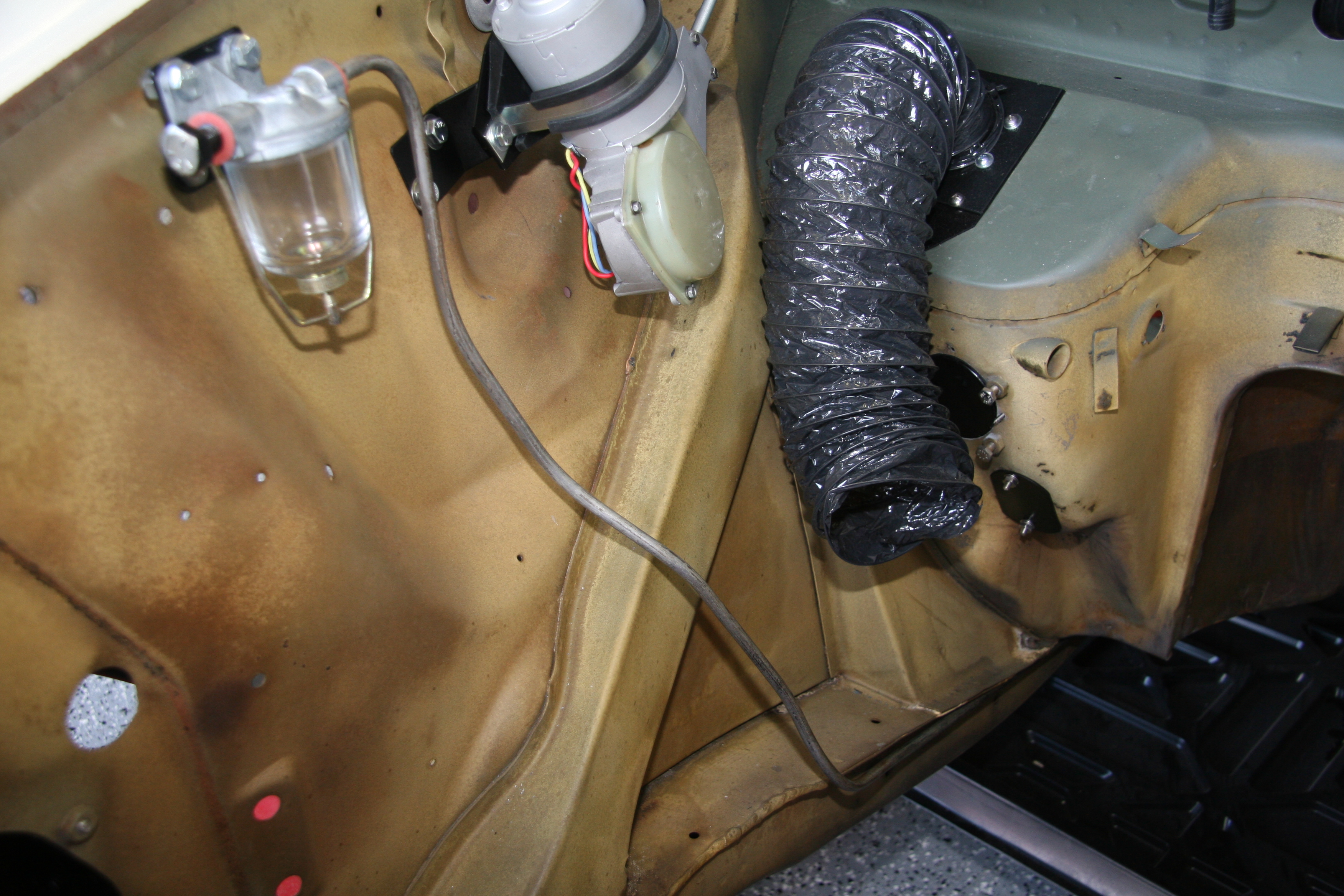
I trial fit the fuel filter and fuel pipe to the RH valance.
Fuel Filter and Fuel Pipe Installed

Fuel Filter and Fuel Pipe Installed

Fuel Lines

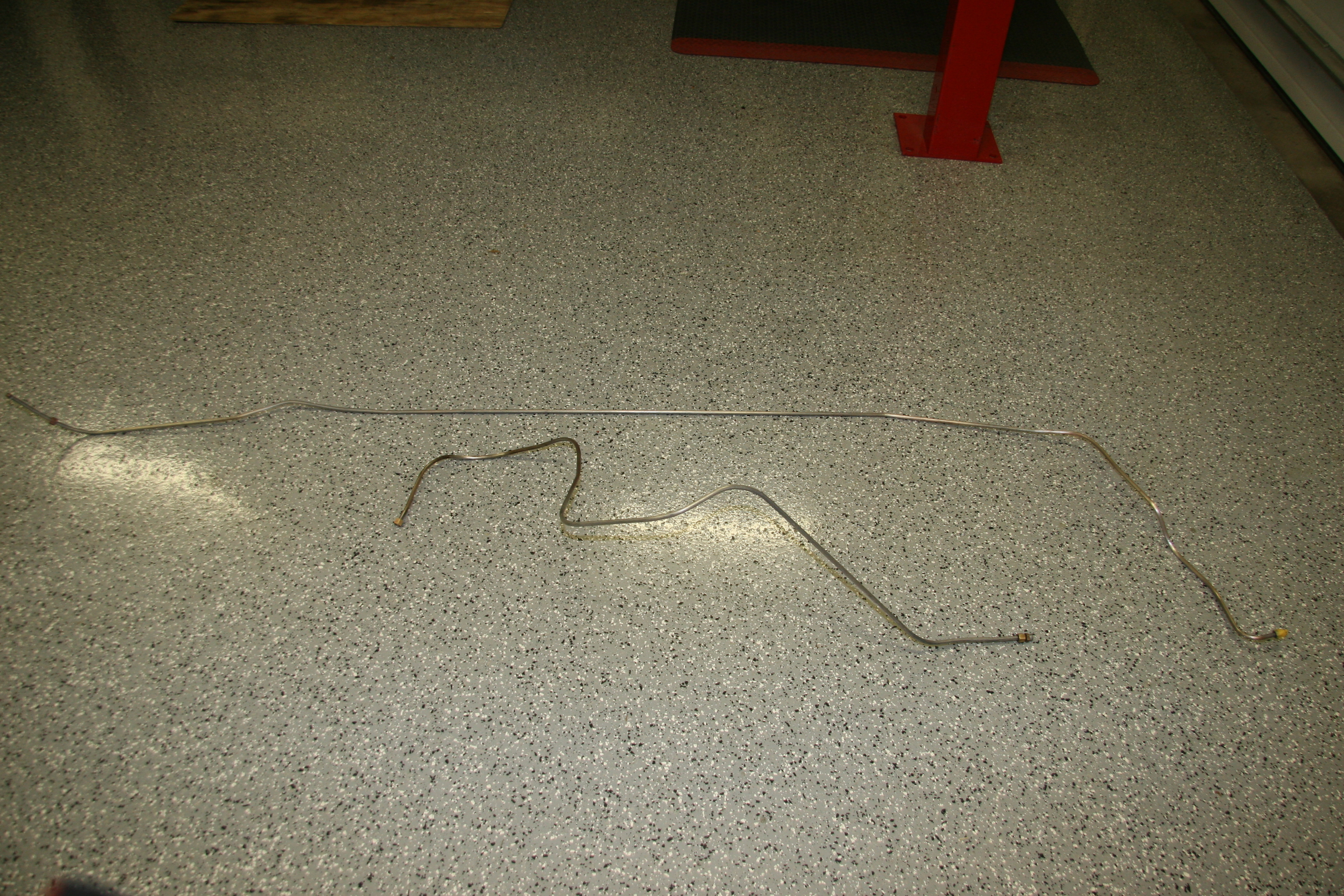
I am replacing the hard brake lines, but the original hard fuel lines were in very good shape. I just cleaned them before reinstalling.

Cleaned Fuel lines


The hard fuel lines run along the RH frame rail. Rather than using the original mounting clips, I used a double stainless steel clip that permitted running the fuel and brake pipe in parallel on one side of the clip and the battery cable in the other. Information and photos of the fuel line installation can be found here” https://valvechatter.com/?p=6627.

Petrol Tank Filter

I ordered a new filter for the tank.

Petrol Tank Filter

Petrol Tank Filter

Petrol Pump

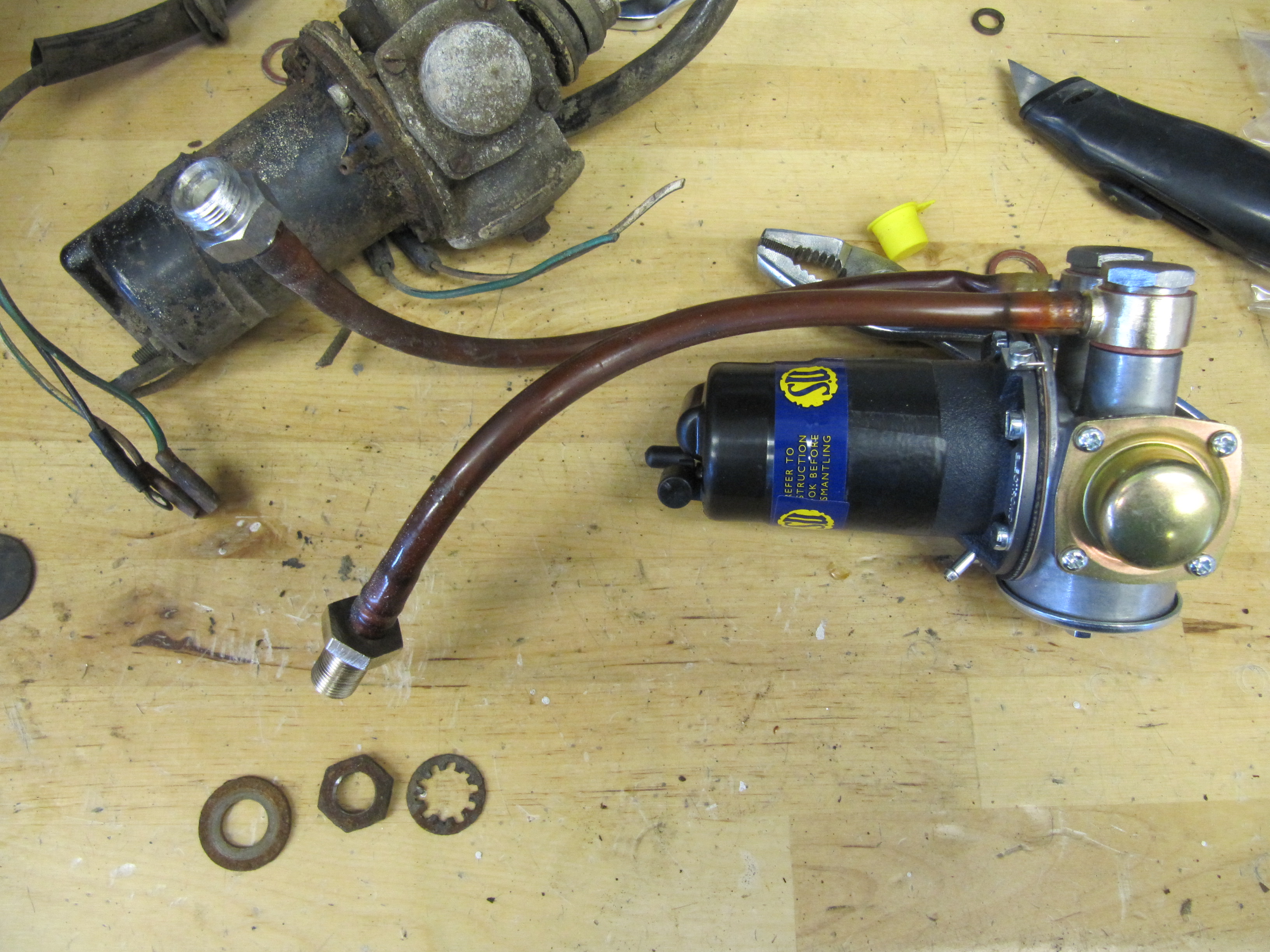
I ordered a new SU electronic petrol pump to replace the old, but still functioning unit.

SU Electronic Petrol Pump AZX1308EN

SU Electronic Petrol Pump AZX1308EN

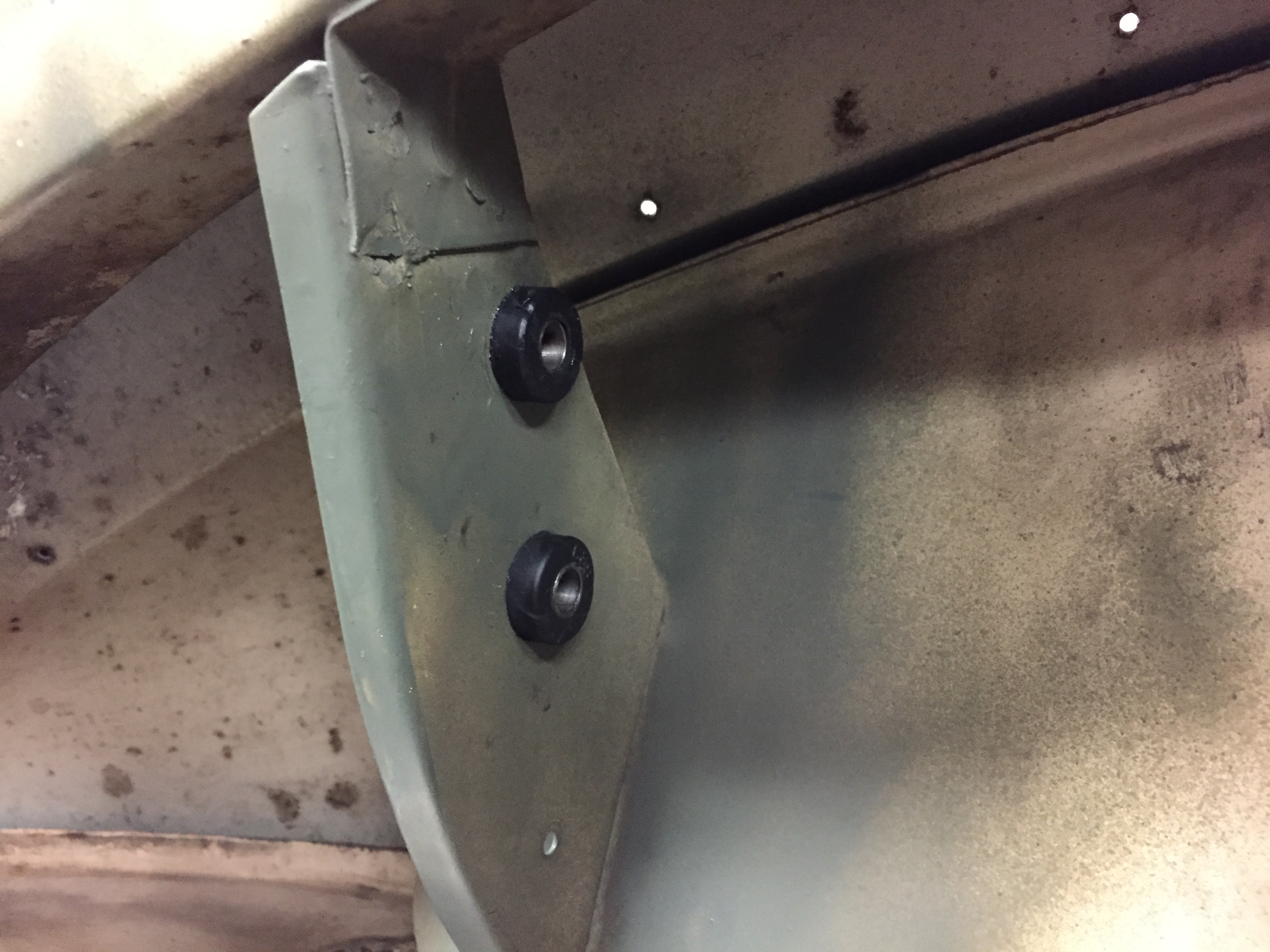
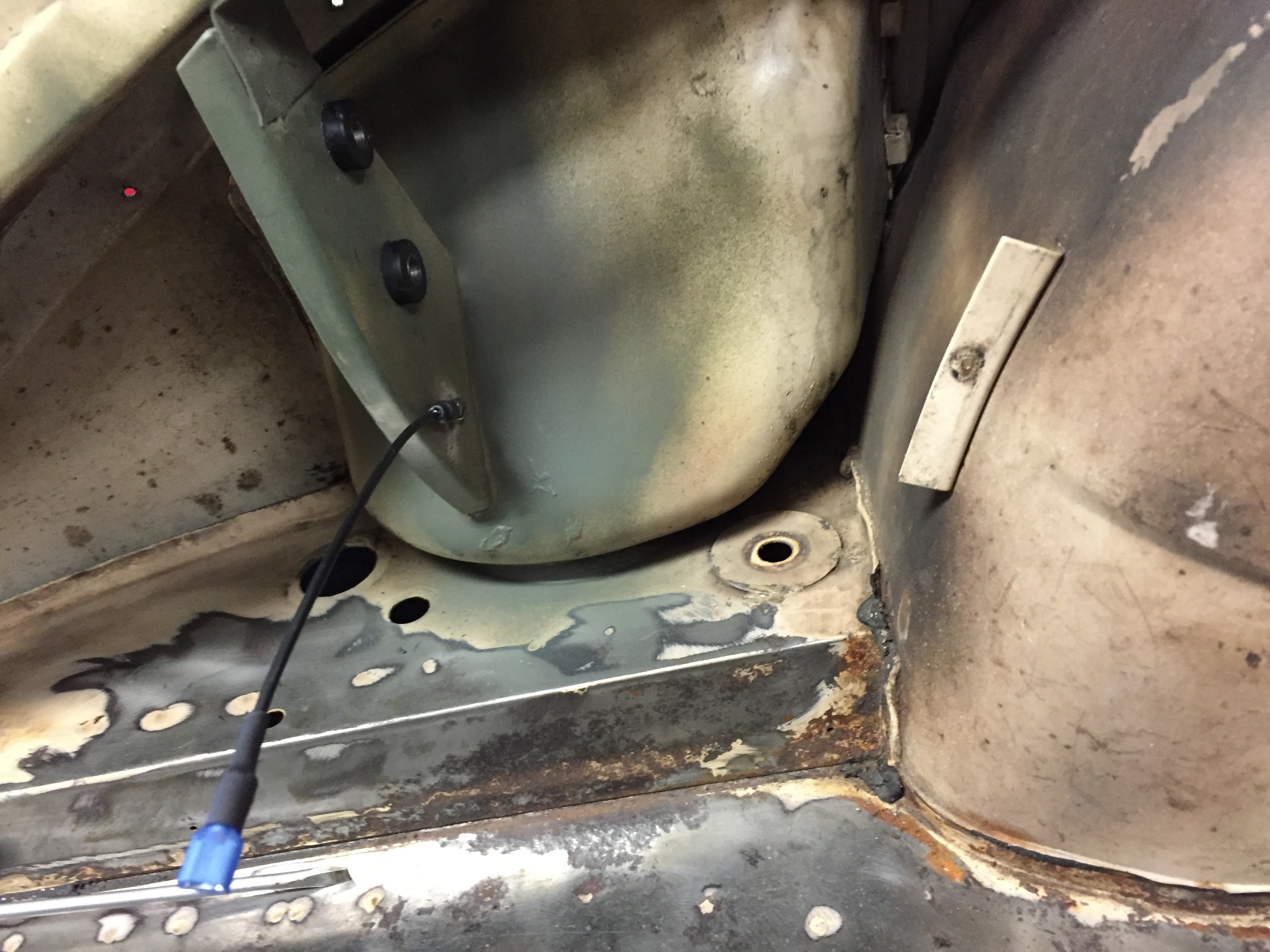
As part of the trial fitting process, I installed the two rubber grommets with their metal “distance tubes” in the boot. Pushing the grommets into place is no easy task. I placed them in boiling water for a few minutes to soften them and it did seem to help. Also put a little vaseline on the mounting plate to which they are affixed.

Petrol Filter & Bracket

Petrol Filter & Bracket

A black 14 AWG wire is used as the ground for the pump and it attaches to the mounting plate via a #10 – 32 x 1/2″  machine screw, flat washer, split washer, and nut. A spade connector is located on the pump for the other end of the wire.

Ground Wire Mounting for Fuel Pump

Ground Wire Mounting for Fuel Pump

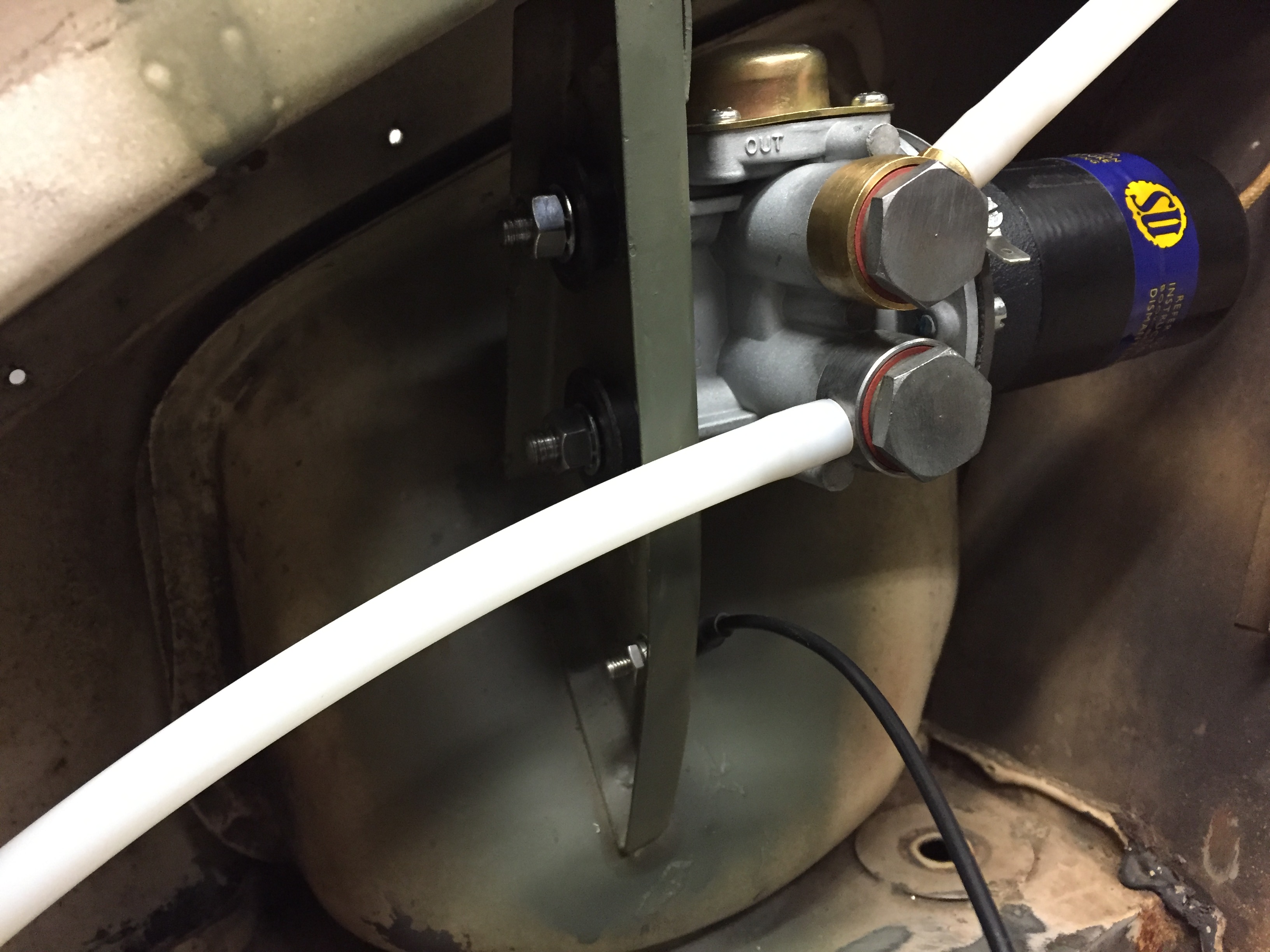
I cut the new nylon hoses, sourced from SNG Barratt, to length using the originals as patterns, and pressed them onto their pump fittings. I then installed the pump by inserting the pump mounting studs through special large washers (to evenly compress the rubber grommets) and then fastened in place with lock washers and nuts.

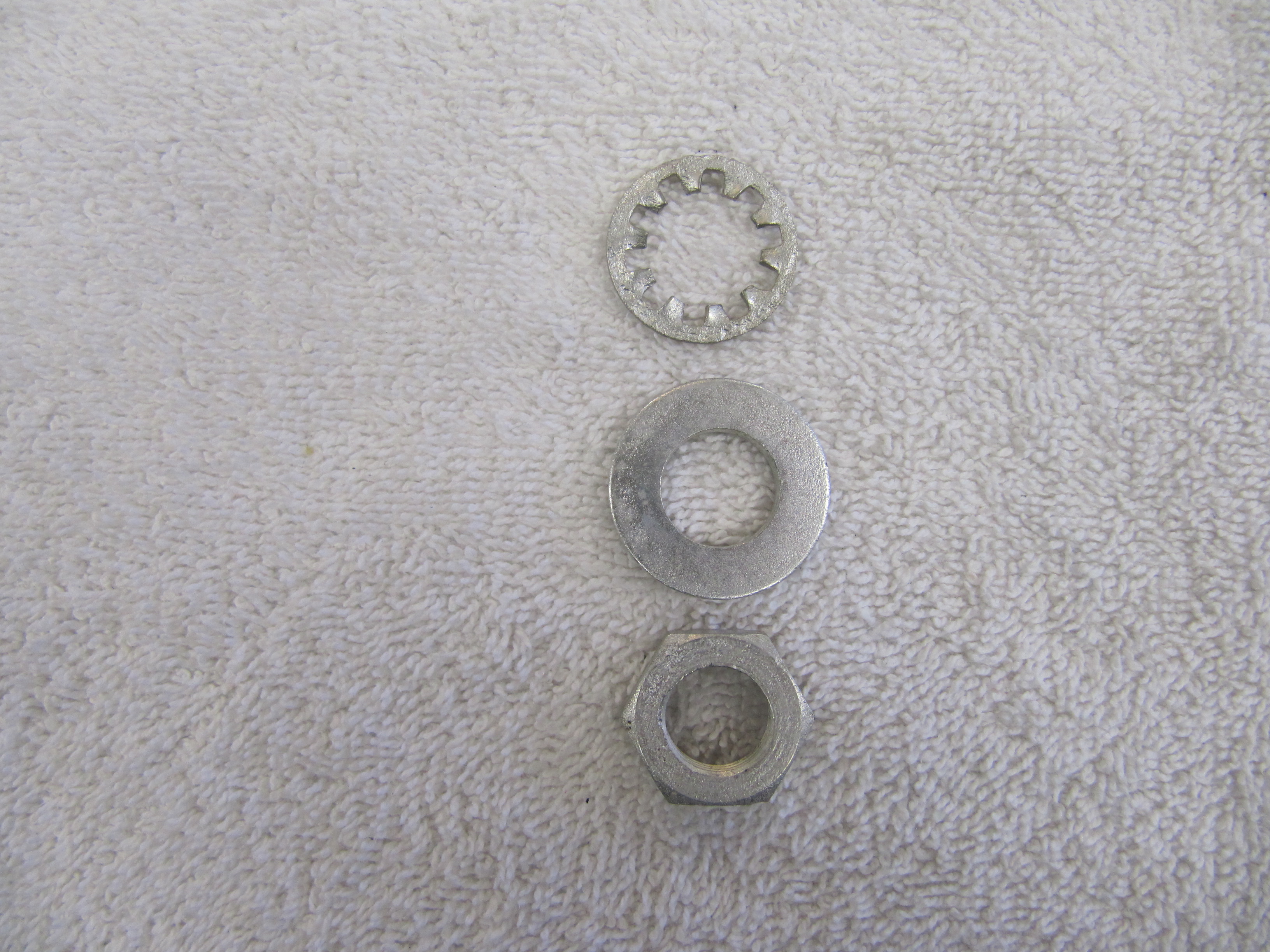
Fuel Pump Mounting Studs, Special Washers and nuts

Fuel Pump Mounting Studs, Special Washers and nuts

Installed Fuel Pump with Nylon Hoses

Installed Fuel Pump with Nylon Hoses

Petrol Hoses

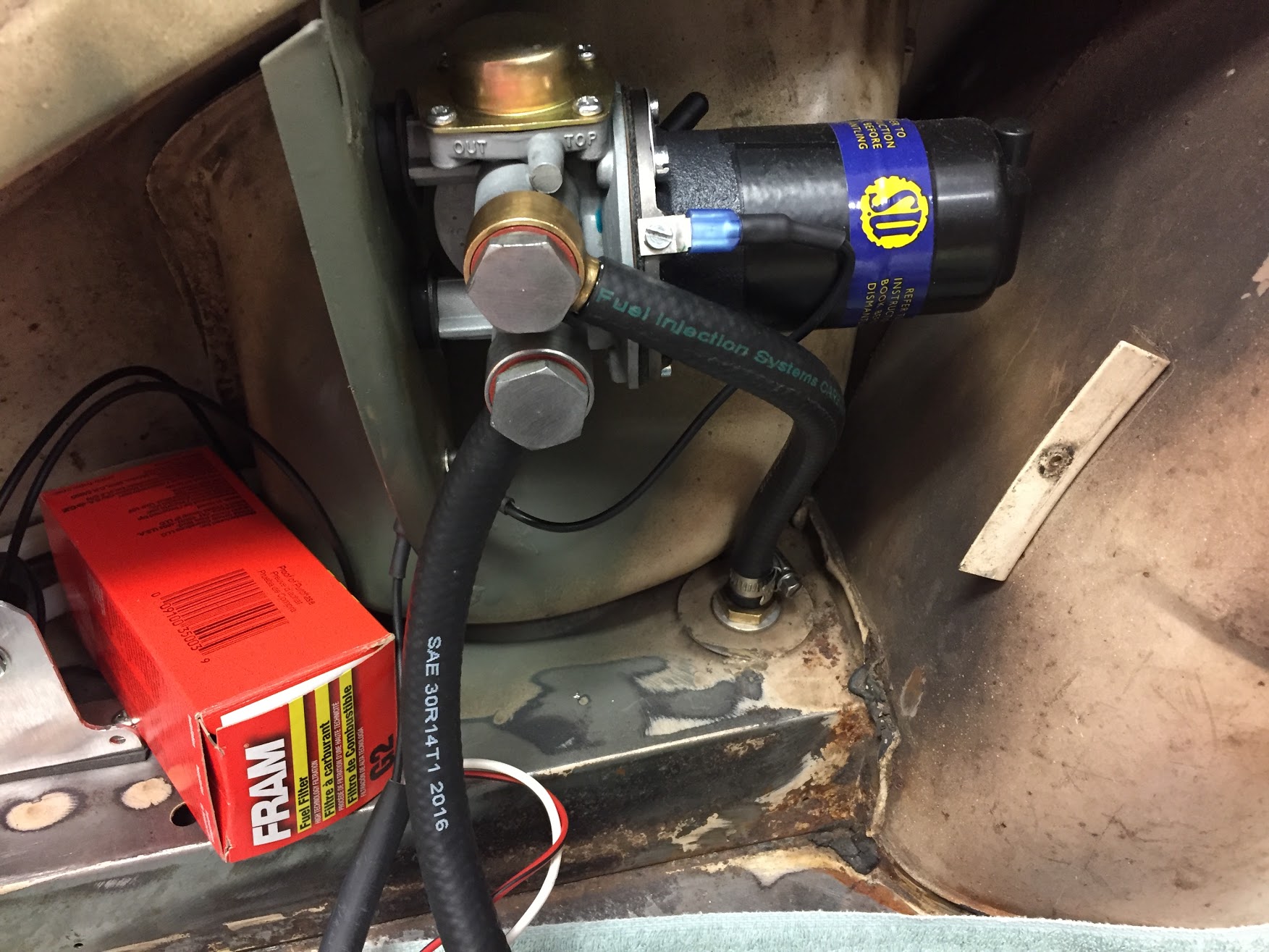
New petrol hoses were purchased for installation. I had purchased the hard nylon tubing from SNG Barrett as shown in the image above, but have since decided to use rubber fuel hose. The rubber hose is easier to work with. I did not want to use the fuel tank for the fuel source for  a test start-up of the engine, so I plumbed the fuel pump, including the relocated fuel filter, and will use a five gallon plastic fuel can sitting in the spare tire well.

Fuel Pump Hose Fittings 5/16″ Rubber Fuel Hose

Fuel Hose with Filter to Temporary Fuel Source


The petrol hose fittings from the petrol pump were cleaned and clear cad plated for re-use.

Fasteners for Petrol Pump Hose

Fasteners for Petrol Pump Hose

The image below shows these fasteners securing the fuel hard line that travels to the front of the car from the fuel pump. The image was taken from the floor, looking up to the underside of the boot.

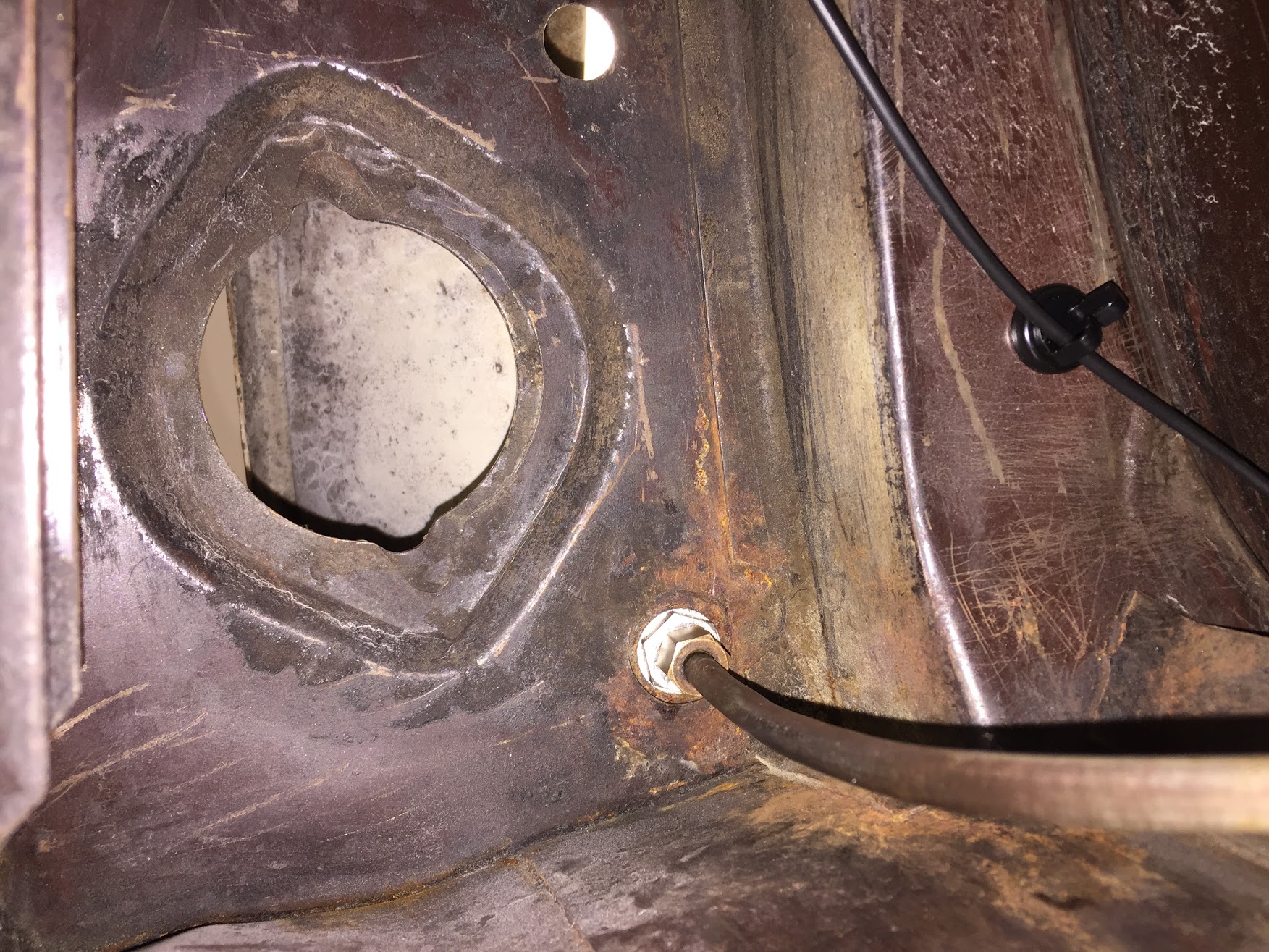
Fuel Connection From Pump to Pipe to Engine Bay

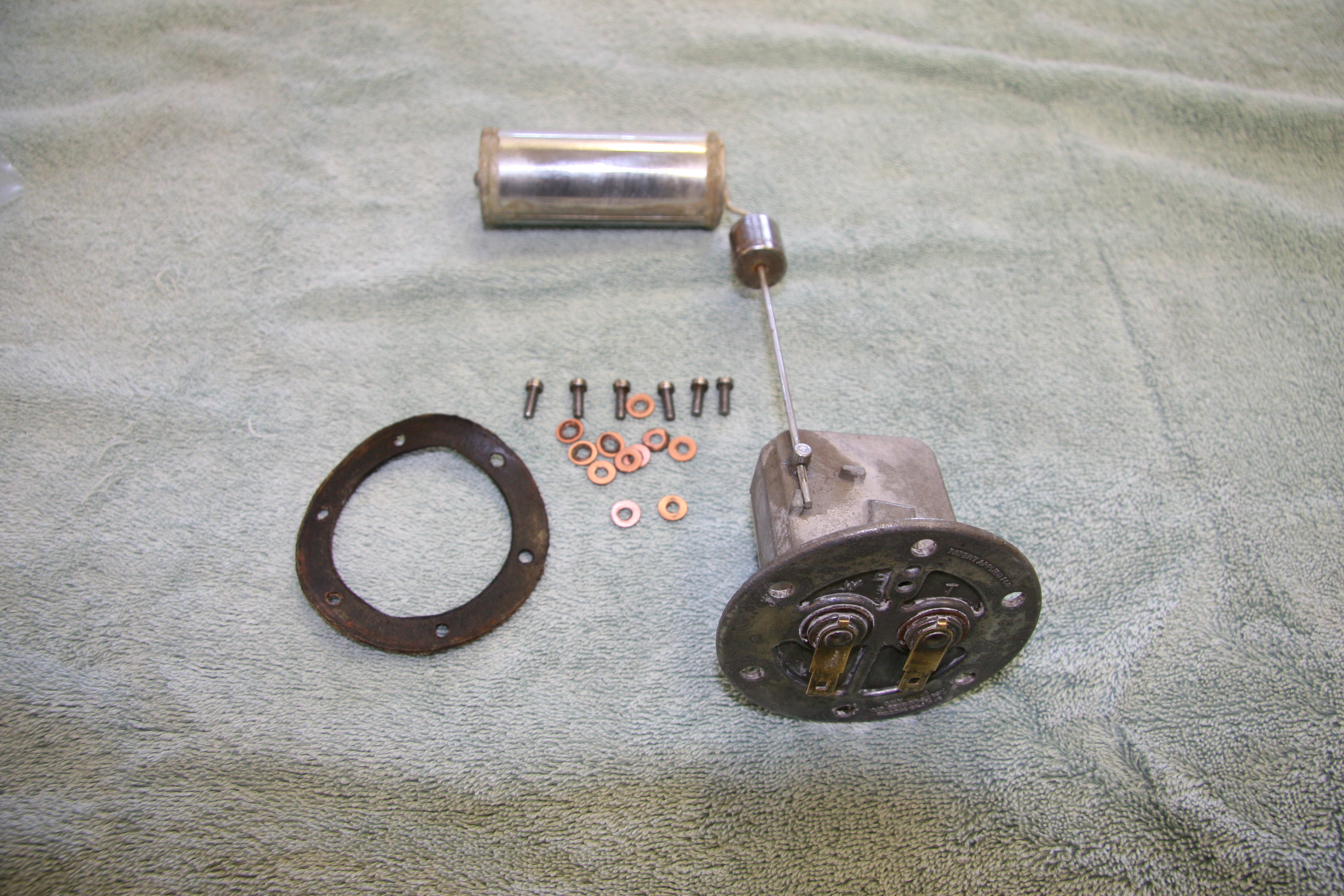
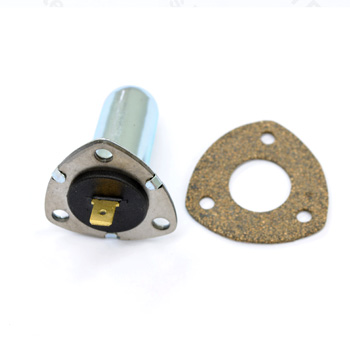
Petrol Tank Element Unit

The unit is secured to the tank with six set screws and 12 copper washers and a cork seal. The unit is positioned in the tank so that the float is toward the front of the car. I did check the fuel gauge with my multimeter and found it to be functioning properly. The swing motion of the Petrol tank Element Unit float arm worked just fine and the interior of the units seemed to be clean and without damage so I just cleaned up the exterior of the mechanism and got it ready to reinstall when the time comes. I ordered a new seal.

Petrol Tank Element Unit, Seal and Fasteners

Petrol Tank Element Unit, Seal and Fasteners

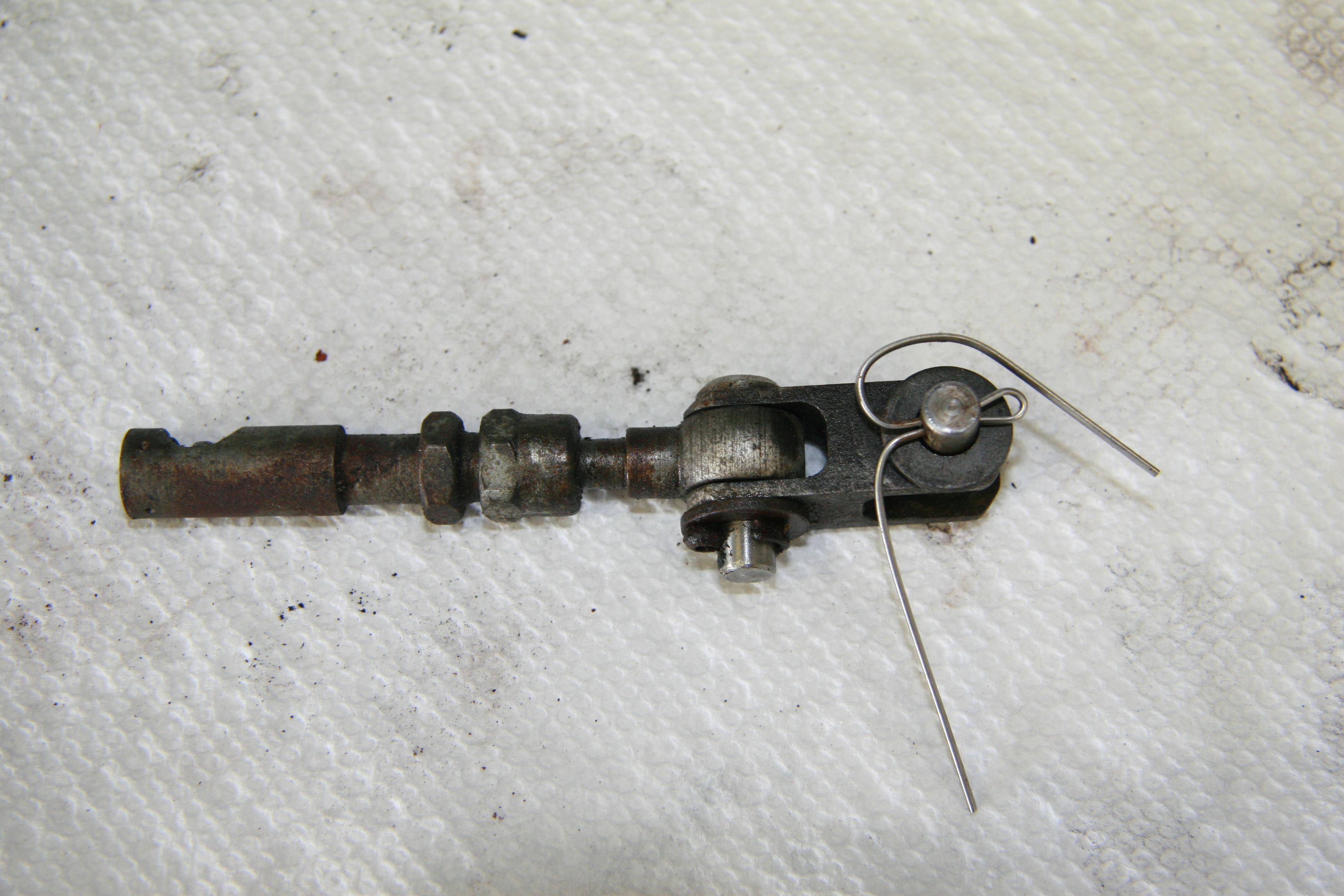
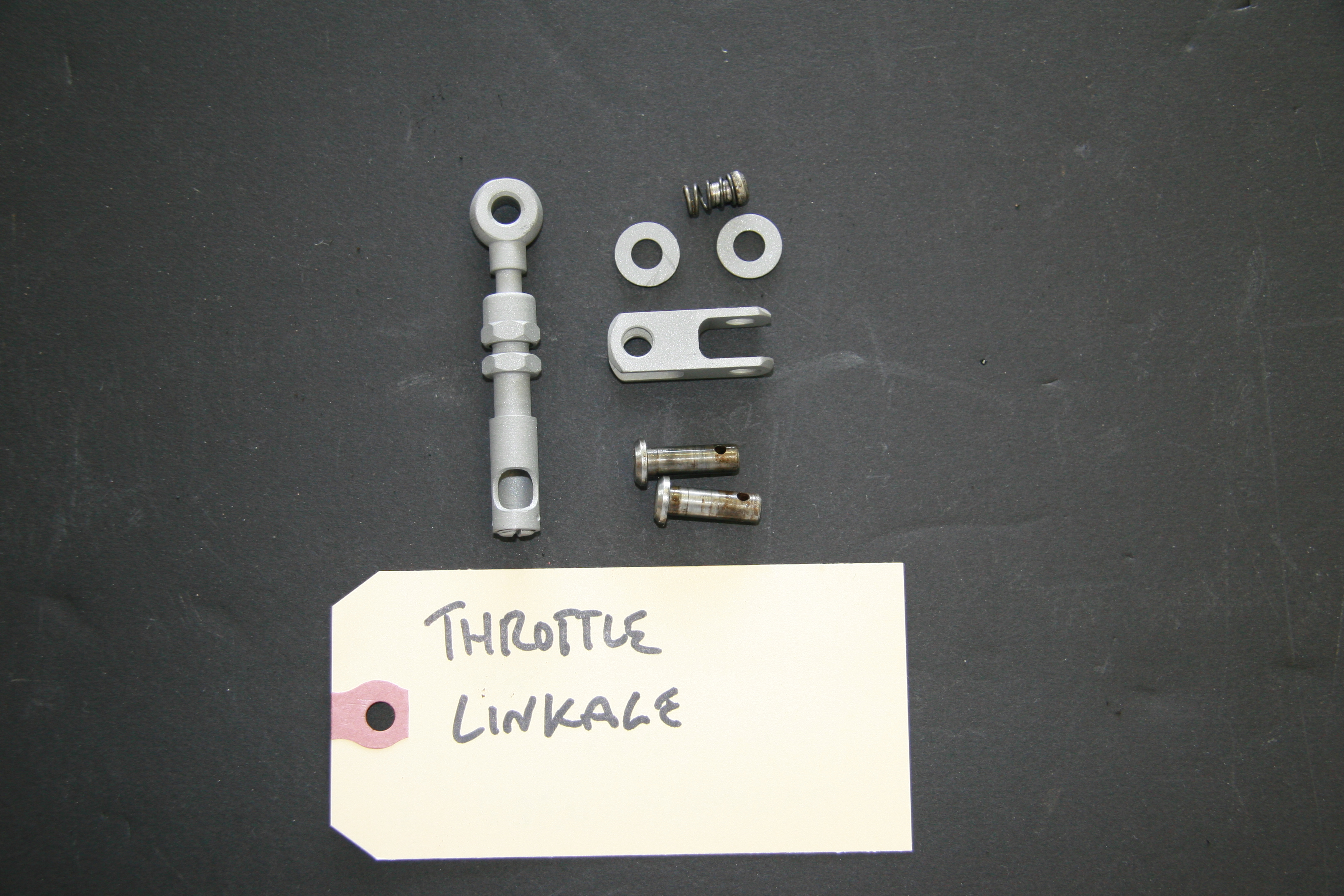
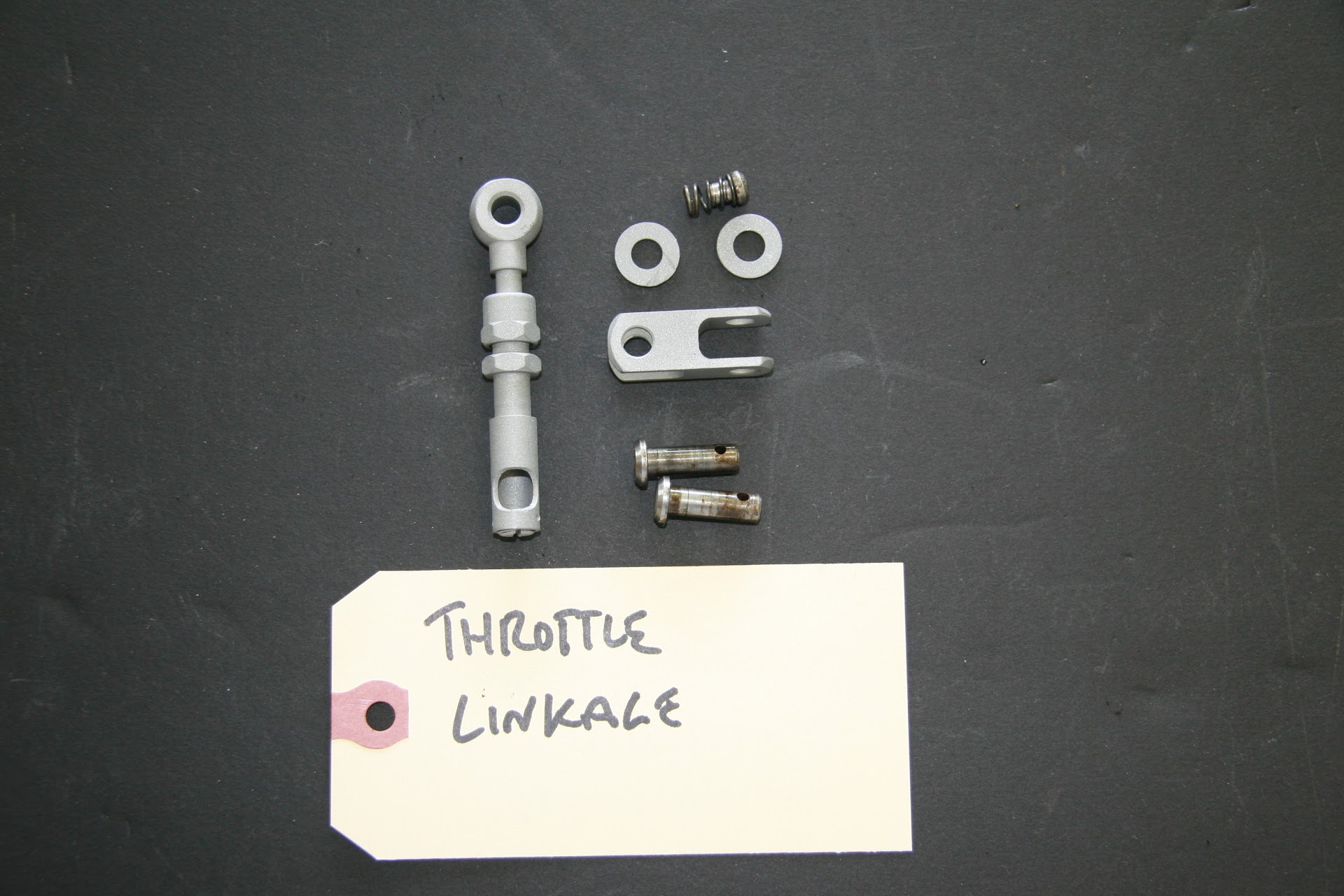
Throttle Link Rod Assembly on Trunnion

I just media blasted this throttle controls component to zinc plate for reuse.

Throttle Link Rod Assembly on Trunnion

Throttle Link Rod Assembly on Trunnion

Throttle Link Rod Assembly on Trunnion

Throttle Link Rod Assembly on Trunnion

SU HD6 Carburetors

I am using the original HD6s used on my 3.8 motor. The carbs and all of the hardware were cleaned and inspected by Joe Curto and rebuilt by Mike Gassman. Mike tuned for the run-in, but I will re-tune after the engine is in the car and operating with load. These are tuning instructions located on the Moss Motors website:

SU Carb Tuning

Carburetors Fuel Feed Pipe

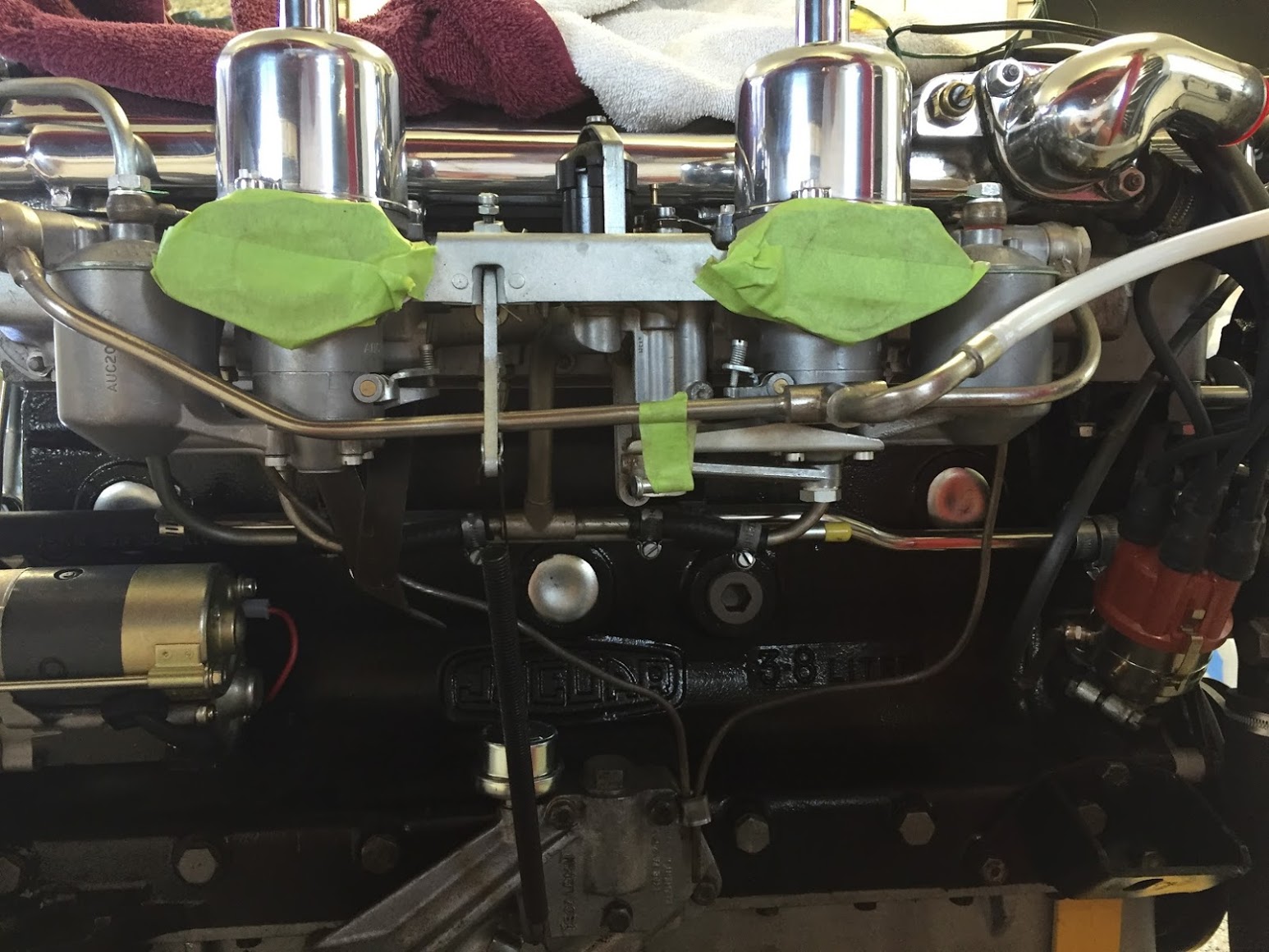
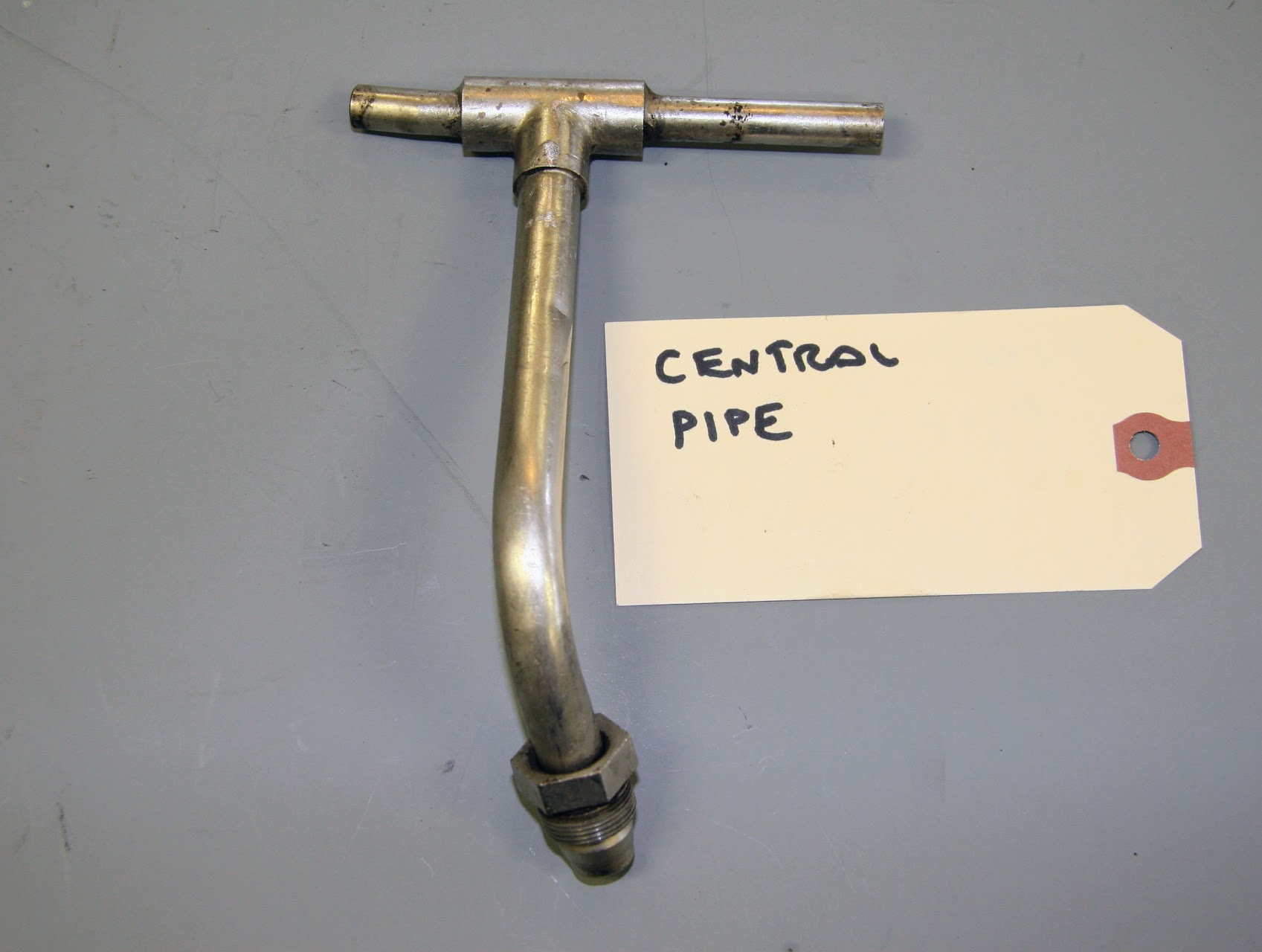
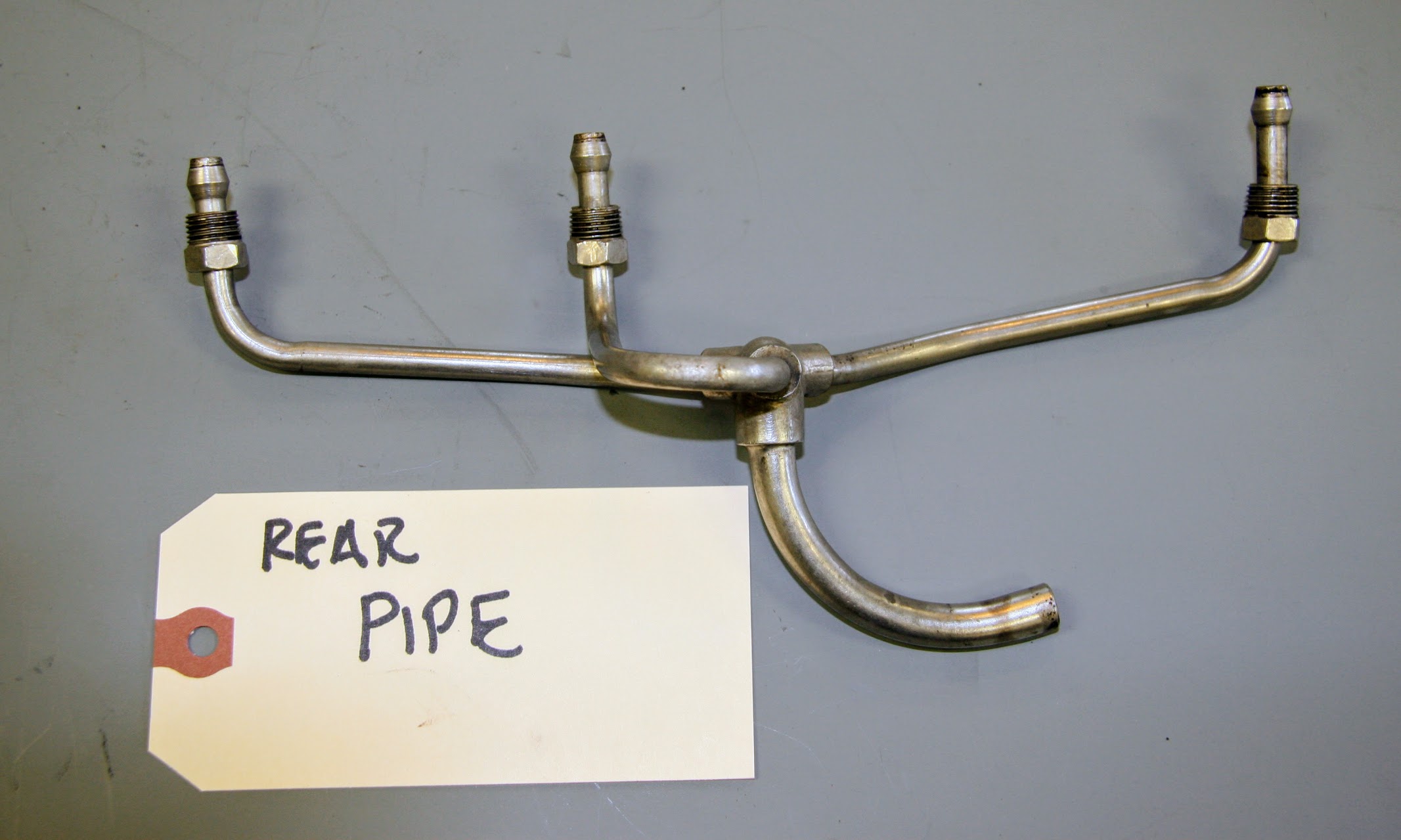
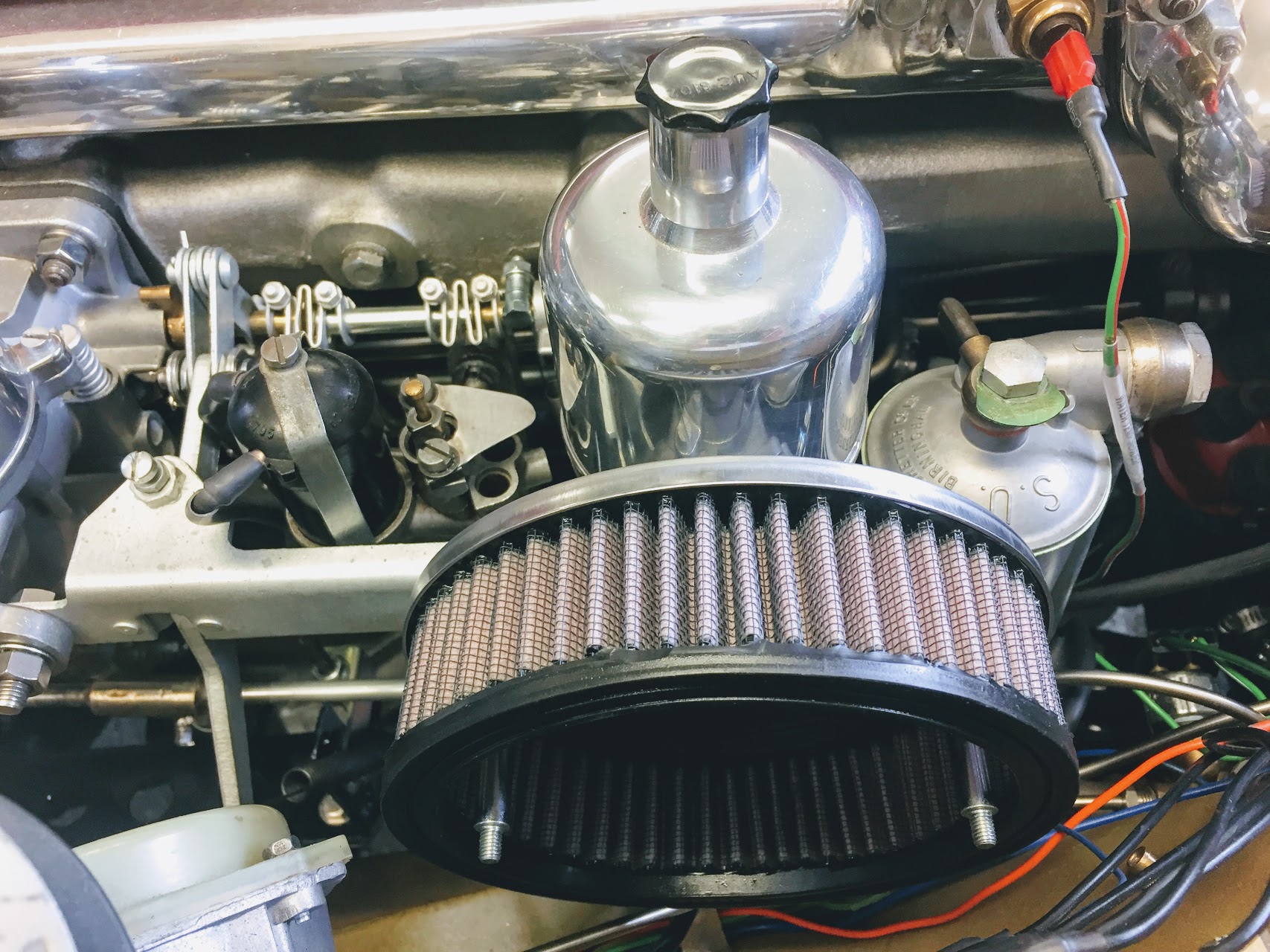
I am not using the original “pancake” air cleaner designed for the 3.8 MK2. I just cannot cover up the beautiful twin cam engine with a big ugly air cleaner, so I will be using small air cleaners located at each carb. This does create a few logistics problems. For starters, the original carb fuel feed pipe junction fitting and flexible line to the fuel filter on the RH engine bay valance conflict with the front air cleaner. This image illustrates the problem with fitting individual air cleaner using the original fuel feed pipe.

Original Fuel Feed Pipe to Carbs

Original Fuel Feed Pipe to Carbs

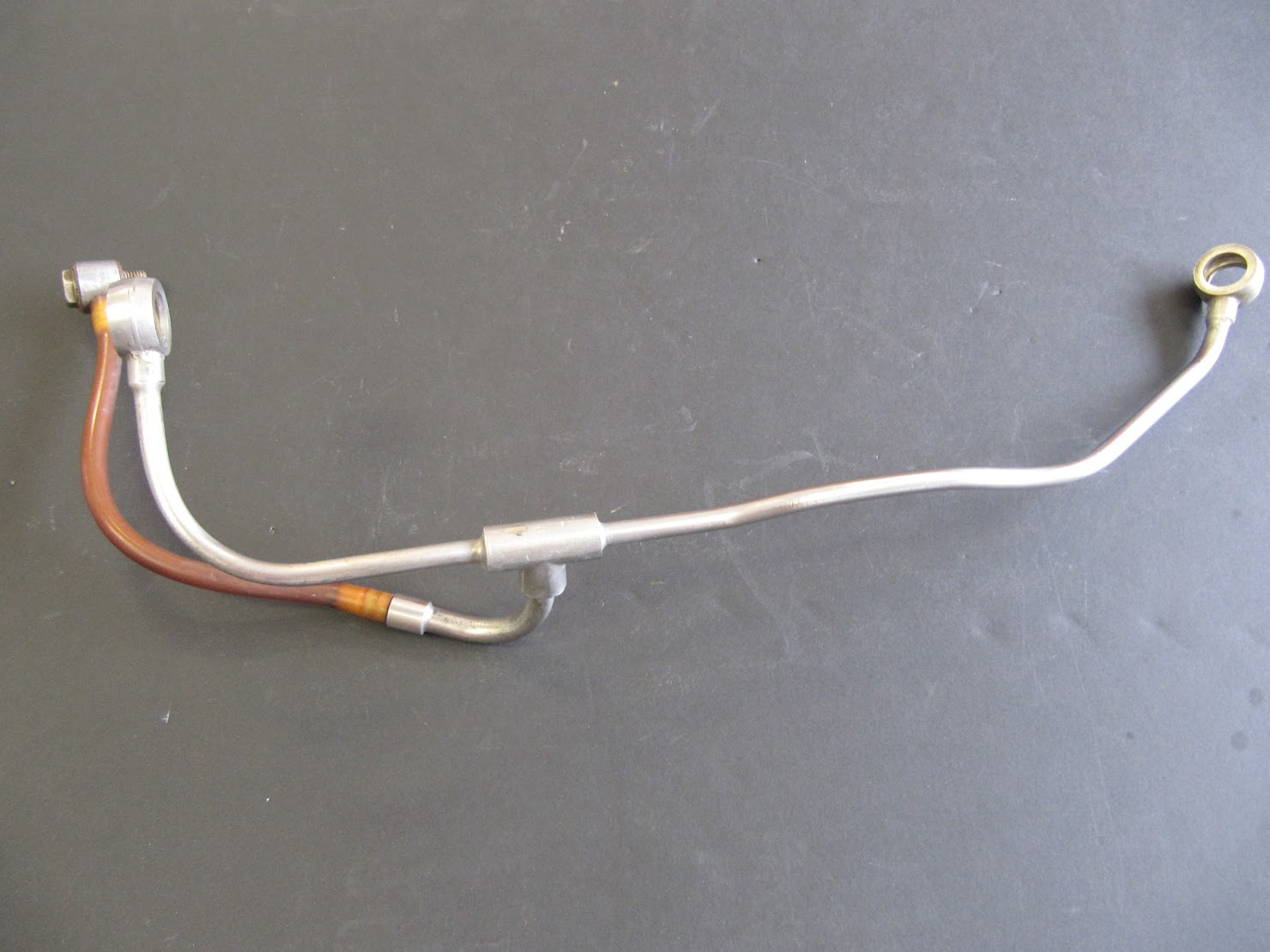
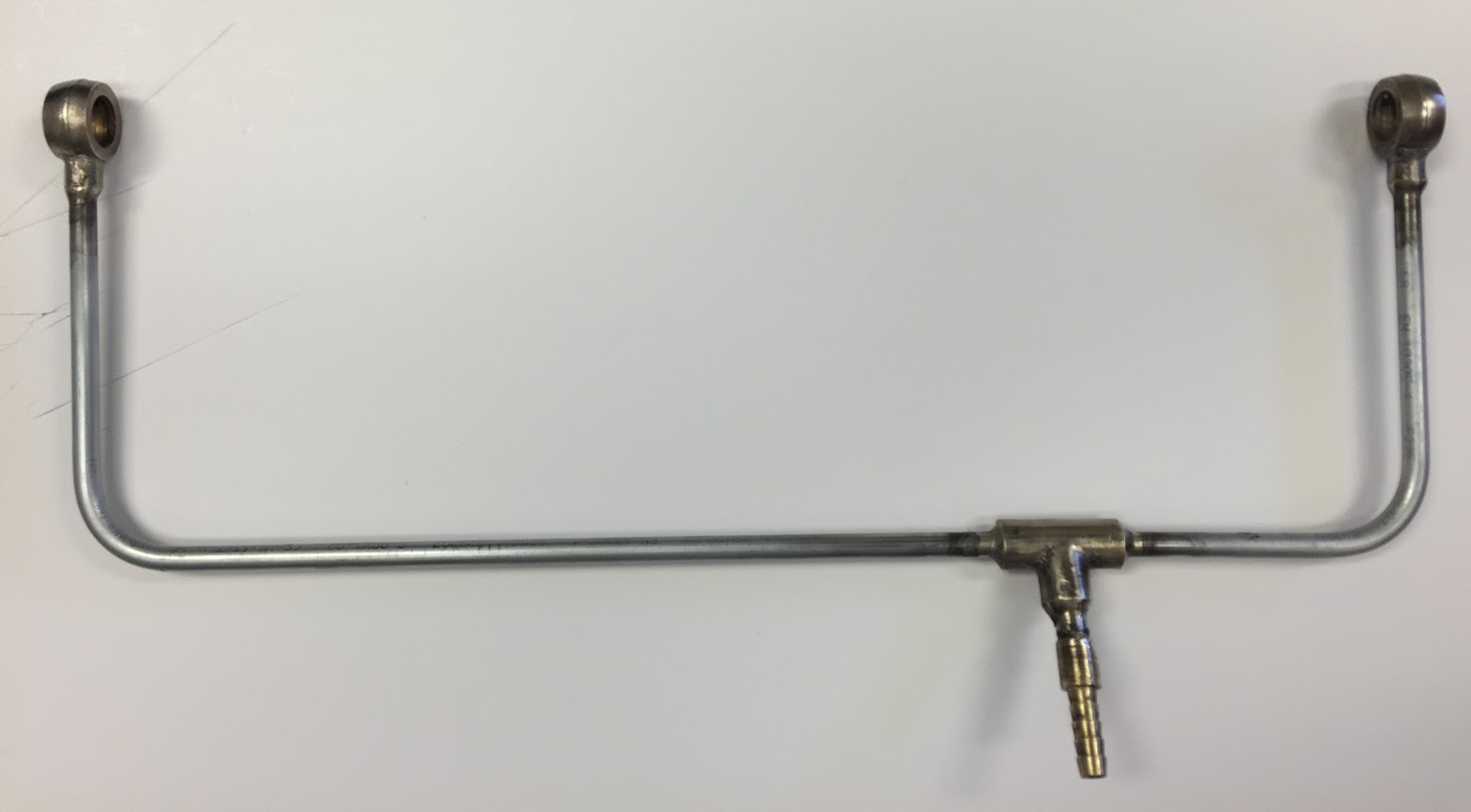
I had a new fuel feed pipe made using the original fittings with a relocated junction to avoid the problem.

Original Carb Fuel Feed Pipe & Fittings

Original Carb Fuel Feed Pipe & Fittings

Modified Carb Fuel Feed Pipe

Modified Carb Fuel Feed Pipe


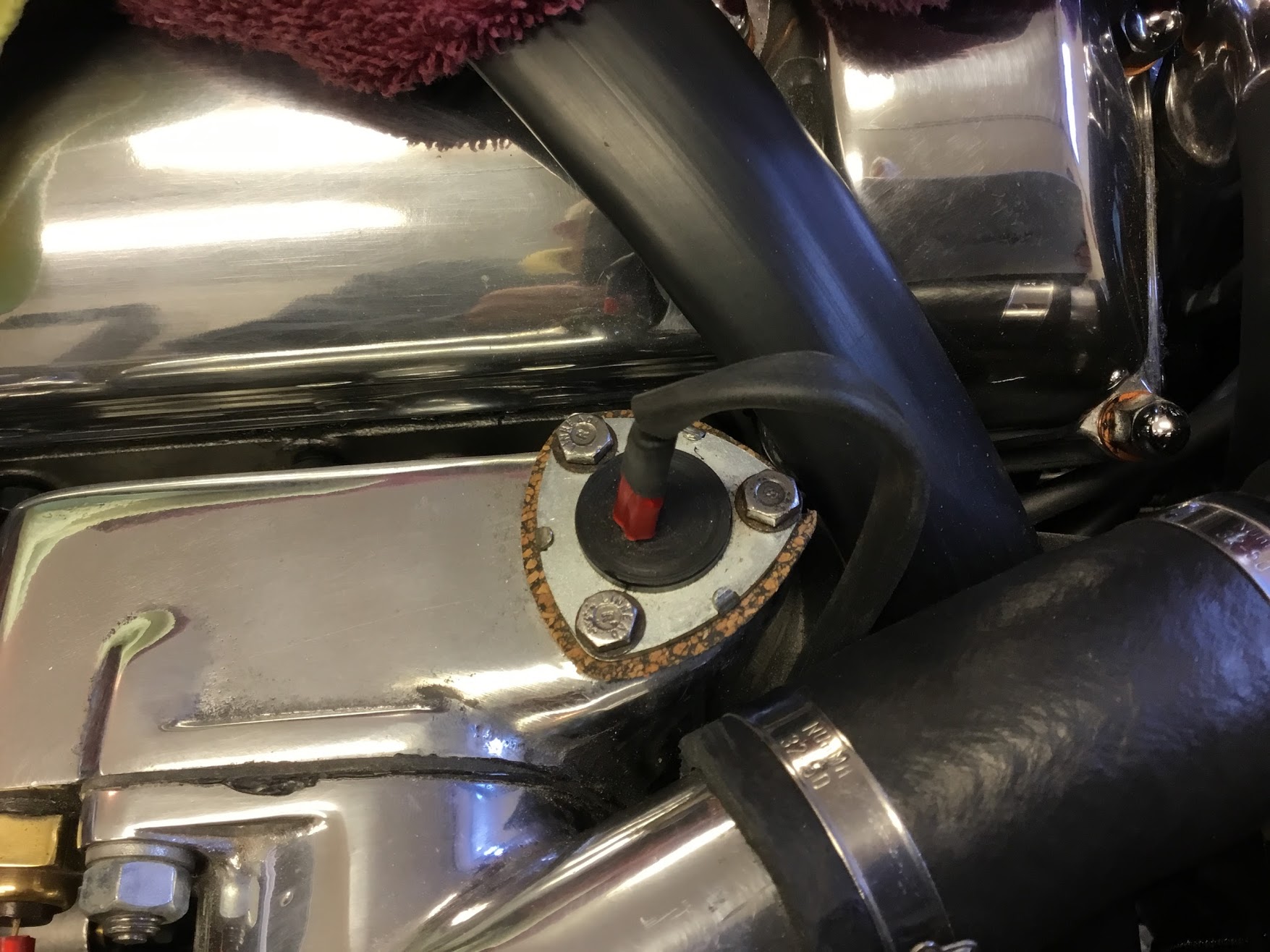
The Auxiliary Starting Carburetor – Otter Switch

The auxiliary carburetor is an enrichment device to make starting the car easier. The unit is actuated by a thermostatic switch (Otter Switch). These switches are notorious for failure; however, Mike Eck, best known for his Jaguar clock repair, upgrades the original Otter Switch by by putting a sealed thermostatic module inside it, so it looks the same as it did originally but works reliably.  At the time I had his improvement fitted he charged $45 for the modification.

Otter Switch

Otter Switch

The electrical connection from the otter switch to the solenoid of the enrichment carb is achieved with a dark green 18 AWG wire in a rubber sleeve. 

Otter Switch Electrical Connection to Auxiliary Starting Carb

The thermostatically controlled enrichment caburetter is actuated by a solenoid. The additional electrical connection for the solenoid comes from a four way snap connector on the RH engine bay valance. The connector joins the 18 AWG light green/white from the enrichment carb solenoid with the wire emanating from fuse position #22 to the brake switch. In other words, the starting carb gets its power from the powered side of the brake switch located on the RH engine bay valance.


Trial Installation Update

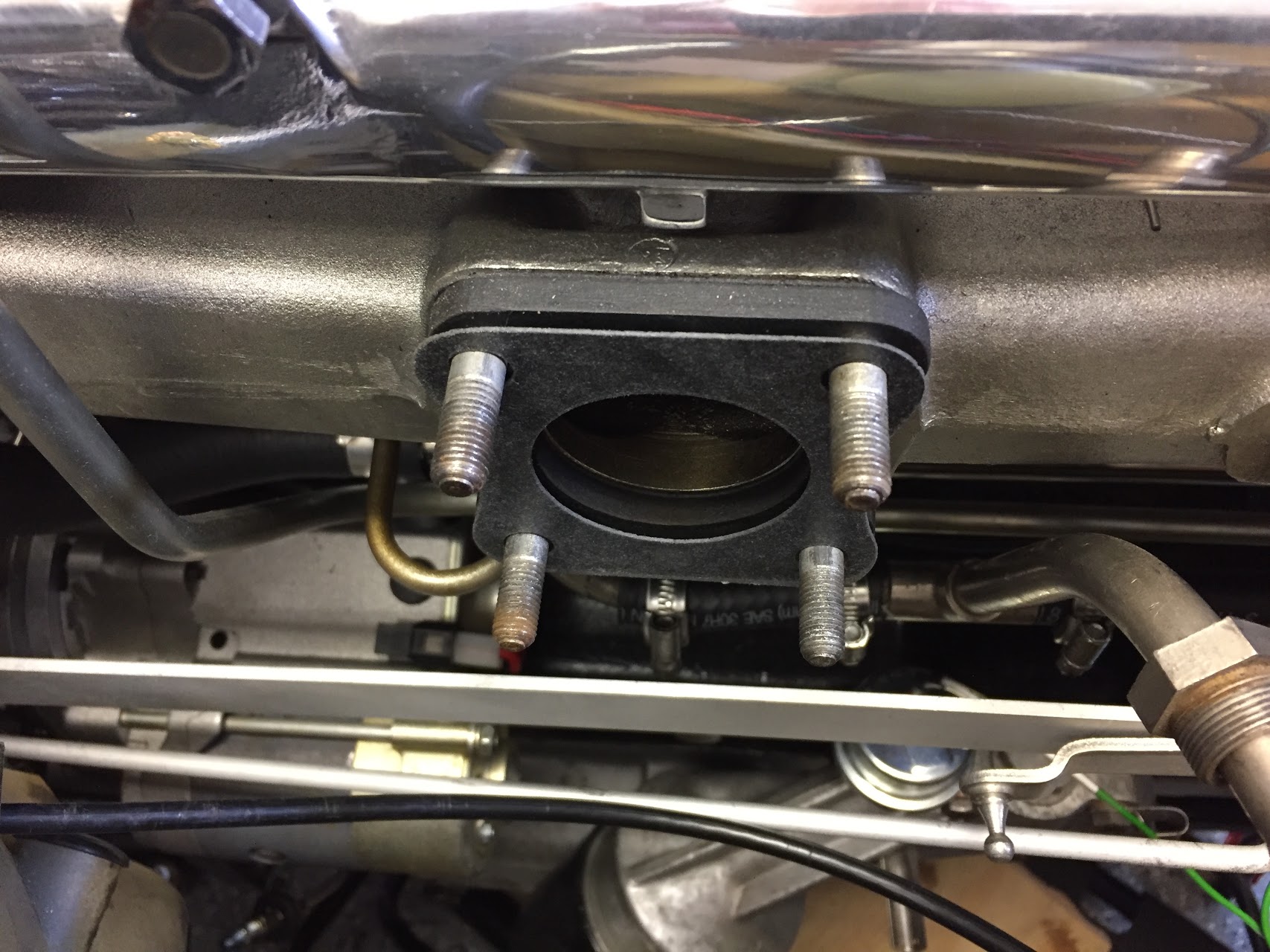
Carburetor Mounting

I installed the carbs as an assembly. I loosened the couplings between the connecting rod and the throttle spindles, fully closed each butterfly and then secured the couplings. In my case because I am not using the original air cleaner, I had to remove the dowel bolts that connects the throttle stop bracket between the front and rear carbs. I replaced the dowel bolts with 5/16″-24 x 1″ hex head bolts and nuts. After the carbs were mounted to the inlet manifold I removed the two nuts and the 1″ hex head bolt was then used for the installation of the air cleaner.

Before mounting the carb assembly on the inlet manifold I first installed one gasket (c.7221), then an insulator block (C.8486) and then another gasket (C.7221) on the four 5/16″-24 inlet manifold studs for each carburetor.

Gaskets and Insulator Blocks between Carb Bodies and Inlet Manifold

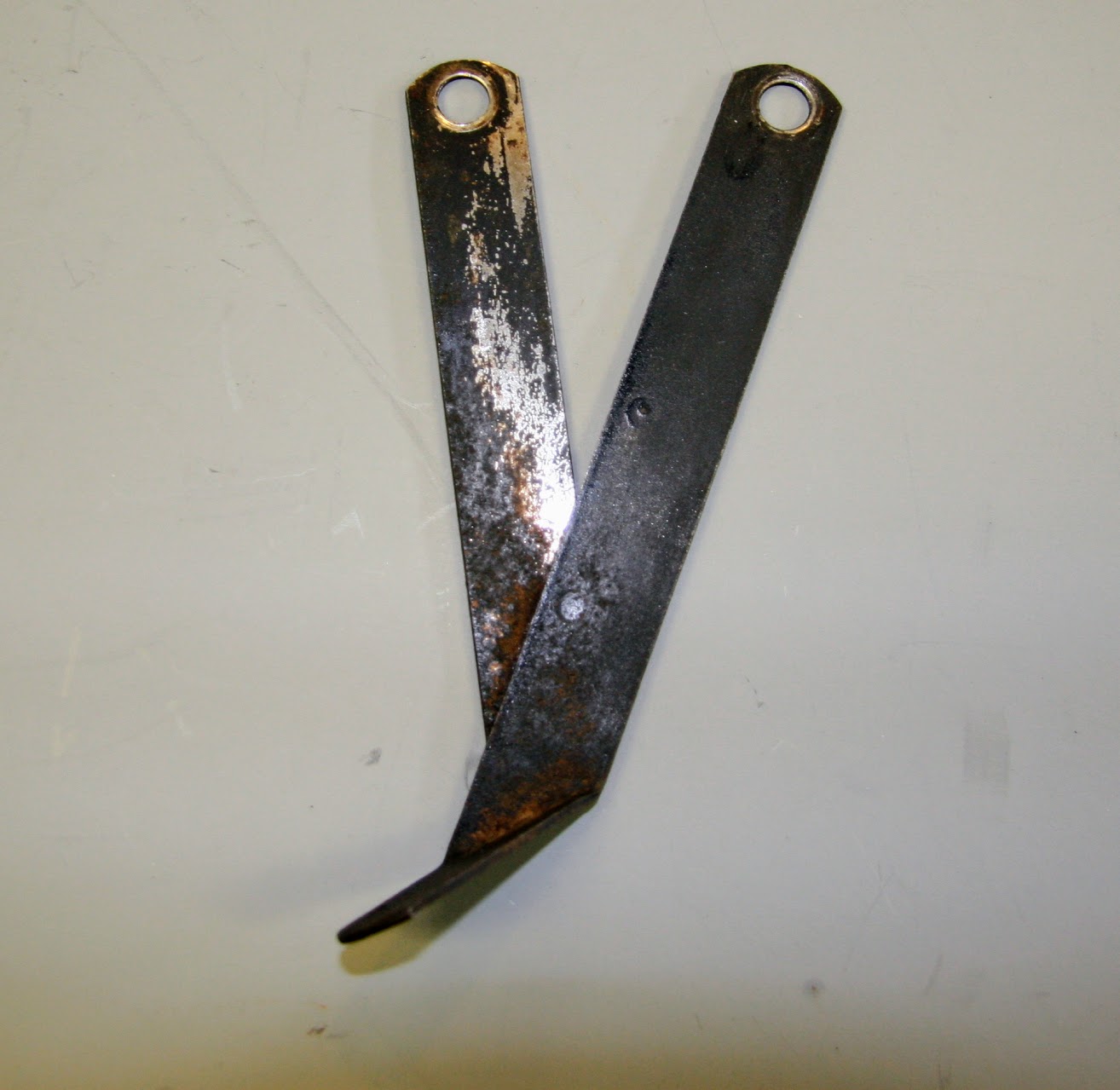
I then mounted the assembly and securely tightened split washers and nuts on each of the eight studs. Before tightening the two nuts/washers on the lower studs of the front carburetor, I reinstalled the bracket assembly for the throttle return spring anchorage. I cleaned and painted the bracket but this is what it looked like prior to “clean-up.”

Bracket Assembly on Front Carburetor

Fuel Delivery

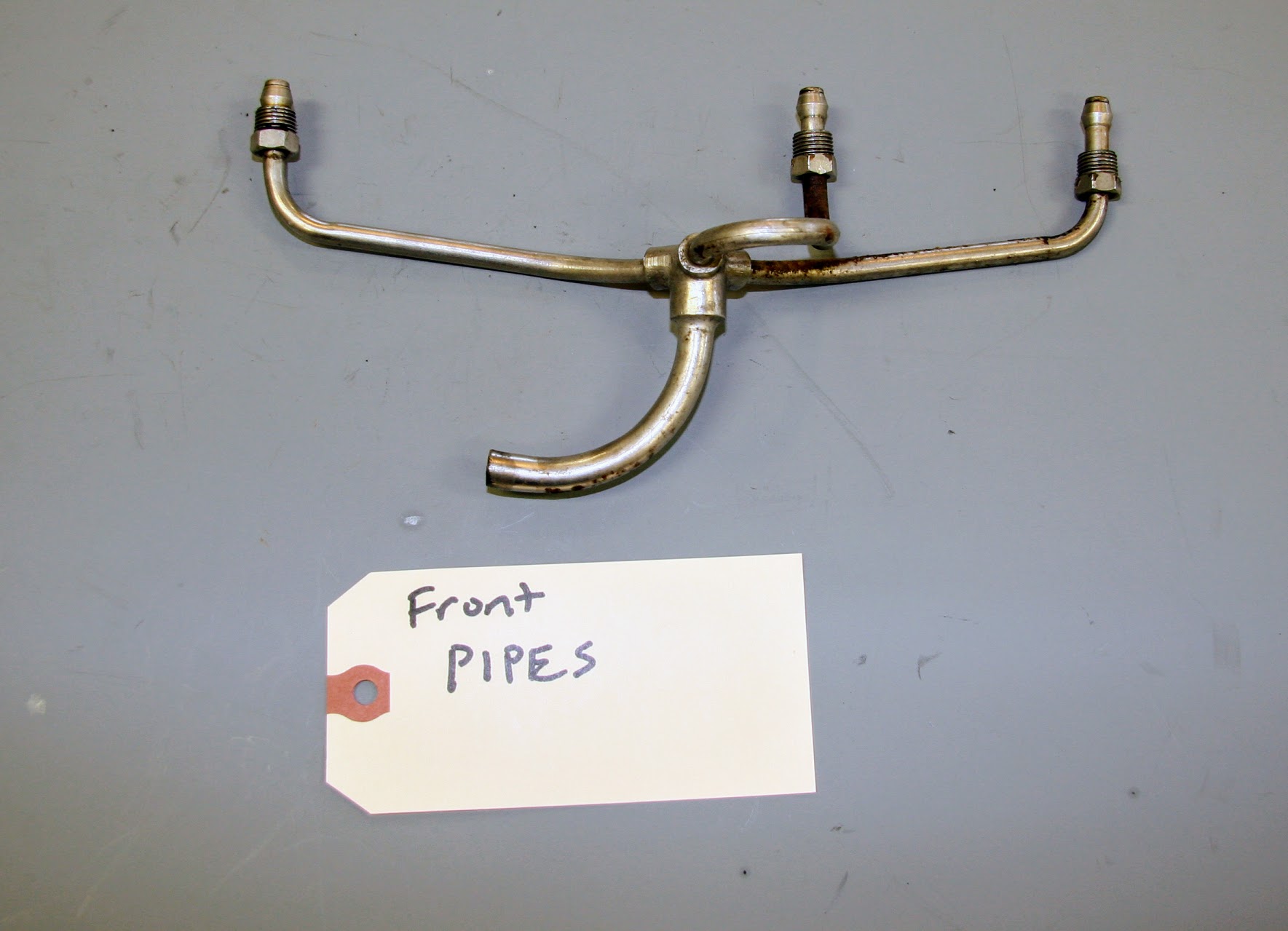
After the carburetor assembly is mounted on the inlet manifold, the starting pipe assembly is connected with two short pieces of neoprene fuel hose requiring four Jubilee Hose Clips. I don’t have a good photo of the staring pipe full assembly, but these are the three components that screw into the underside of the inlet manifold.

Front Manifold Starting Pipe Assembly

Center Manifold Starting Pipe Assembly

Rear Manifold Starting Pipe Assembly

The neoprene hose connections are not simply made and must be done from below the car. These can be seen in the photo below, although they are somewhat difficult to ascertain. The photo was taken from below the car.

Manifold Starting Pipe Assembly Fuel Hose Connections

I have decided to move the fuel filter from the engine bay. 

I am sure that the original design is perfectly fine, but I was never fond of Jaguar’s placement of the fuel filter on the RH engine bay valance. The filter has a glass bowl that is functional permitting easy viewing of fuel flow and any sediment caught by the filter, but I am leary of fuel in glass in an engine compartment. With no insulation, the fuel is also subject to “boiling” after the engine has been run and then parked due to residual engine heat. 

Eliminating the original AC fuel filter from the engine bay also gives me some much needed room under the bonnet. With my modifications including air conditioning, power steering, and carb mounted air cleaners among other items, space in the engine bay is at a premium.

Jaguar located the petrol pump in the LH side of the boot and I decided to do the same with the fuel filter. I will install a Fram G-2 opaque plastic filter  between the fuel tank and the fuel pump.

Fram G-2 Fuel Filter

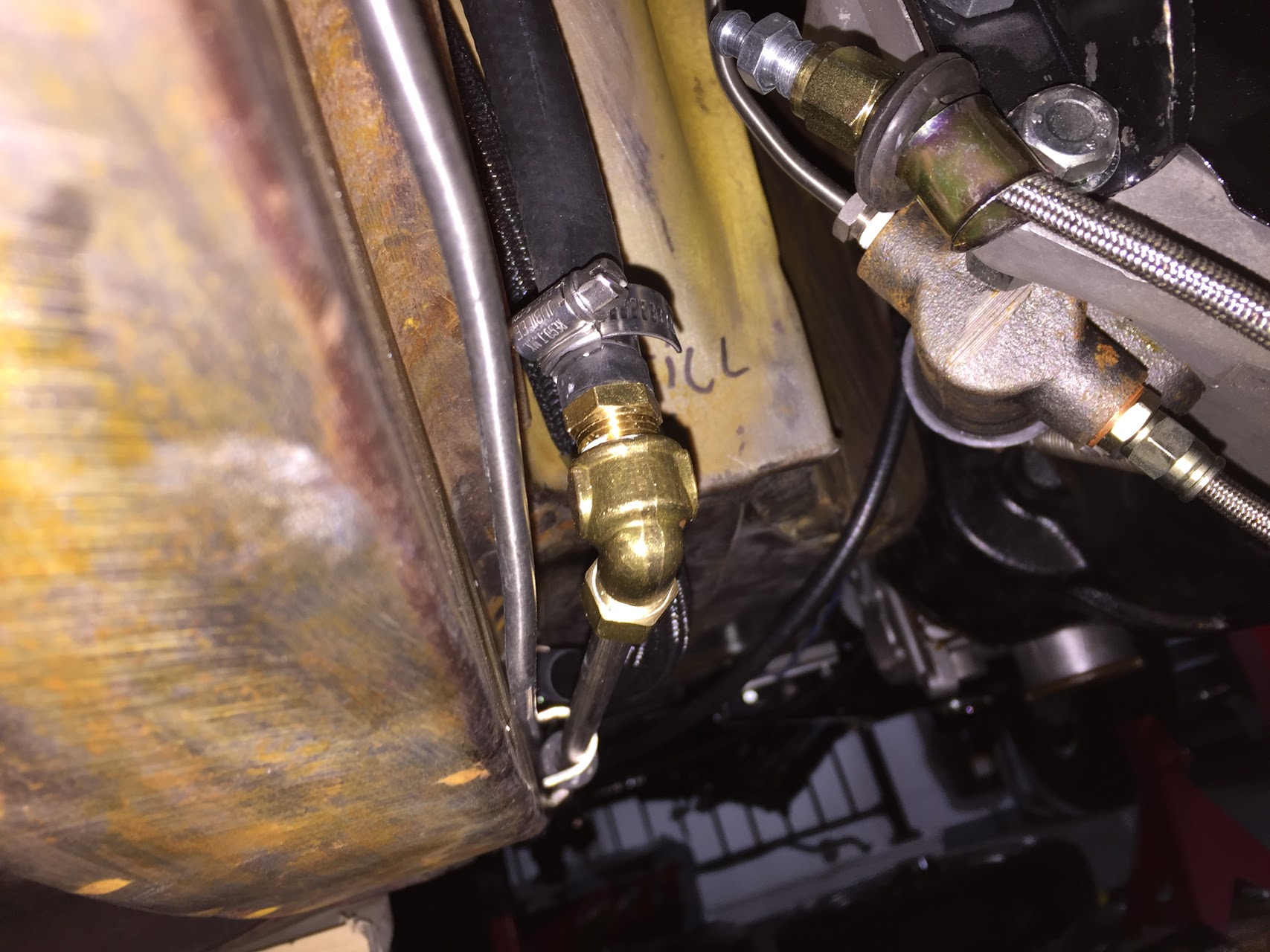
I cut the long 5/16″ steel fuel line that travels along the RH frame rail from the rear of the car to the front slightly above, but near the oil filter. I installed a ninety degree elbow female compression brass fitting to the end of the fuel line. Holyoke P/N 70-54, 5/16 compression to 1/4 NPT. The elbow is attached to a male 1/4″ NPT to 5/16″ barb fitting.  I then ran a 5/16″ ethanol resistant rubber fuel hose from the barbed fitting to the barbed fitting on the carburetor fuel delivery pipe. Used two 11-16mm jubilee hose clamps.

Brass Connection Hardware from Fuel Pipe to Rubber Fuel Hose

Fuel line from tank is connected to the rubber fuel hose that is routed to the Caburetters

A Jubilee Hose Clip is used to tighten the hose on the barbed fitting.

The image below shows the new rubber fuel hose running from the head fuel line under the car to the carburetor fuel feed pipe.

Fuel Hose from Carb Fuel Feed Pipe to Hard Pipe from Tank

Throttle Return Springs

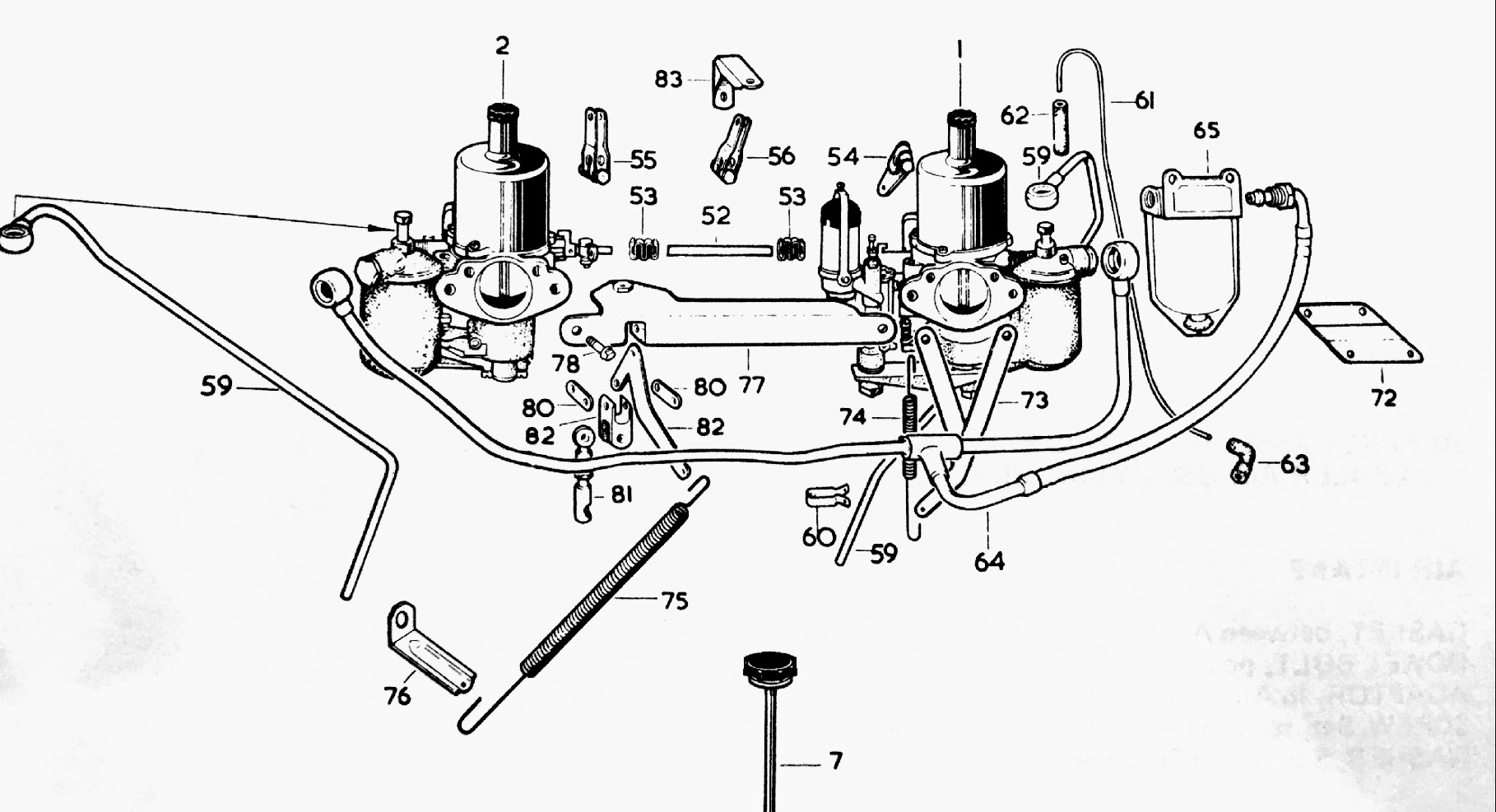
With all of the fuel delivery hose connections made, I then attached the throttle link rod assembly on trunnion – part #81 in the schematic to the bell crank lever assembly from the accelerator controls and tightened the securing screw holding the ball joint together.

Throttle Link Rod Assembly

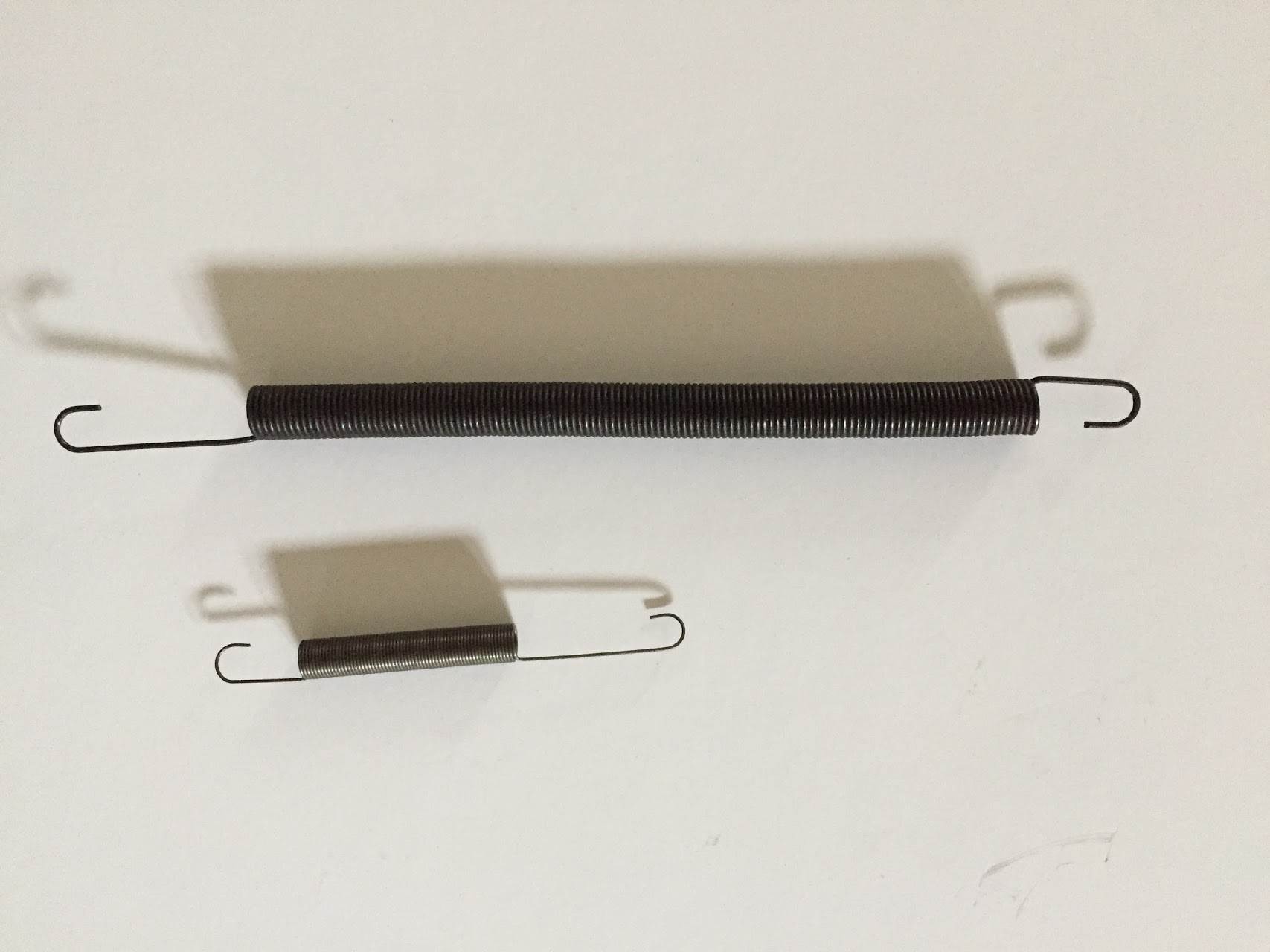
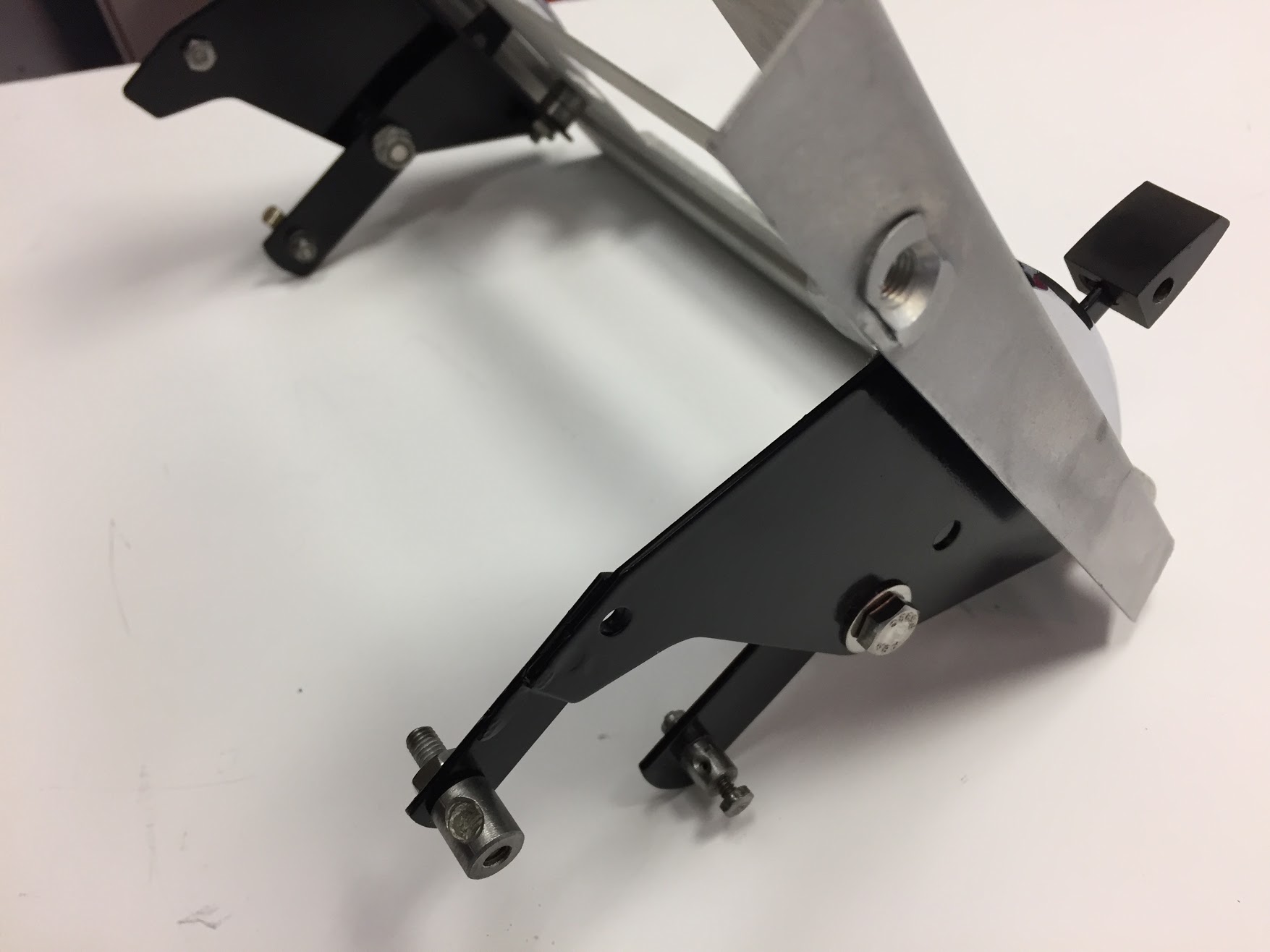
I then moved onto the throttle return springs. The shorter spring is the return spring from the lever on the front carburetor to the anchor bracket mounted below the front carburetor (photo shown above). The longer spring is the return spring from the linkage to the Bracket on the Oil Cleaner.
Throttle Return Springs

My next step was to loosen the two float chamber overflow pipes at the float bowls so that the pipes could be aligned and routed through the clip near the oil filter.
Air Cleaners

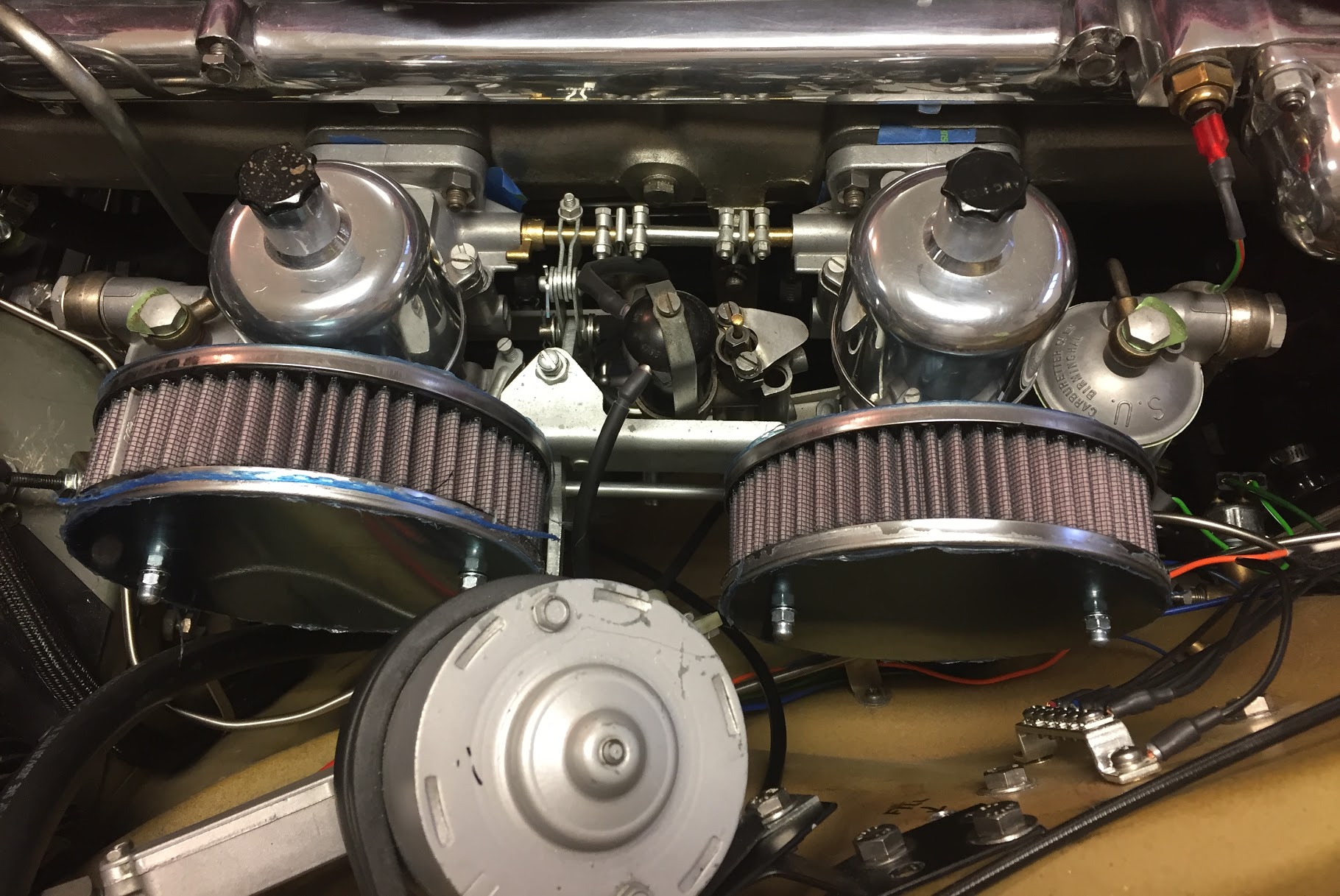
As previously mentioned, I am using carb mounted air cleaners rather than the original contraption that I am confident worked well but completely covered up the beautiful twin cam engine. After experimenting with a number of options, I settled on air cleaners sourced from Advanced Performance Technology (APT) http://www.aptfast.com. These air cleaners use K&N Filters.

Carb and Fuel Connections Schematic

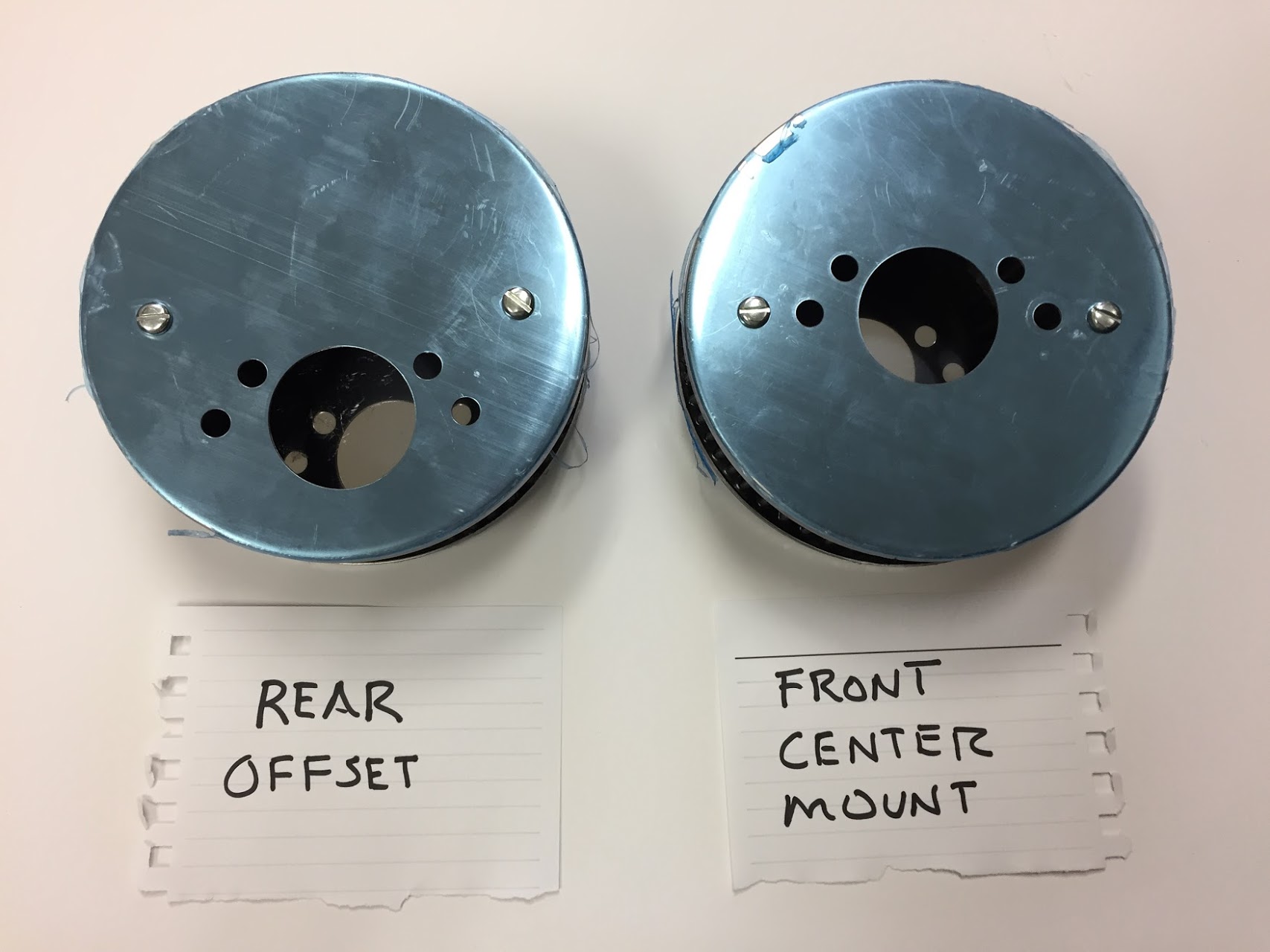
The “intermediate throttle lever from throttle link to stop bracket” – part# 82 in the diagram – on the  MK2 carb set up is offset to the rear of center. This requires a comparable offset in the air cleaner mounting to avoid the throttle lever striking the air cleaner casing as it travels its logical path.

I used filters that are 1-3/4″ tall. The rear cleaner is offset upward and is part number: SD24-318 for HD6 SUs. The front cleaner is center mounted and is part number SD4-318. The air cleaner casings are actually highly polished. The blue tint in the image below is a plastic protective coating that easily peels off.

APT K&N Air Filters

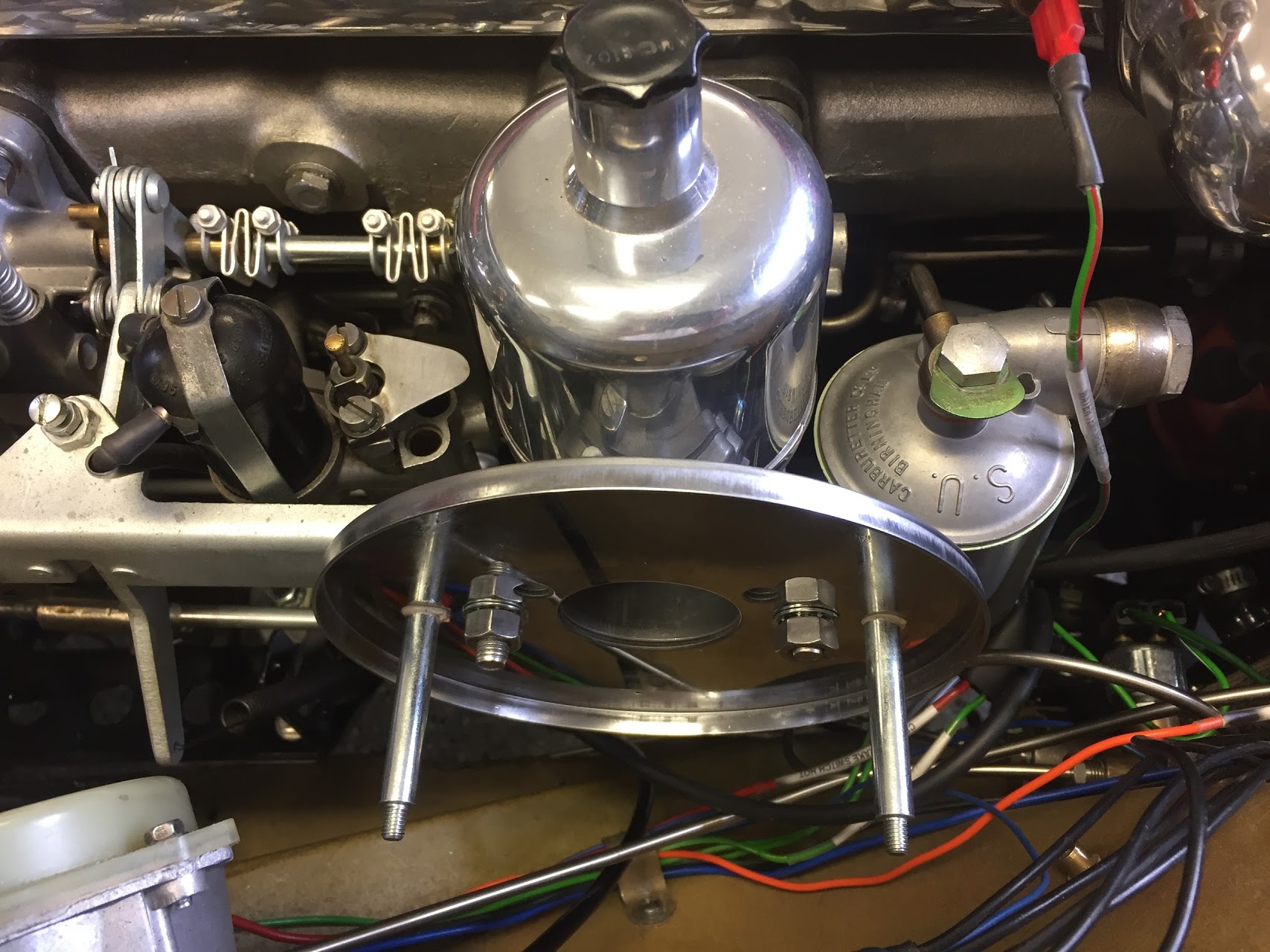
A gasket is placed over the mounting studs for the air cleaners and then the back plate of the air cleaner is installed and secured. I used a 5/16″-24 x 3/4″  and a 5/16″-24 x 1″ for each air cleaner. The longer bolt is needed where it must also travel through the throttle stop bracket.

Air Filter Rear Plate Mounted

The K&N oiled filter is then installed followed by the cover plates secured by shake proof washers and acorn nuts on the studs.

K&N Air Filter Element Installed

APT K&N Air Cleaners Temporarily Mounted

Air Cleaner Update – Cold Air Box

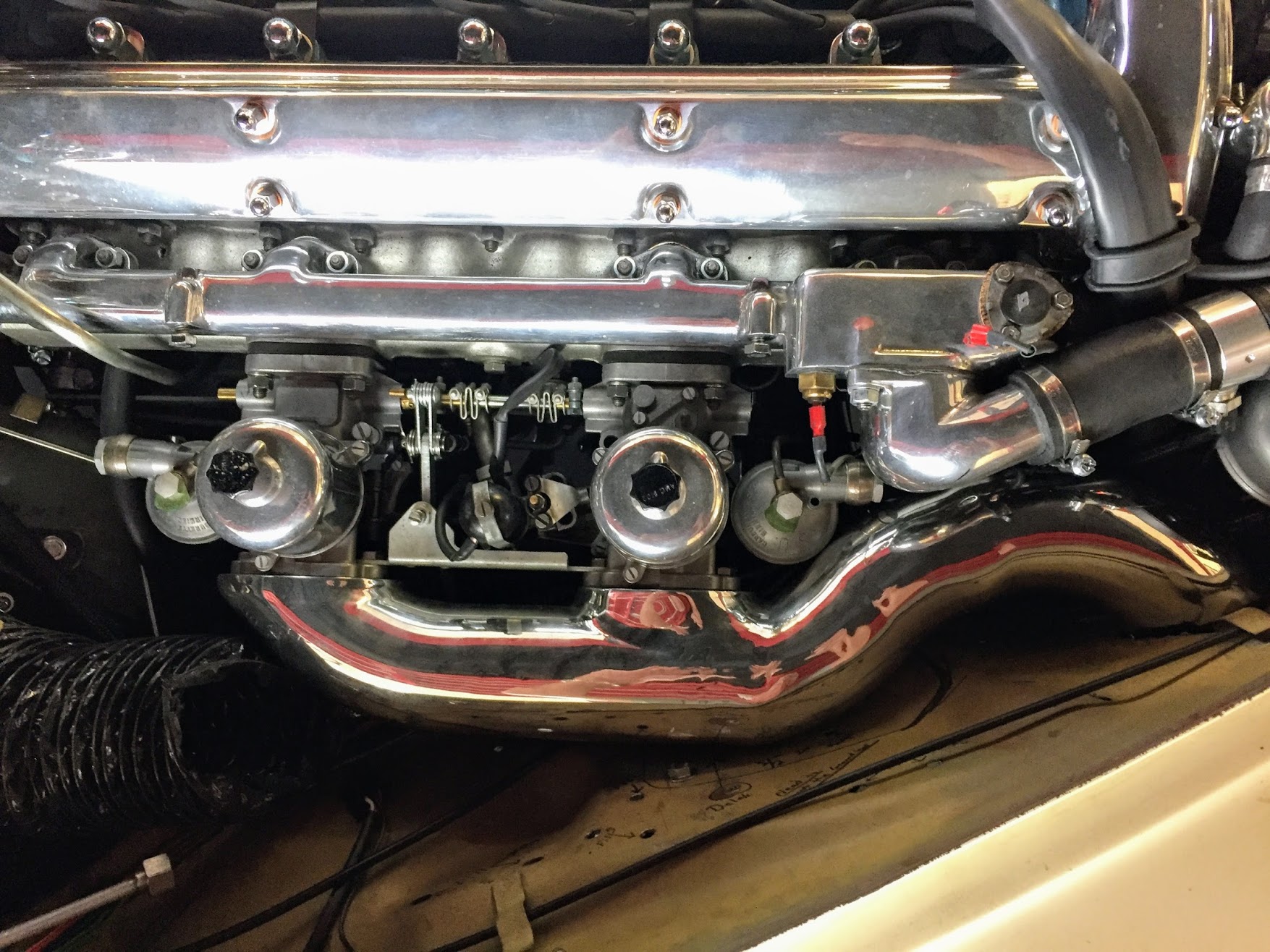
Well, after the time devoted to researching the ideal air cleaner solution and the expense of ordering the K&N offset filters, I became convinced that an air box delivering cool air to the carbs is the way to go. I recently saw several approaches to these “boxes” on some of the Jag Forums, and Mike Gassman of Gassman Automotive convinced me that the cold air delivery system would be a good modification to make to assist with expected heat problems under the bonnet. I anticipate that my air conditioning system will add more heat to an already “hot” situation. Mike has a very talented welder/fabricator on his team, Brandon Tyree, who designed, fabricated and installed the “box” – I am going to call it a “pipe.” I don’t know why “they” call these  things “cold air” boxes – they do not deliver cold air, but instead, ambient air from outside the engine bay to the carbs. A “pipe” also has all smooth and rounded surfaces which would seem to promote better air flow than a “box.”

This topic deserves a separate post and it may be found at: https://valvechatter.com/?p=9163

Coombs Rear Fender Skirts

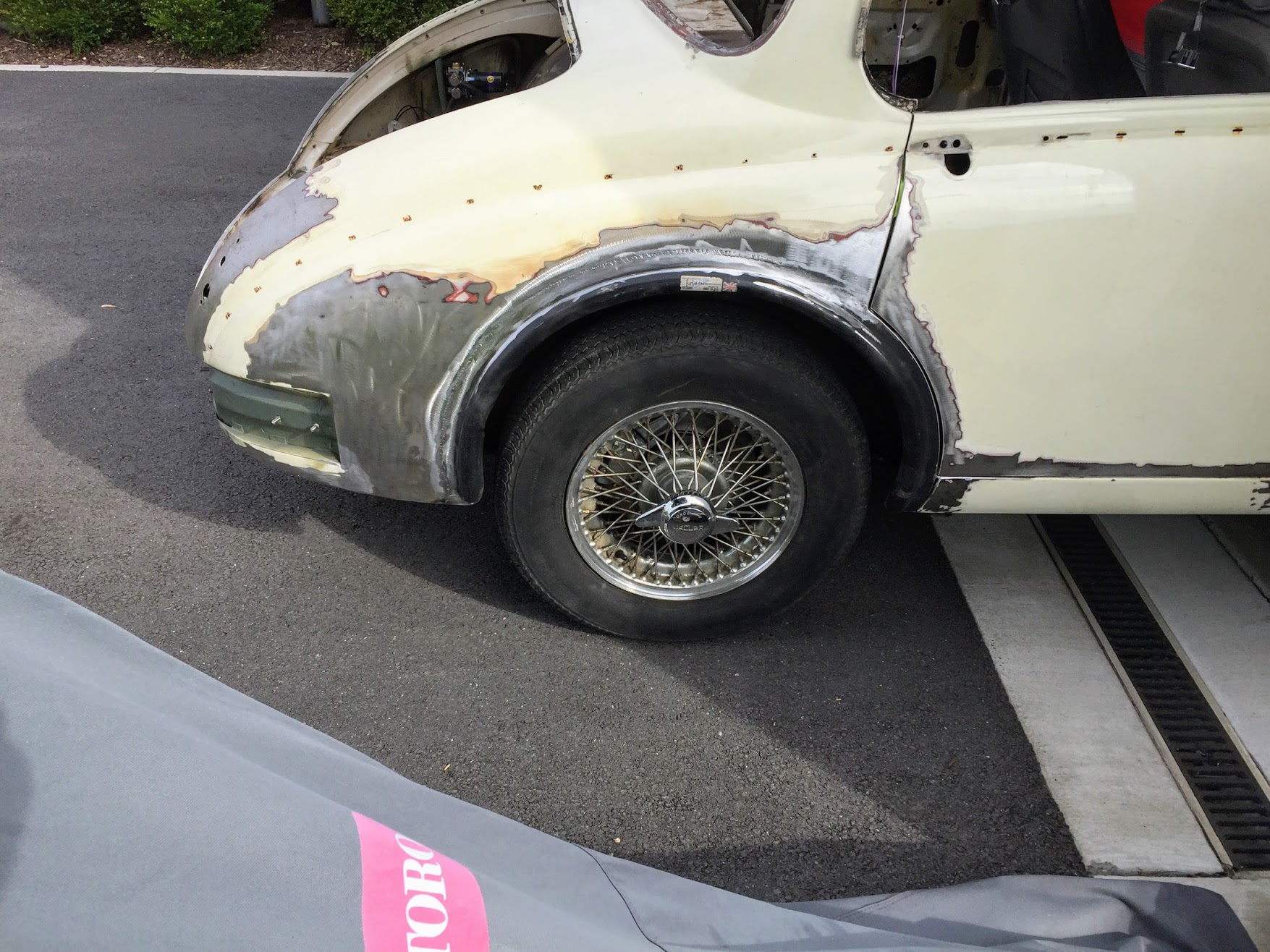
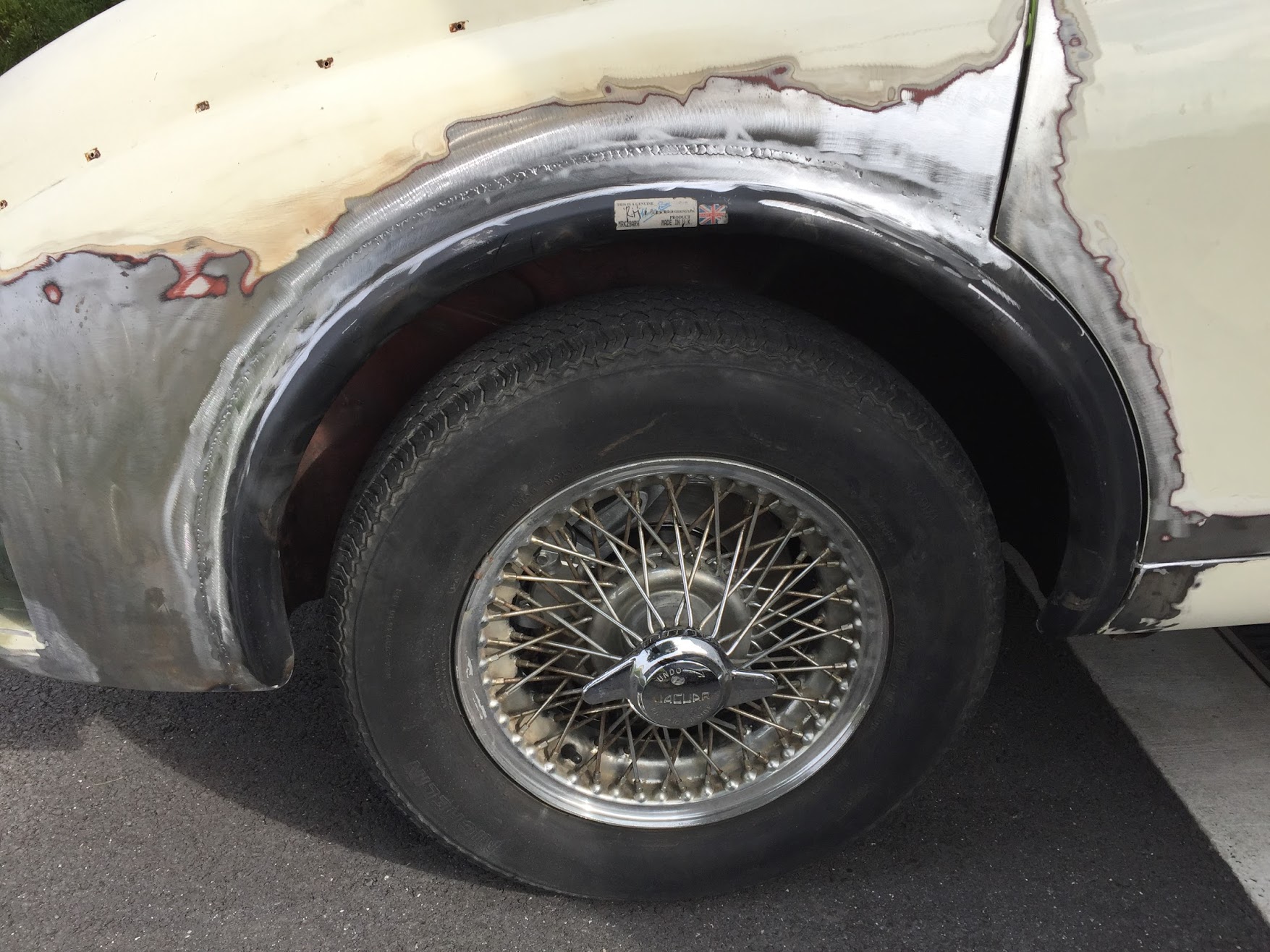
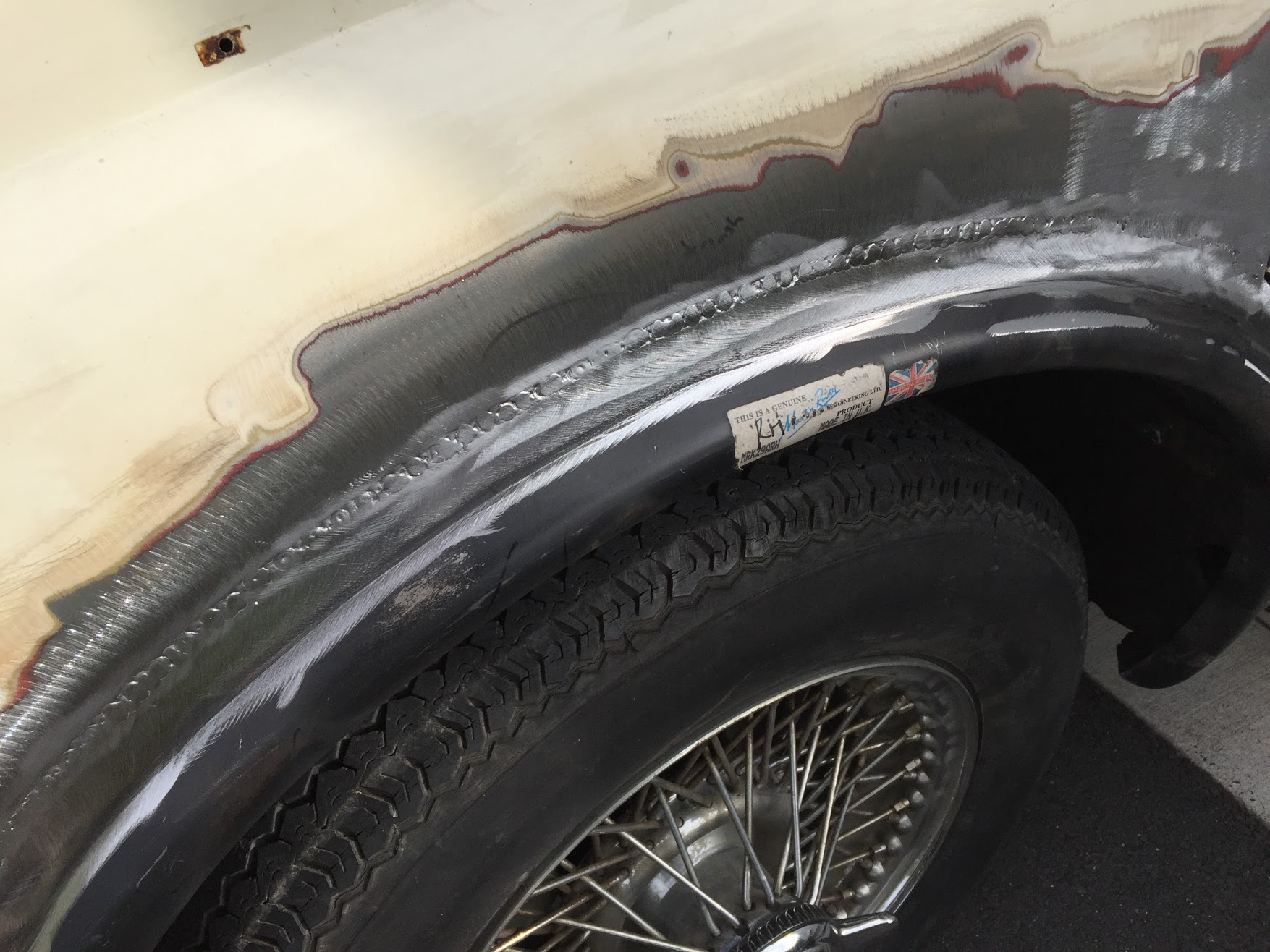
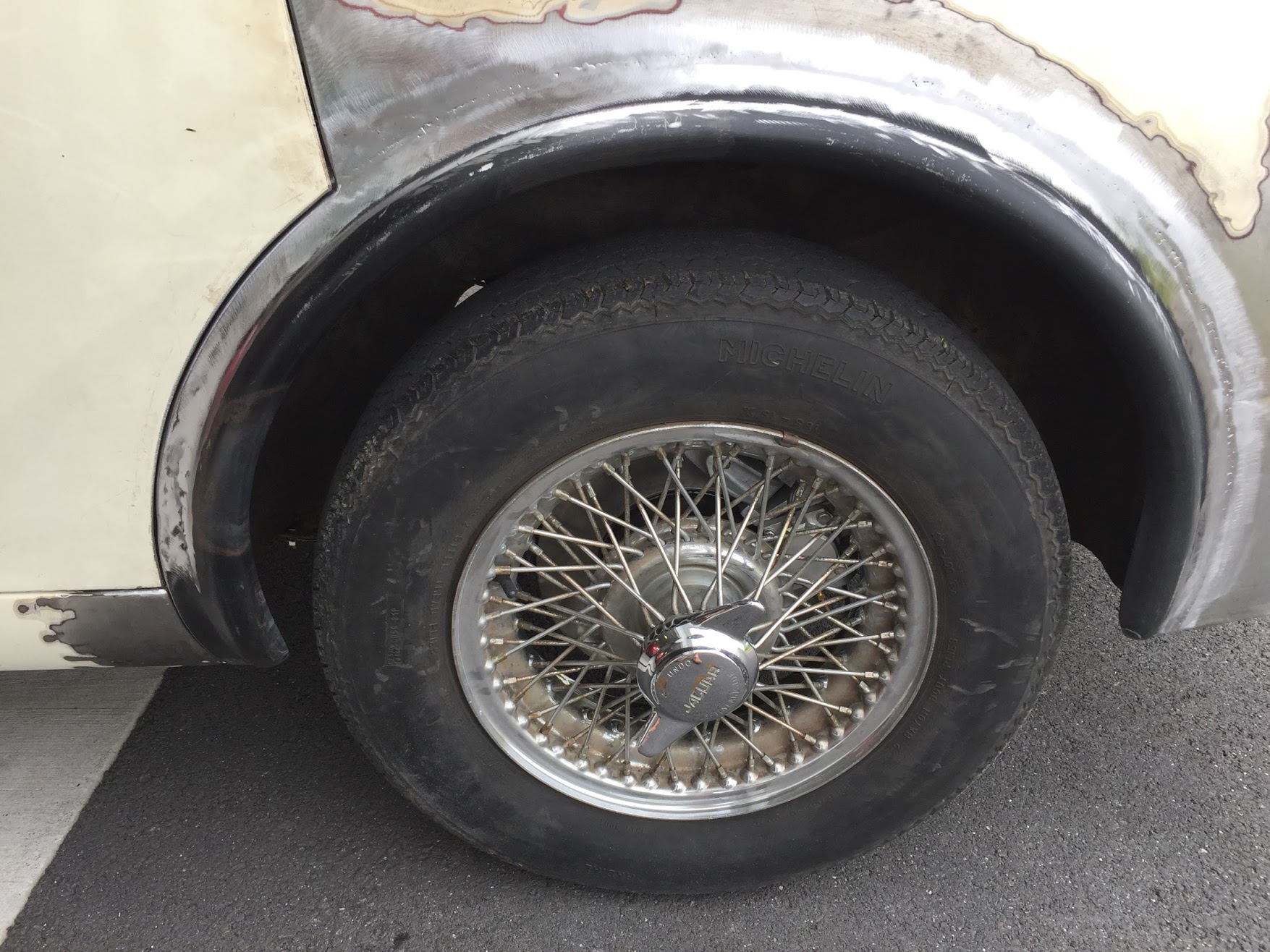
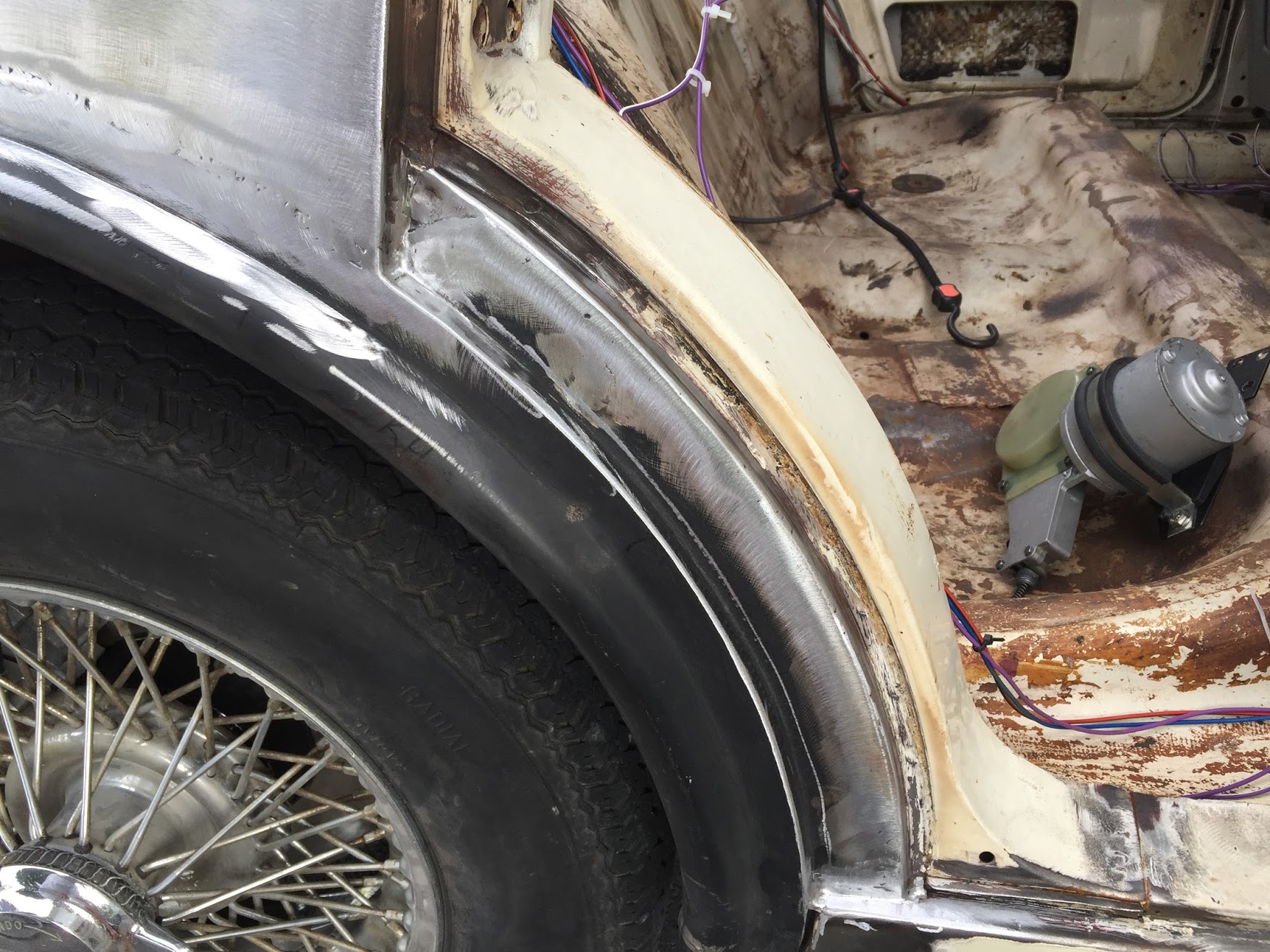
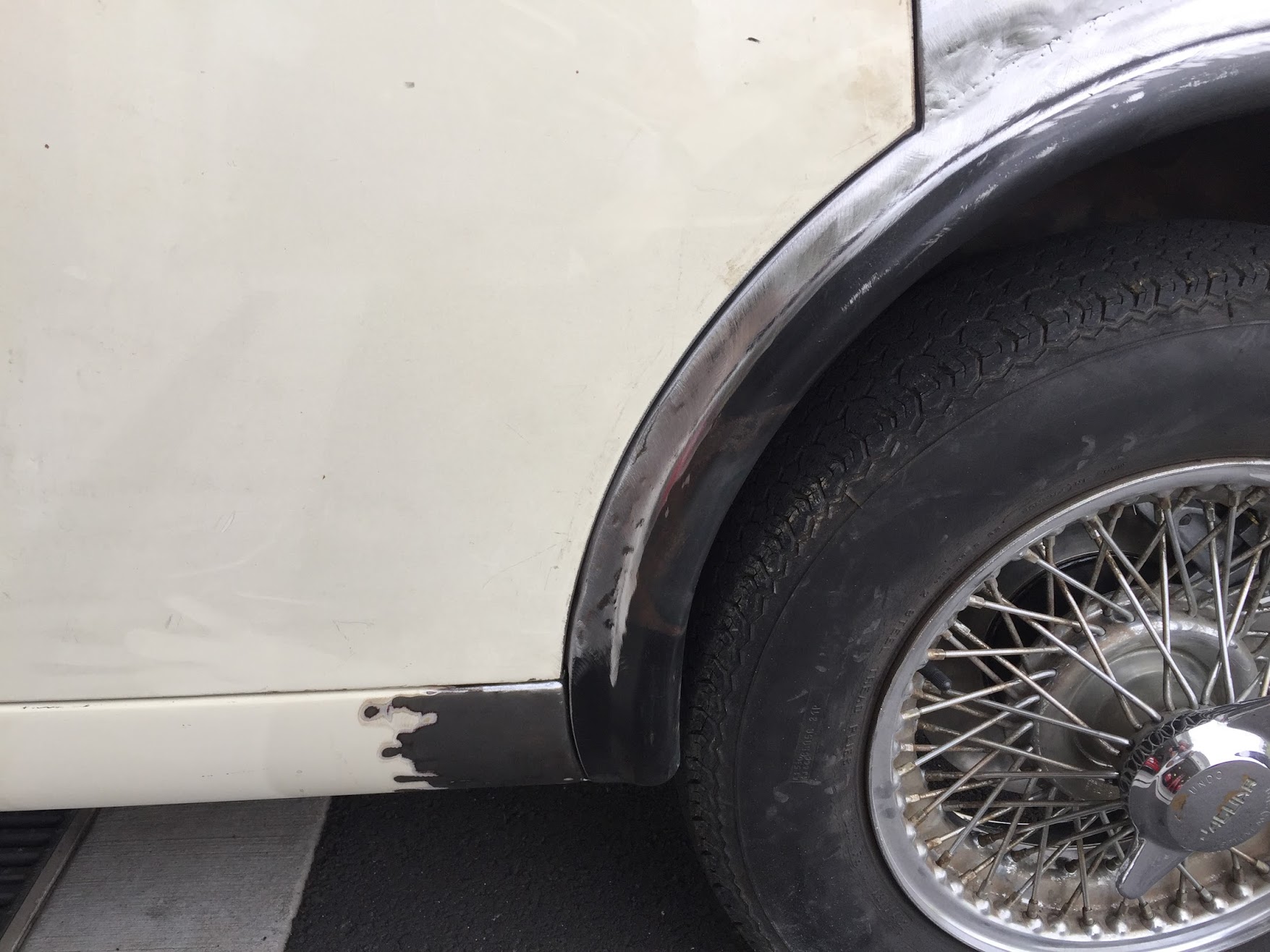
I purchased the Coombs rear fender skirts, or spats, some time ago from XKs Unlimited. The skirts are mounted to the body with a rear bracket, a clip in the middle, and Duz-type fasteners at the front. They do not fit particularly well and can shift about. John Stefanik, who did some masterful metal work on the car previously, had done some preliminary fitting of the skirts when he had the car in Pennsylvania.

However, after seeing a number of fellows on the various Jaguar MK2 Forums weld these to the body rather than mounting as per usual, I was inspired to do the same. In my opinion once all of the bodywork is complete this will yield a much smoother and pleasing appearance. The rubber gasket that is typically used and visible is eliminated.

The original Coombs MK2s did not, in fact, use a skirt or spat, but accomplished the same effect by welding in a rod around the wheel opening to create a fender bead or roll similar to the front of the car. This, of course, also provided much easier access to the rear wheels/tires when racing. Reference is made to the rear wheel opening modification in the Coombs brochure of the time:Coombs Specifications for Jaguar MK2 (2)

These skirts are available in steel as well as fiberglass. I had purchased the steel variant.

Brandon Tyree, welder and fabricator extraordinaire, at Mike Gassman’s Gassman Automotive shop http://www.gassmanautomotive.com did the welding work for me. All of the finishing touches will be handled when the car is returned for bodywork and paint.

Here are a few images of Brandon’s work:

Coombs Rear Wheel Skirts Welded

Coombs Rear Wheel Skirts Welded

Coombs Rear Wheel Skirts Welded

Coombs Rear Wheel Skirts Welded

Coombs Rear Wheel Skirts Welded

Coombs Rear Wheel Skirts Welded


Cold Air Box

Air Cleaners to Cold Air Box

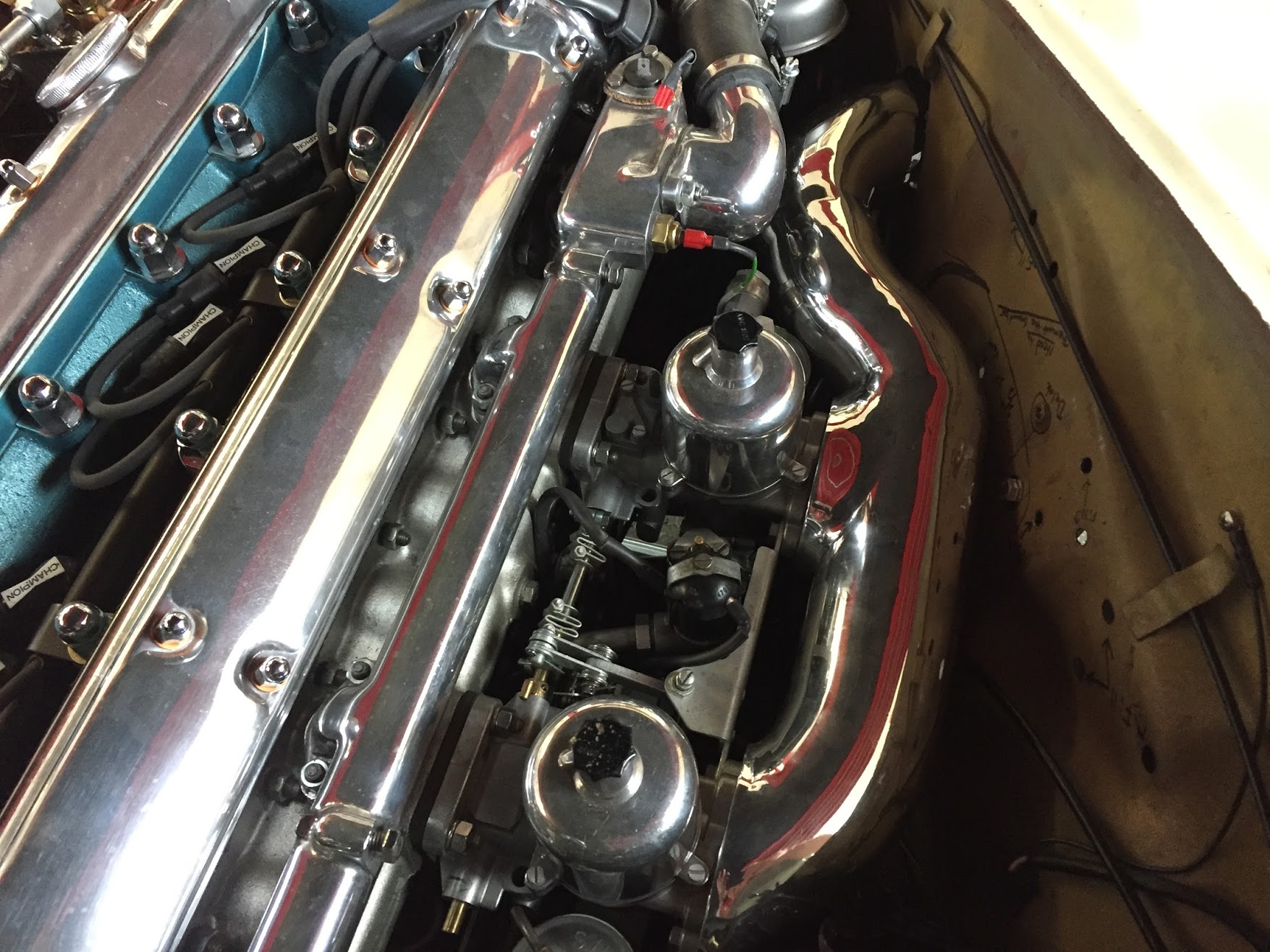
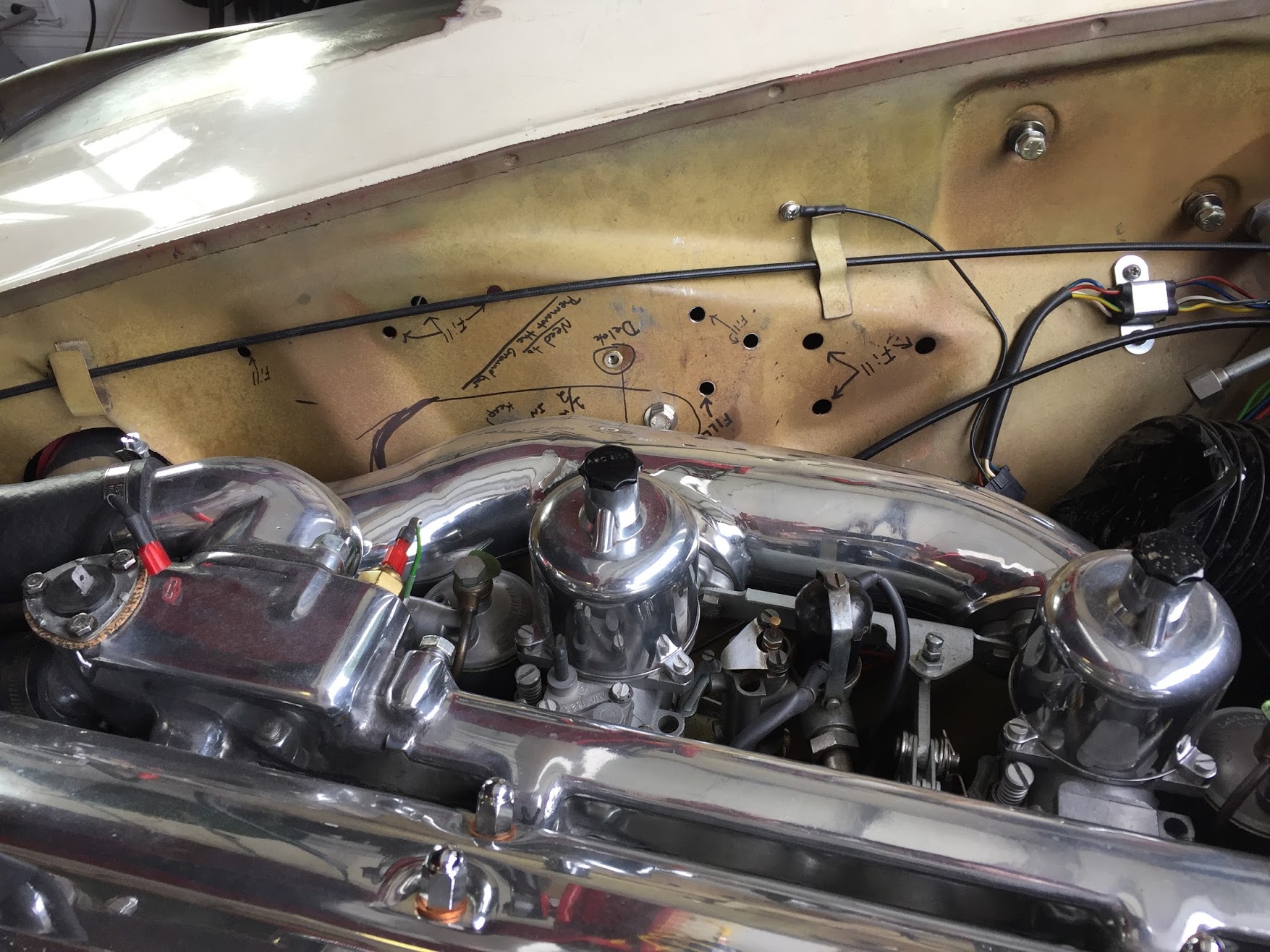
Well, after the time devoted to researching the ideal air cleaner solution and the expense of ordering the K&N offset filters, I became convinced that an air box delivering cool air to the carbs is the way to go. I recently saw several approaches to these “boxes” on some of the Jag Forums, and Mike Gassman of Gassman Automotive http://www.gassmanautomotive.com convinced me that the cold air delivery system would be a good modification to make to assist with expected heat problems under the bonnet. I anticipate that my air conditioning system will add more heat to an already “hot” situation. Mike has a very talented welder/fabricator on his team, Brandon Tyree, who designed, fabricated and installed the “box” – I am going to call it a “pipe.” I don’t know why “they” call these  things “cold air” boxes – they do not deliver cold air, but instead, ambient air from outside the engine bay to the carbs. A “pipe” also has all smooth and rounded surfaces which would seem to promote better air flow than a “box.”

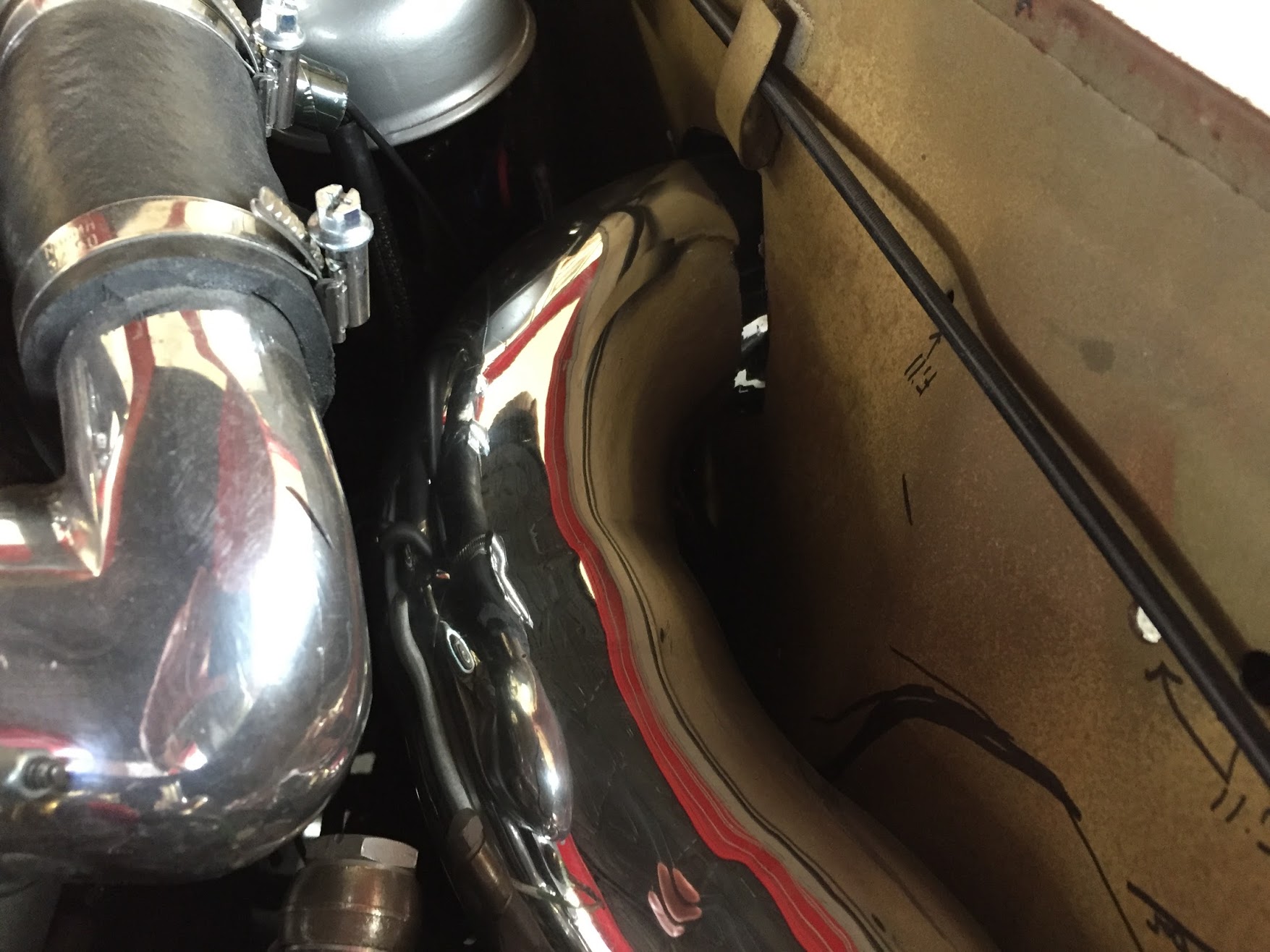
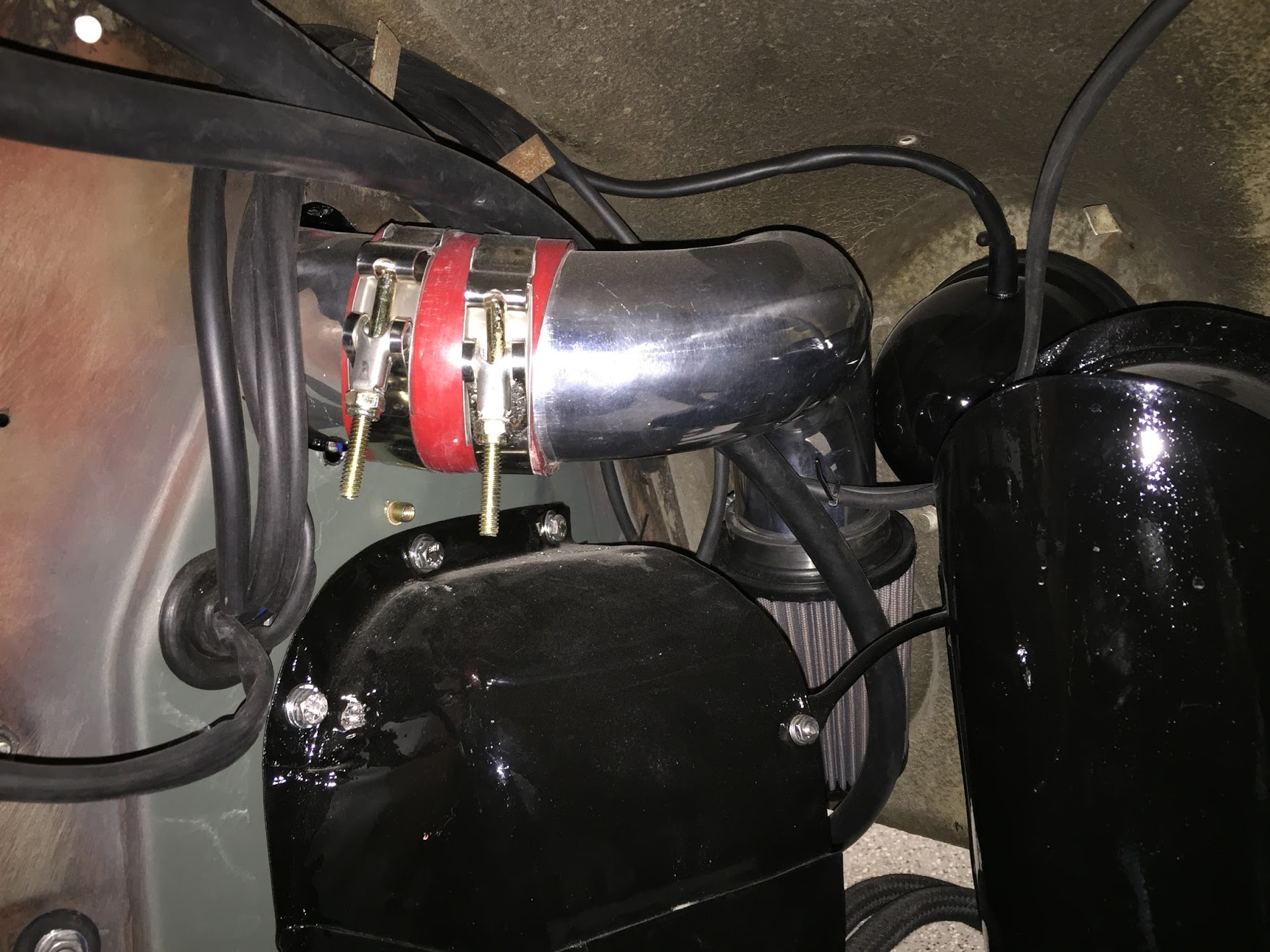
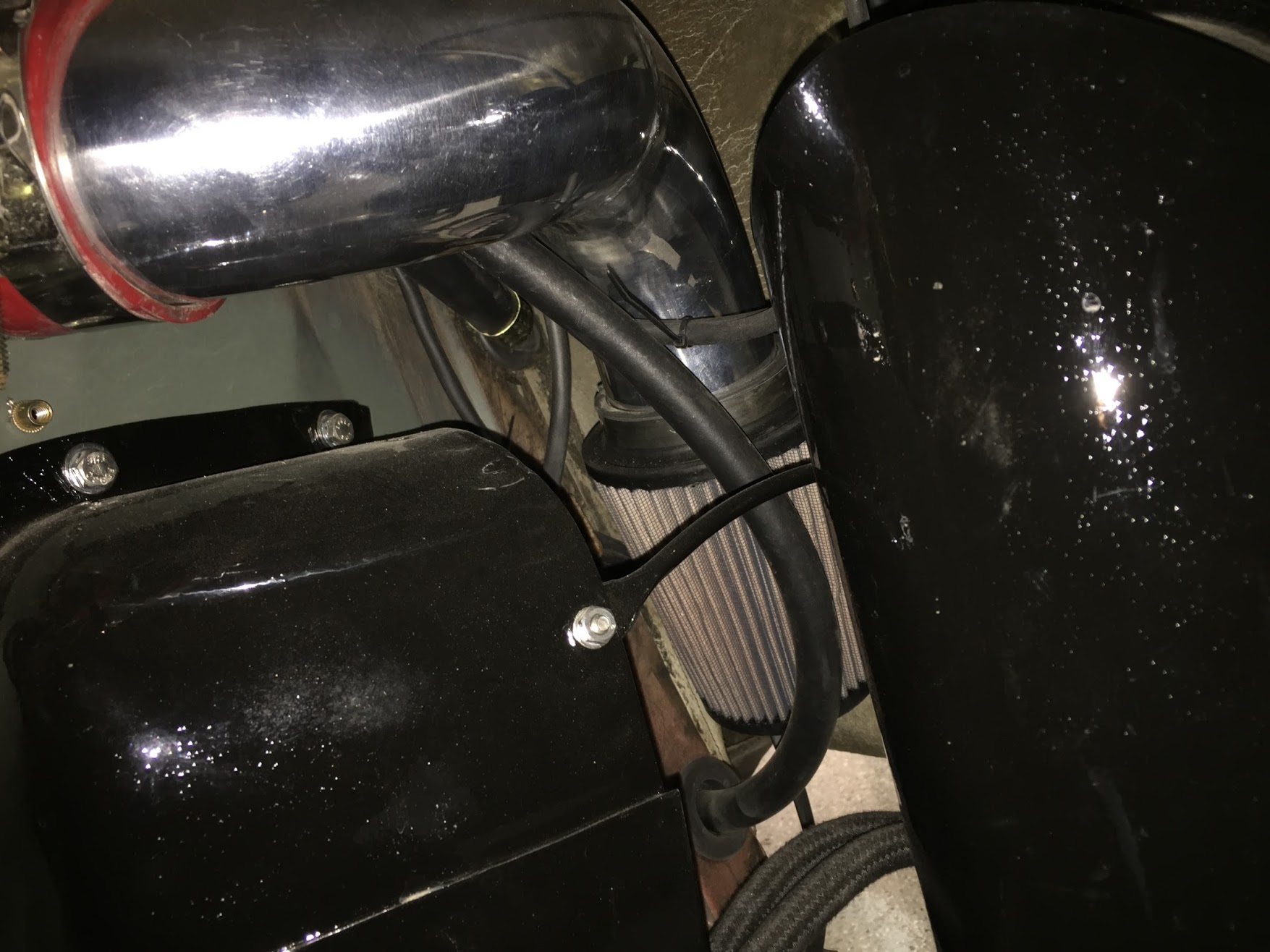
Brandon began with a three inch tube and worked his magic. The pipe punches through the side wall of the RH engine bay valance and snakes down to the front of the RH wheel well, near the reservac tank. A K&N air filter is installed on the end of the pipe. 

The pipe installation will require a slight relocation of the wiper motor. Mounting points have been located and the final fitting of the wiper motor will occur after the engine is removed, before bodywork and painting.

After the engine is removed from the car and access is improved, the valance opening will be refined and a trimmed MGB gear shift leaver rubber gaiter will be used as a grommet to cushion the pipe through the valance wall.

Removing the air pipe is quite easy. The two clamps on the silicone sleeve joining the two sections of the pipe are loosened allowing the wheel well pipe to be removed. The same four 9/16″ inch hex head bolts used to fasten the air cleaners are then loosened and removed. The original carb/air cleaner gaskets are also used.

The air pipe can then be rotated and lifted away.

Thanks to Mike Gassman for the ideas and conceptual design and to Brandon Tyree for his superb execution.

Cold Air Delivery Pipe to Carbs Top View

Cold Air Delivery Pipe to Carbs

Cold Air Delivery Pipe to Carbs

This image shows the hole cut in the engine bay valance for the pipe. As mentioned it will be “cleaned-up” when the engine is out of the car and before bodywork and paint. Locating the hole was a little trickier than it might have otherwise been because of the previously located air conditioning hoses, drier, and trinary switch. 

Cold Air Delivery Pipe to Carbs RH Valance Access Hole

The following two images show the pipe joint, silicone sleeve, clamps and pipe extension to the K&N filter.

K&N Air Filter for Cold Air Pipe in RH Wheel Well

K&N Air Filter for Cold Air Pipe in RH Wheel Well


Radio/Heater Control Panel

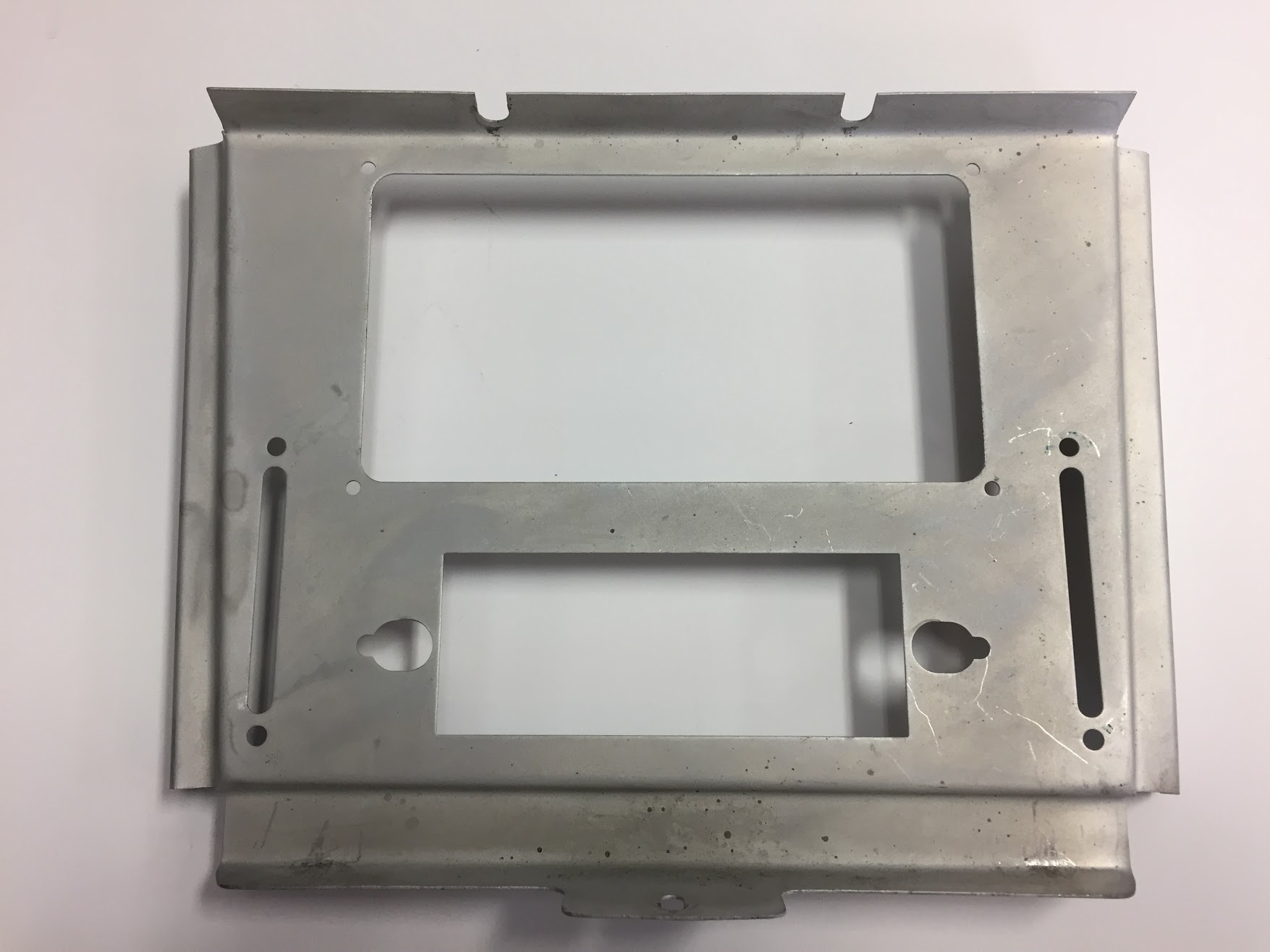
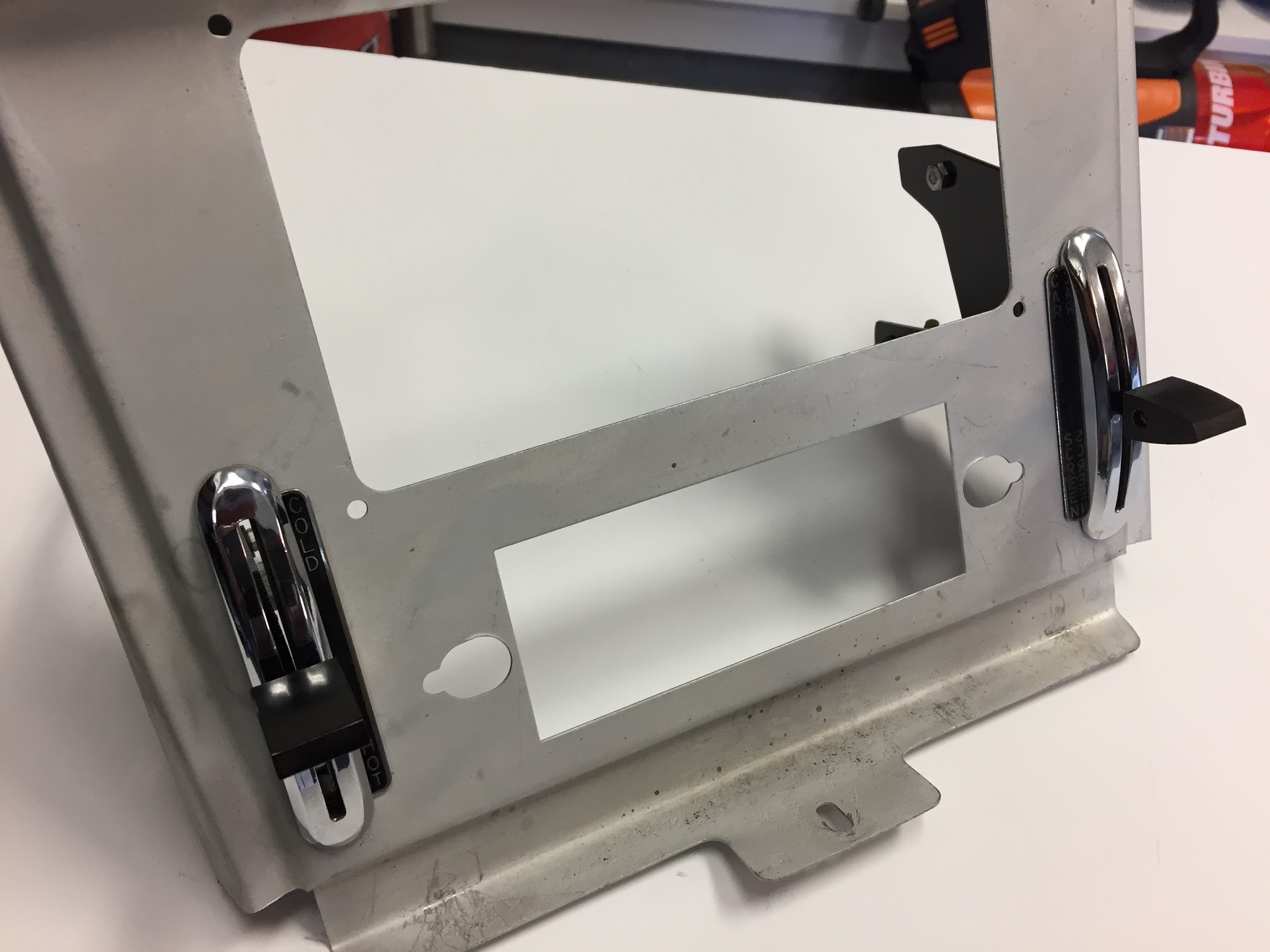
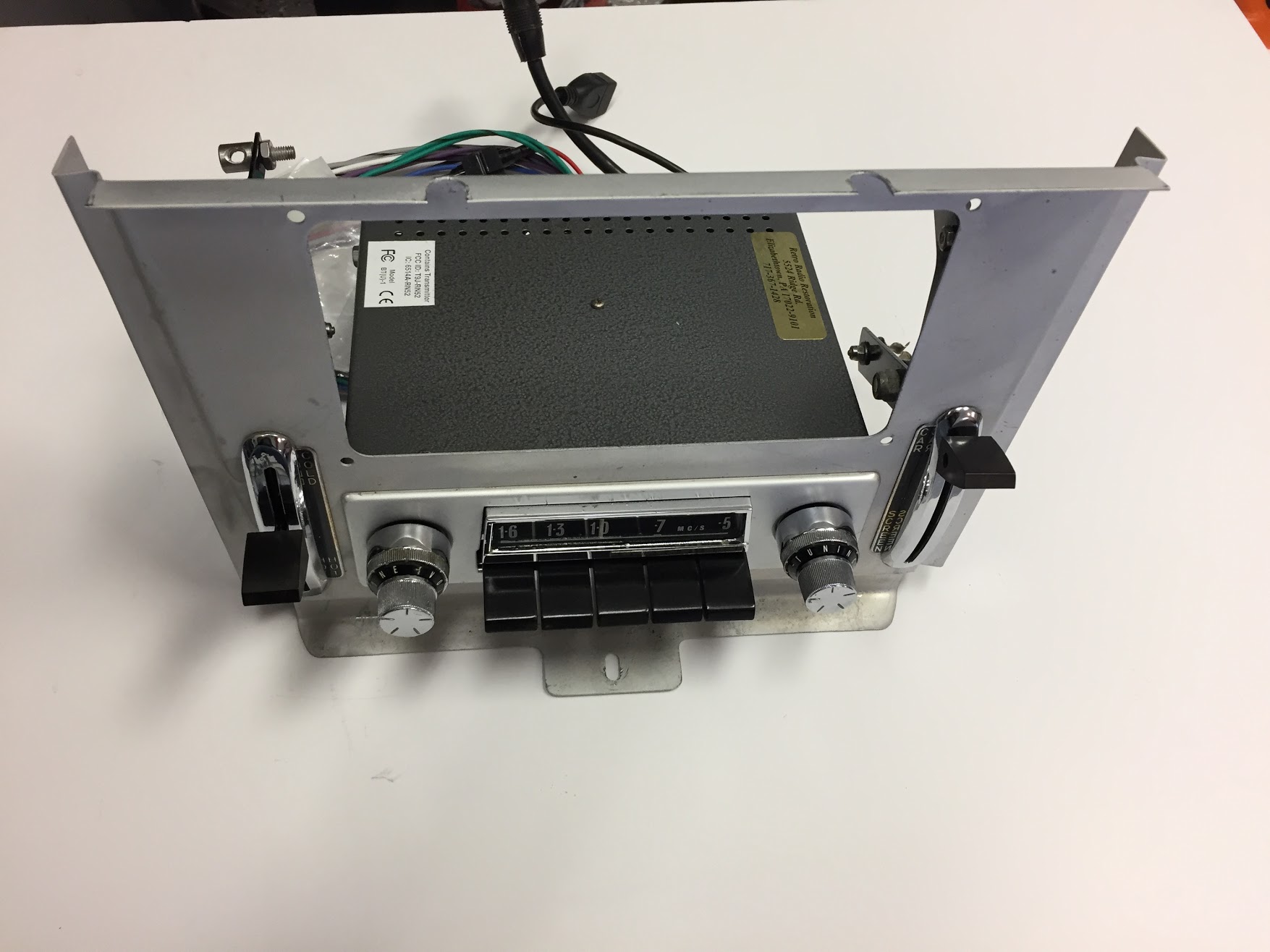
Just as a trial run – I have no leather yet! – I assembled the control panel including the radio, heater control levers, and the speaker grill. I am going to be adding locations for air conditioning control switches and I needed to take a close look at the assembled panel to identify the best spots. I will not be installing a speaker behind the speaker grill, so I will need to place a “blackout” panel behind the grill to prevent one from looking through the grill.

The control panel attaches to the bottom of the newspaper tray and to a bracket on top of the gearbox cover. It will be covered in leather/vinyl to match the interior color.

Radio Control Panel

Heater Control Lever with Fasteners, Escutcheon and Identifier Plate

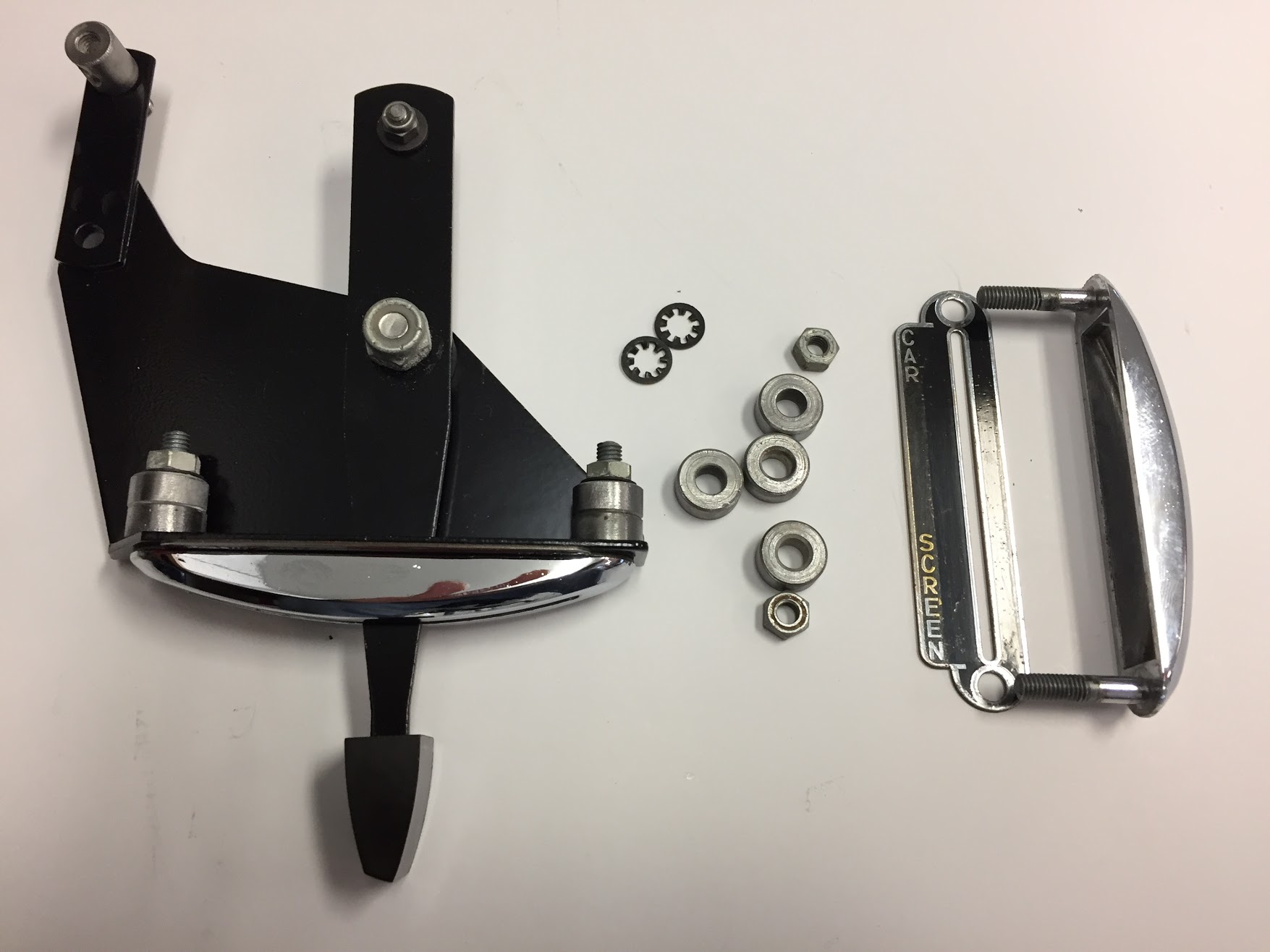
I first inserted the chrome escutcheon with its identifier plate through the mounting holes on the RH side of the panel. I then placed two 5.5mm spacers on each threaded mounting post followed by the lever assembly. The collection was then secured with a shake proof washer and a 10-32 stainless hex nut on each post. The RH side lever is for the “car/screen” control. The Identifier plate is to the inside of the escutcheon. The black control lever knob can then be attached with a small #6? fillister head machine screw.

The procedure was then repeated for the air temperature control lever on the left side of the assembly. This lever has an identifier plate with “hot/cold” lettering, again placed to the inside of the panel.

Heater Control Levers in Place, Front View

Heater Control Levers in Place, Rear View

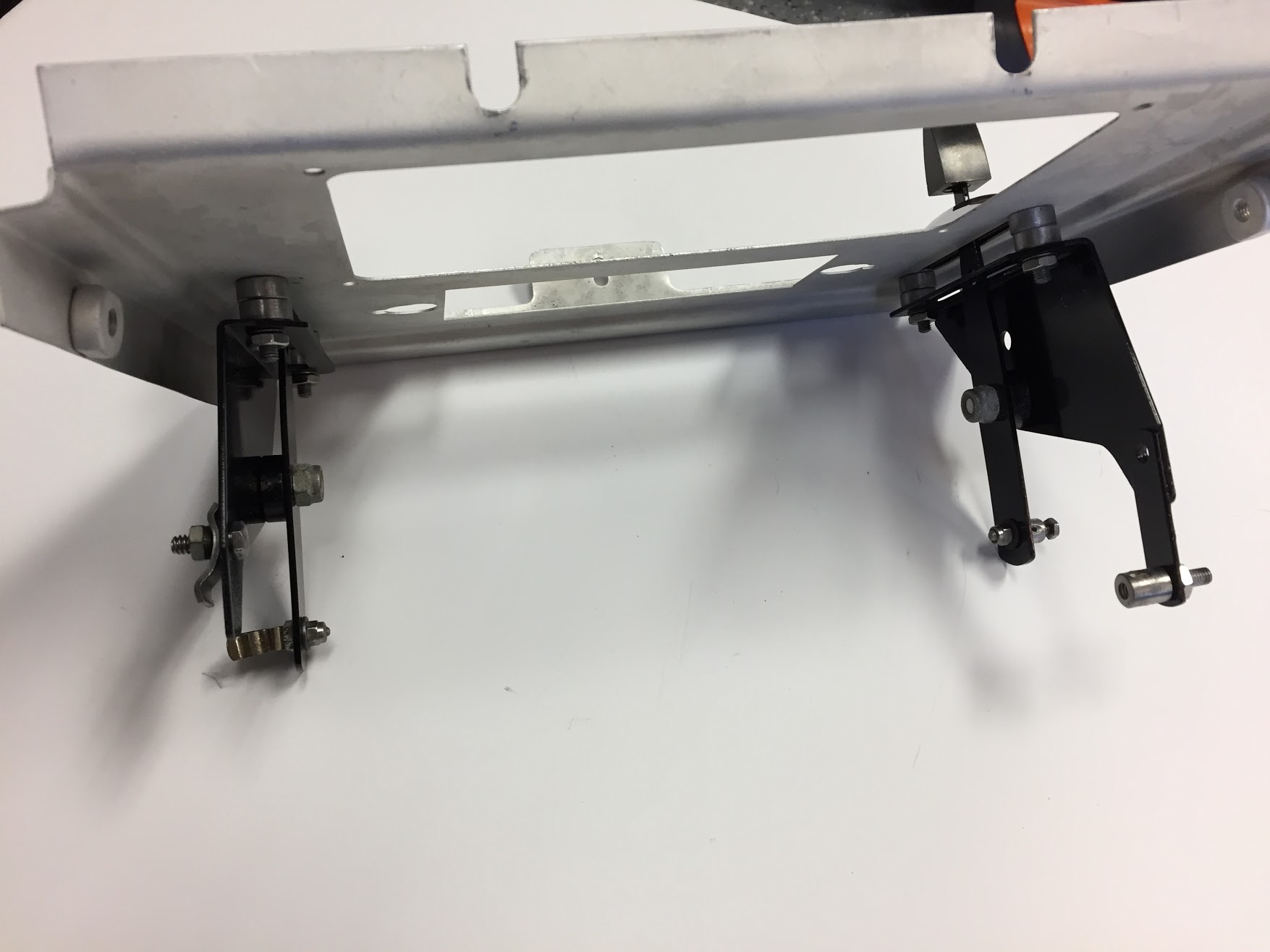
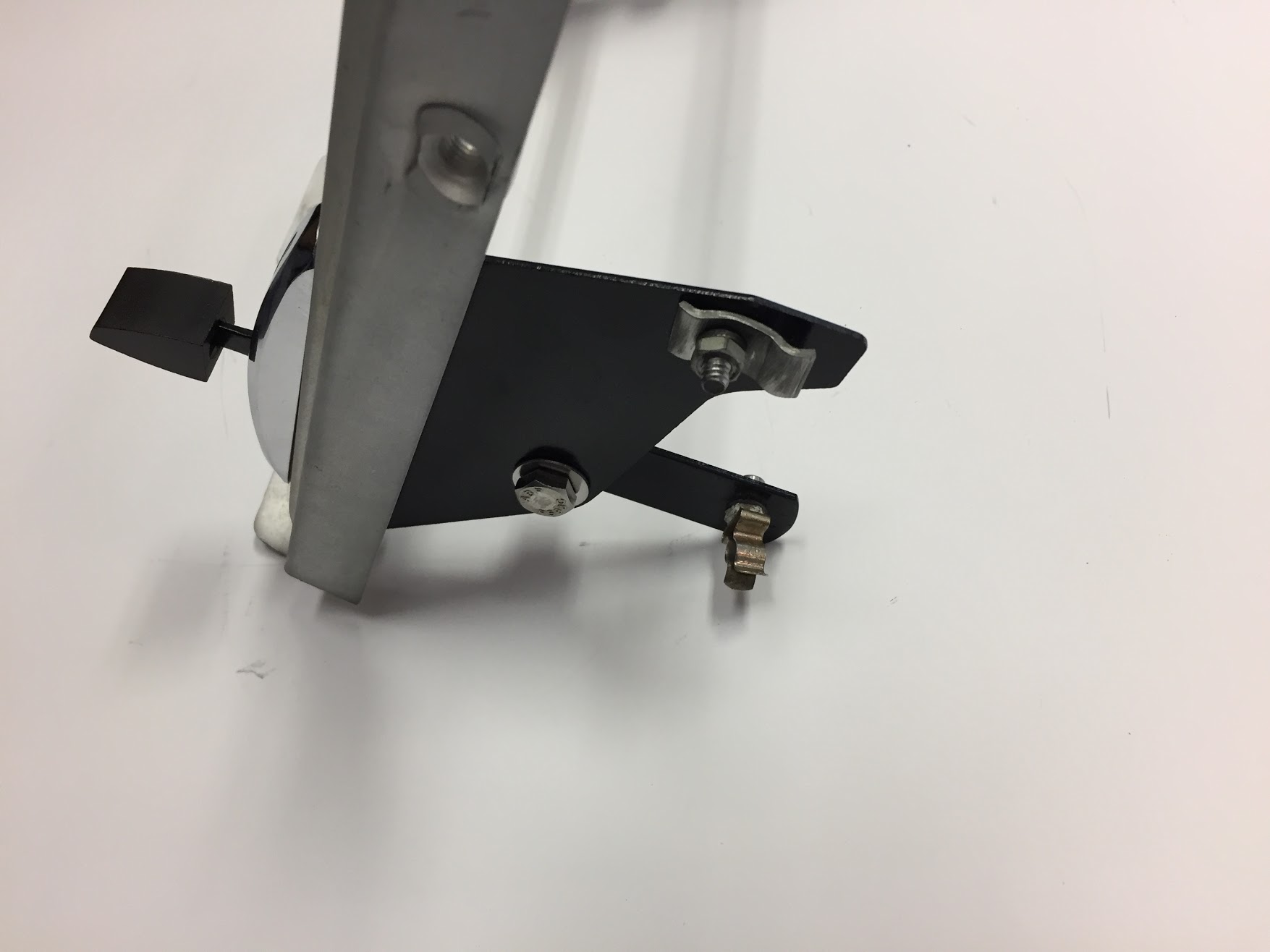
Hot/Cold Control Lever Cable Mountings

Car/Screen Control Lever Cable Mountings

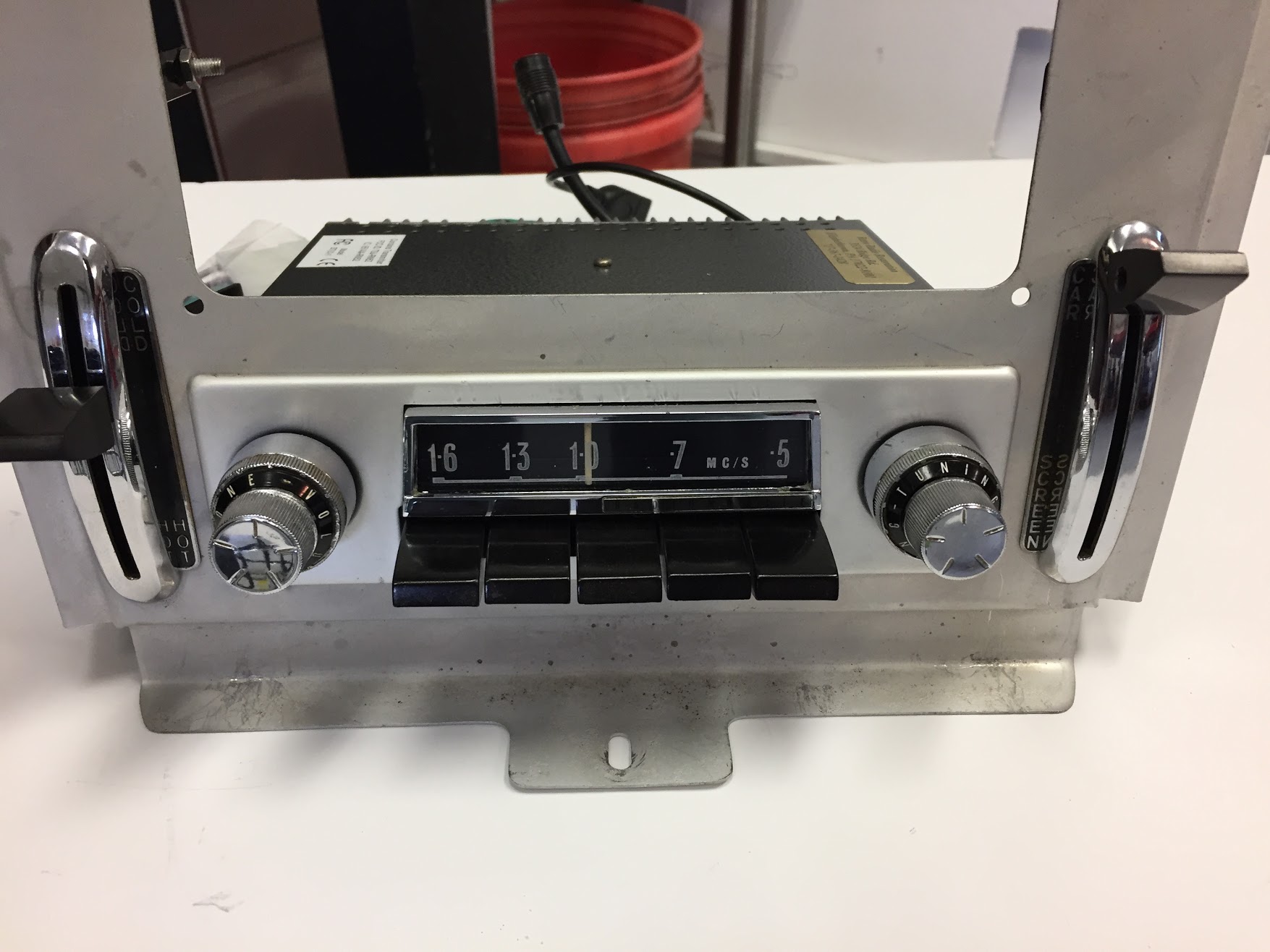
Installation of the radio was next. After removing the locking nuts the face plate and the control knobs from the radio I inserted the radio into the radio control panel from the rear. I then straightened the radio on the control panel, installed the radio faceplate, and the locking nuts on each of the control knobs. The control knobs were then pushed in place with the volume on the left and the channel selector on the right.

Radiomobile Radio Installed, Front View

Radio Installed, Close-up

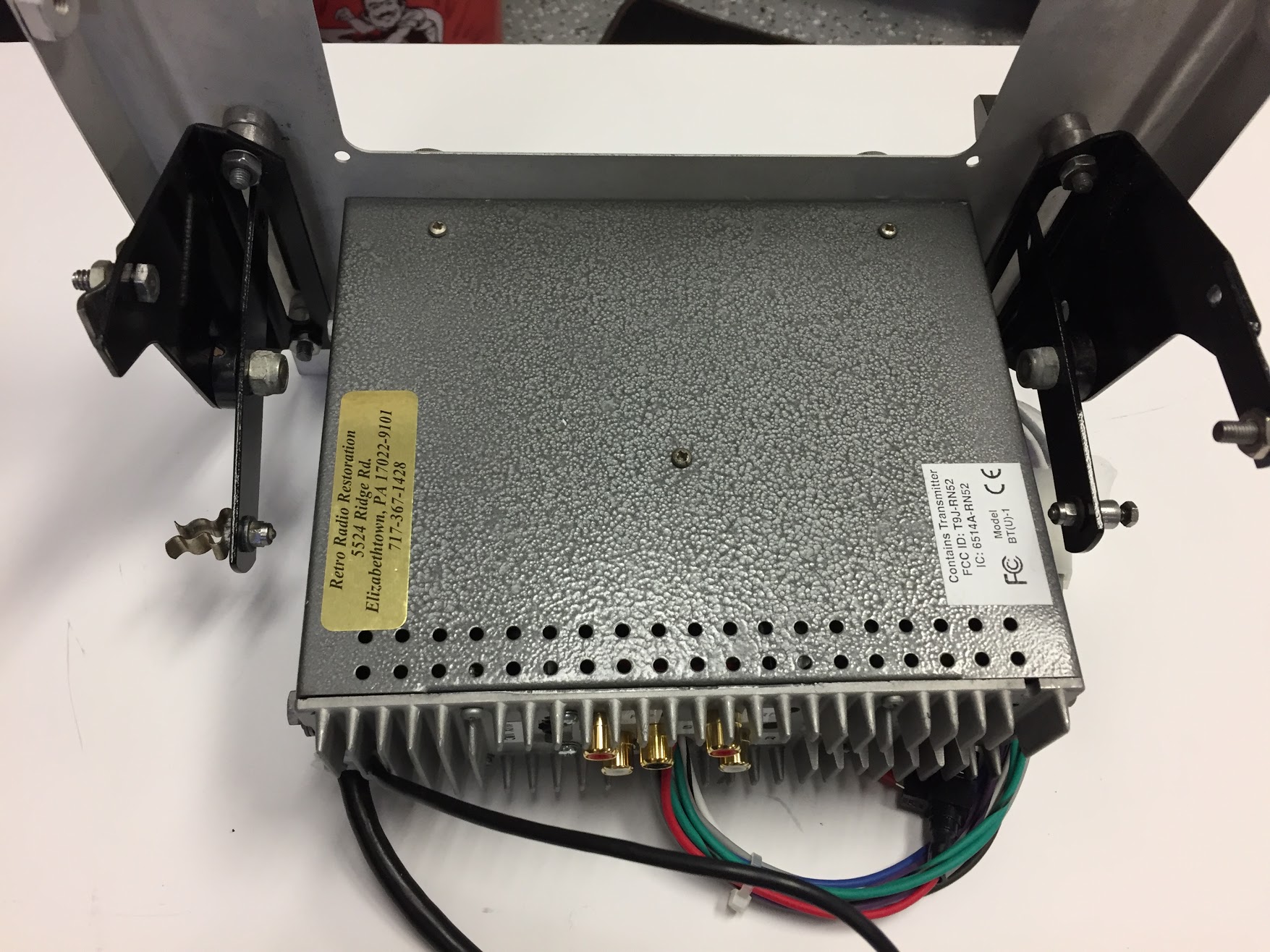
Radio Installed, Rear View

I still need to include the mounting of the radio support arms in this post and will do so soon.


Ignition

Spark Plugs

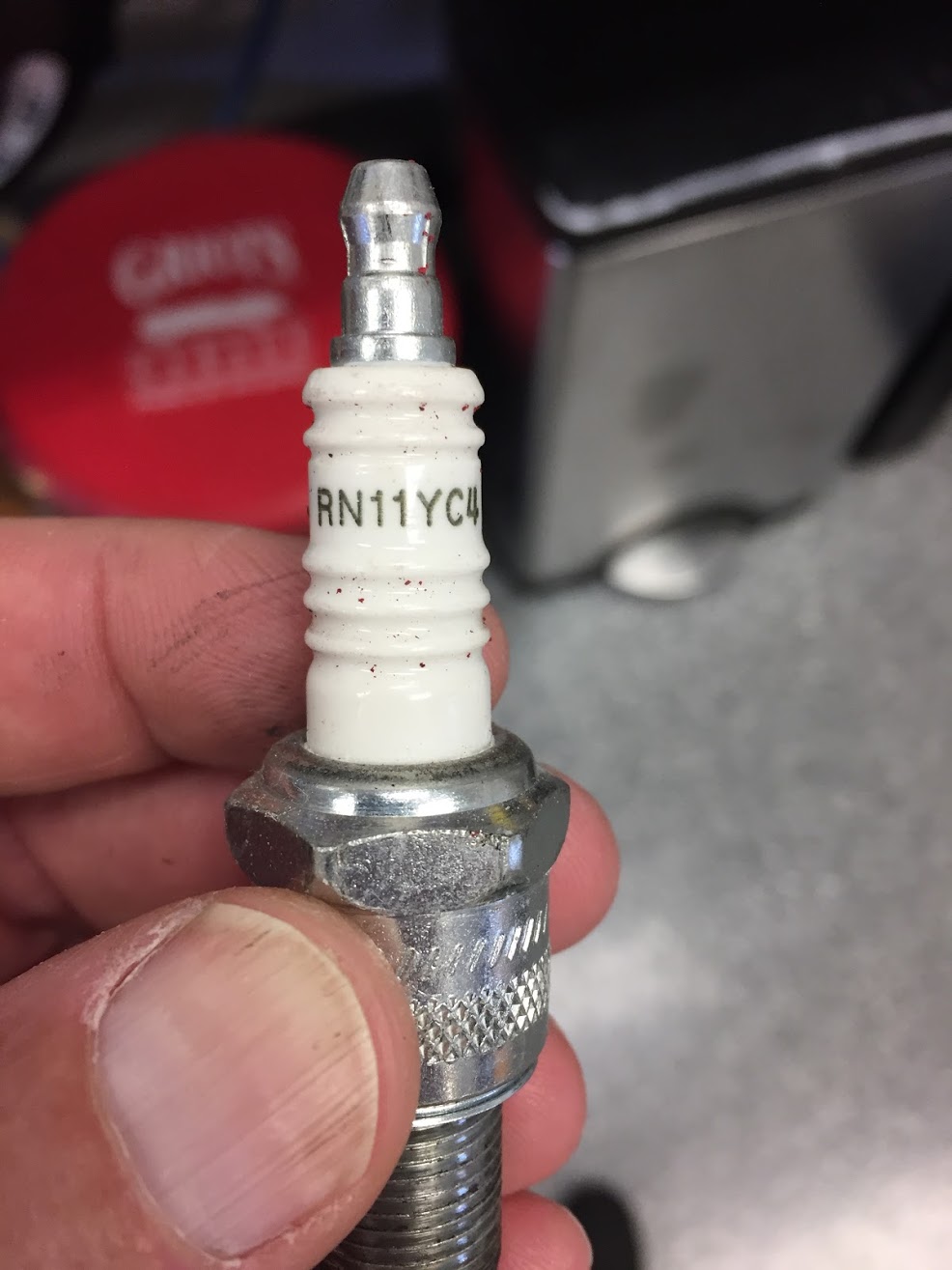
I don’t know if I will stick with the Champion plugs or not, but Mike Gassman installed Champion RN11YCA plugs when the engine was rebuilt and they remain in the engine at this point.

Champion Spark Plug Jag MK2

Champion Spark Plug RN11YC4 Jag MK2

Distributor

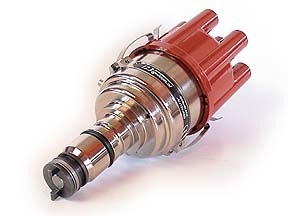
There are several options available for upgrade to an electronic ignition. I used a 123 Electronic Distributor on my 1960 Austin Healey 3000 and was very pleased with the installation so I ordered the same distributor designed for the Jaguar XK motor – negative ground. The company that produces the distributor is located in the Netherlands. This is the link to their website: http://www.123ignitionusa.com/jaguar.html.

I ordered the “Jag 6-R-V” from Classic Jaguar, 9916 Hwy 290 West, Austin, TX 78736     (512) 288 8800 Austin, TX. http://classicjaguar.com/cj/ign_sys.htm for $425.00.

This web site provides some useful commentary on the 123 distributor, although it should be clear that I am using the Jag specific model, not the generic british model.

http://jaguaretype.wordpress.com/home/technical/123-distributor/

123 Distributor

123 Distributor


Directions for Installation Provided with the Distributor

WITH THE OLD DISTRIBUTOR STILL IN PLACE

1. Mark the output towards cylinder #1 on the cap.

Remove the low voltage cable from the distributor to the coil, and remove the cap.

Now ask someone to crank the starter, and make a note: is the rotor rotating clockwise (CW) or is it rotating counter-clockwise (CCW)?

2. Crank the engine in its normal direction until you see that the rotor points toward the mark you made for cylinder #1, and verify that the static timing-marks of your engine align.

Do not rotate the engine anymore!

3. Check the firing order of the cylinders.

Use your workshop manual, or follow the cables from the cap to the spark plugs.

You start with cylinder #1, and remember to count in the direction that you have found earlier.

Make a note of the firing order, too. E.g. ‘1-4-2-6-3-5.’

4. Check which advance-curve is required for your engine. Use your workshop manual, check the model number of the existing distributor. Also compare the curve-listings for the various models in this manual.


OUT WITH THE OLD DITRIBUTOR, IN WITH THE 123 IGNITION!

5. Turn the ignition off, and (with the engine still in the static position for cylinder #1) and remove the old distributor.

6. Using an 8mm Allen wrench, open the cap at the side of the 123 Ignition. Rotate the micro-switch to select the proper advance curve using a small screw driver. Close the cap tightly.

123 Ignition JAG-6 Curves

123 Ignition JAG-6 Curves

7. Mount the unit carefully, and ensure that the drive-dog mates correctly. Find a position so that the vacuum nipple and cables come out conveniently. Fasten it in such a way, that you can still rotate the new distributor.

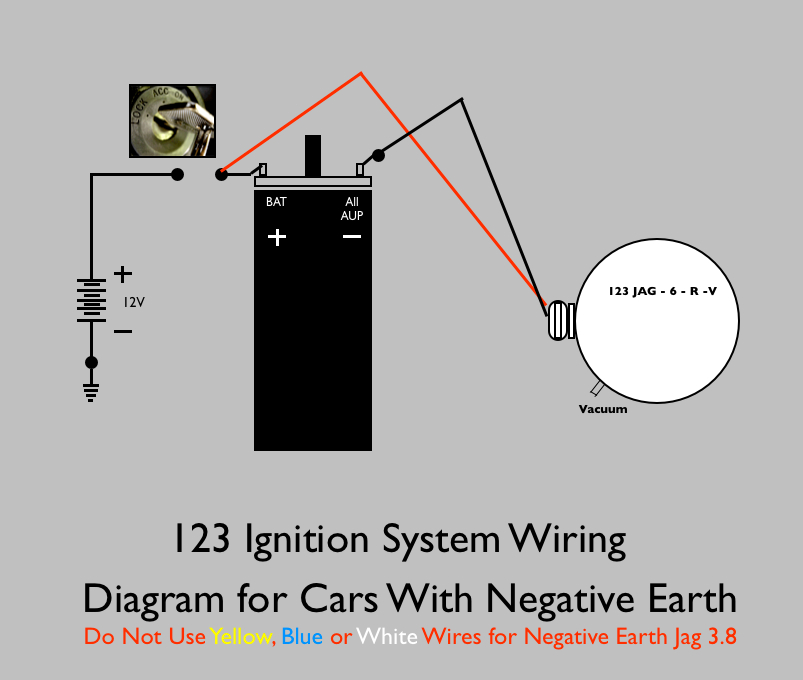
8. Follow the appropriate wiring diagram on the last two pages of the manual, but leave the black wire unconnected for now.

9. Turn the ignition on. A timing LED shines through one of the six holes in the aluminum disc. Rotate the body until the LED is “off.”

Now slowly rotate the body OPPOSITE to the direction that you have found under point 2, until the green LED just lights up. While turning the body, also press the rotor in the same direction to remove any free-play in the drive gear. Now, tighten the 123 Ignition securely.

10. Connect the black wire to the coil. Connect the spark plug leads in the proper sequence to the new cap (see point 4), starting with cylinder #1, to which the new rotor is pointing. Also connect the high voltage lead from the coil to the center position of the cap. Attach the cap to the 123 Ignition. Keep low-voltage wiring well away from the high-voltage cables and from moving parts. Do not connect the vacuum tube yet.

123 Ignition Wiring Diagram

123 Ignition Wiring Diagram

11. You can now start your engine. Use a stroboscope to adjust the maximum advance for your engine. If that is correct, you can attach the vacuum-tube to the nipple of the 123 Ignition with the ‘V’ option.

Coil

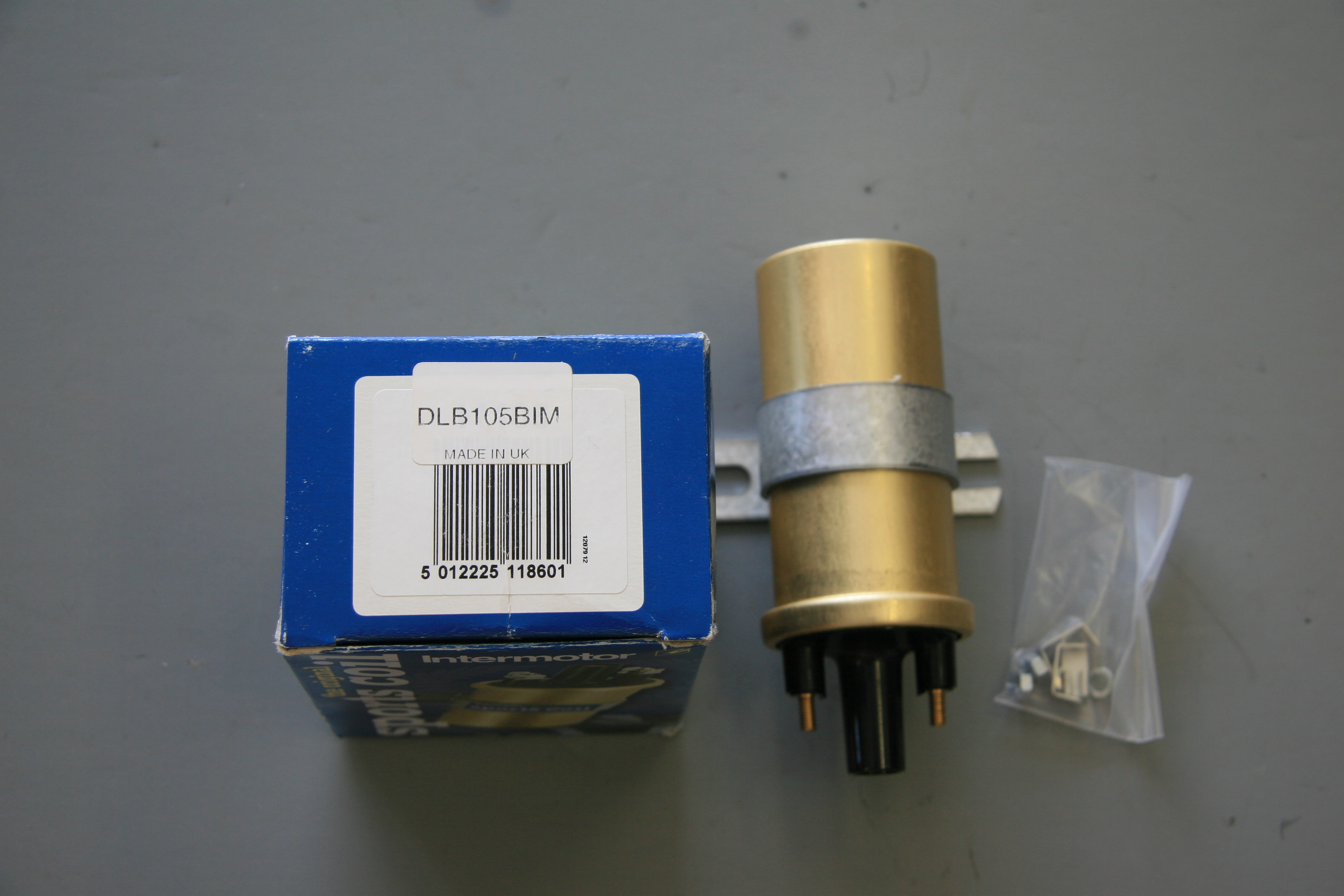
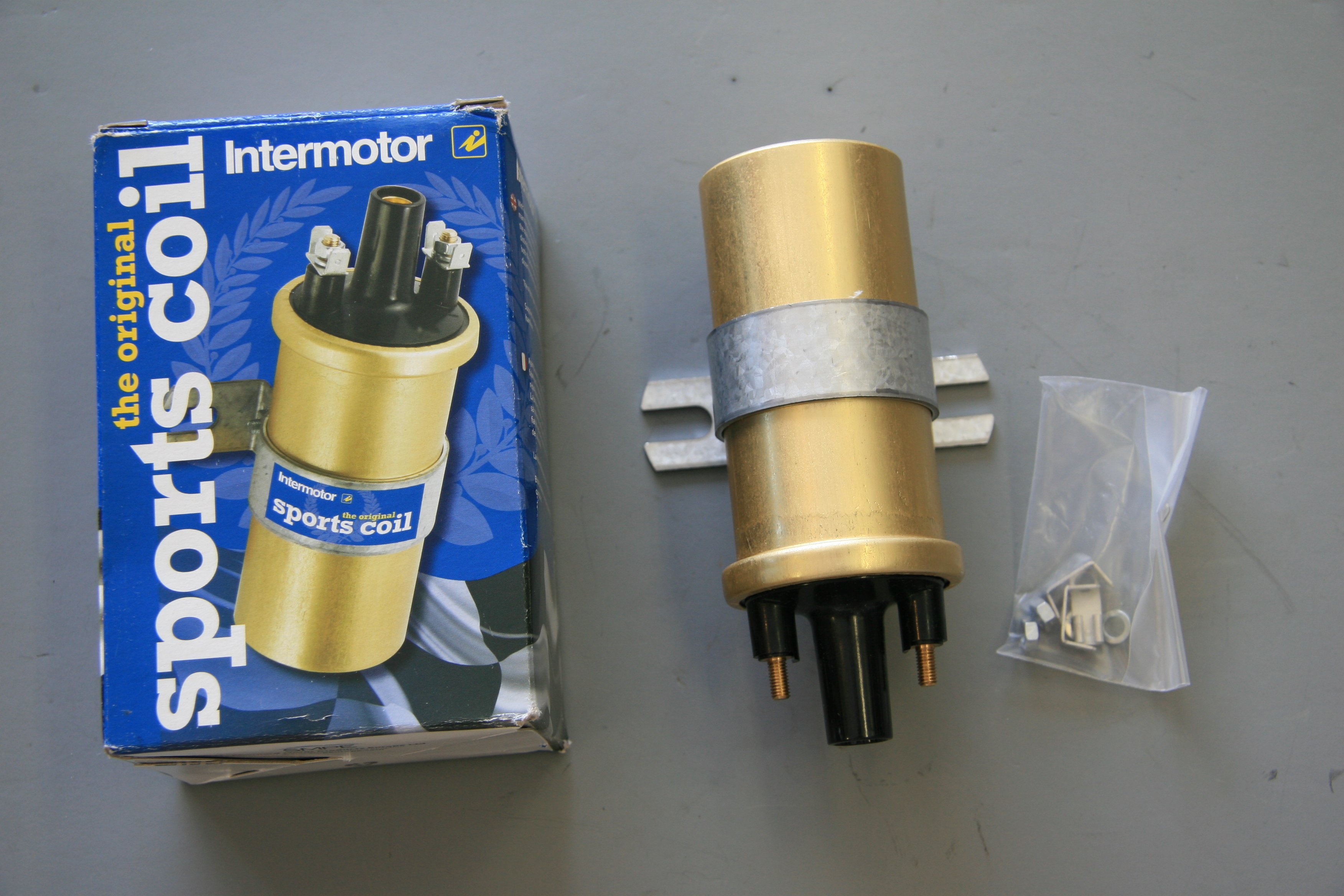
I also ordered the coil recommended by Classic Jaguar as an upgrade for the original unit. It was available for $35.00. It is an Intermotor Sports Coil.

Intermotor Sports Coil

Intermotor Sports Coil

Intermotor Sports Coil

Intermotor Sports Coil


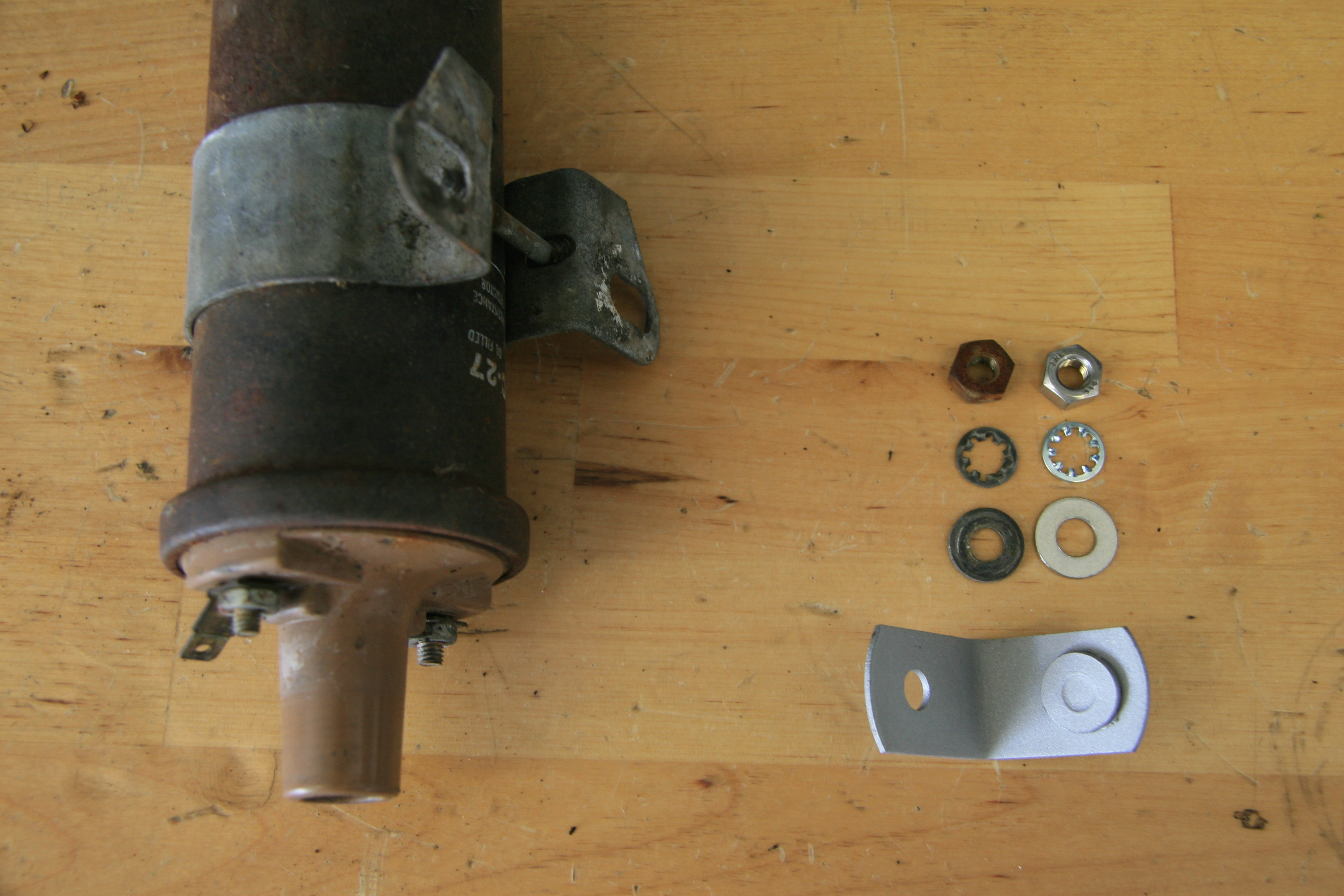
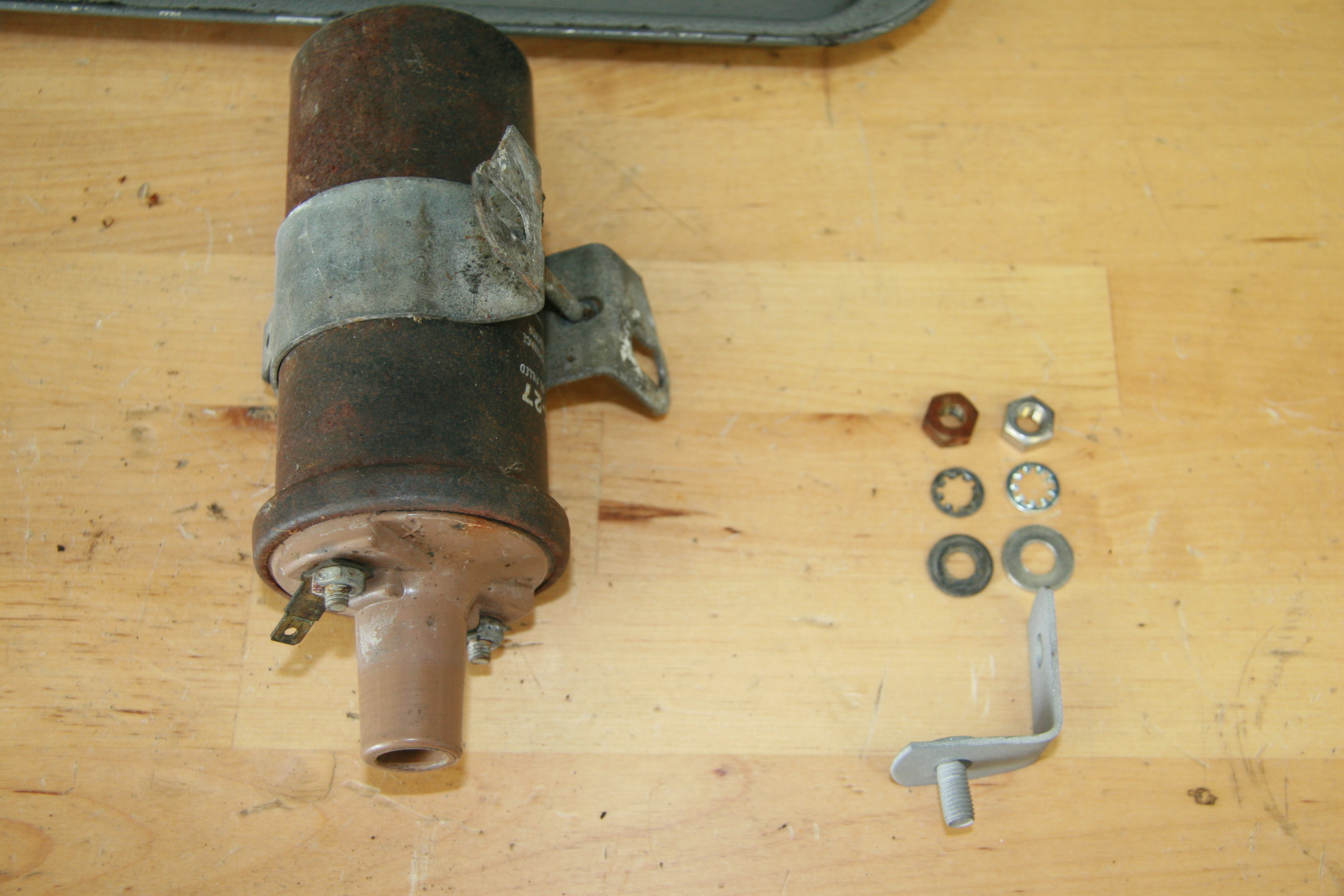
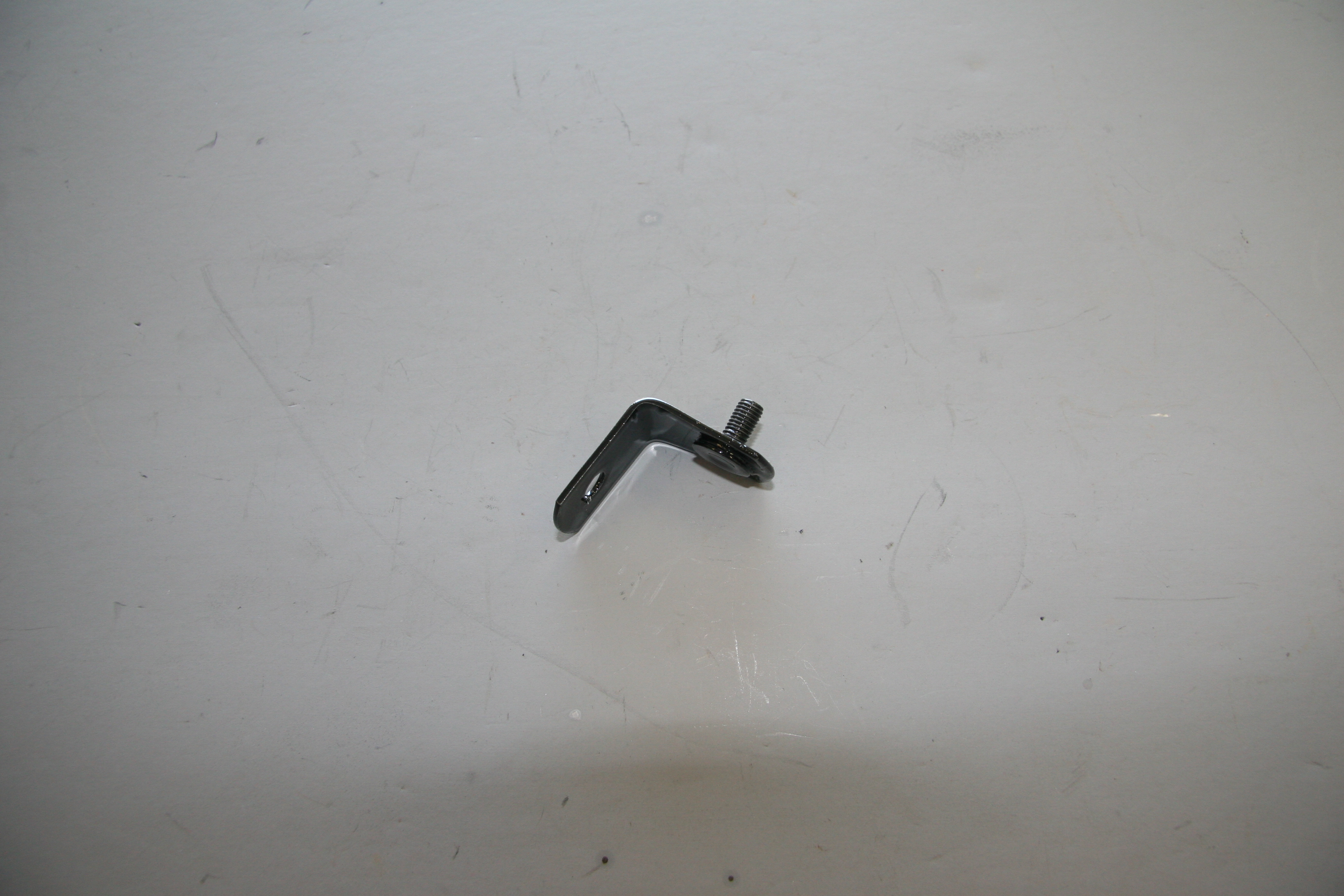
Extension Assembly for Coil Bracket

There is a small bracket that mounts to the coil bracket that is used to attach the coil to the front of the cylinder head.

Coil Extension

Coil Extension

Coil Extension

Coil Extension

Bracket Extension

Bracket Extension


Ignition Wiring

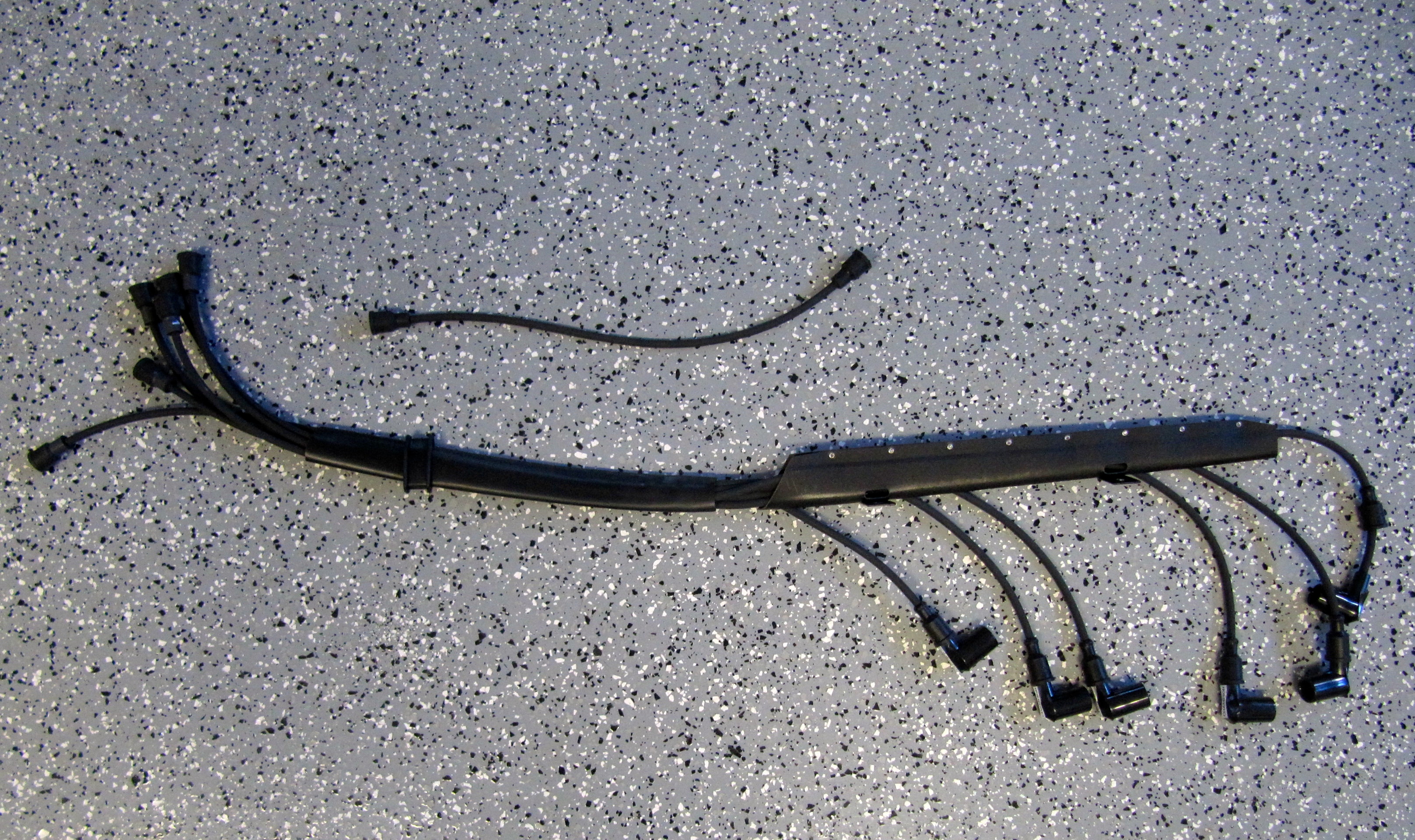
Xks Unlimited fabricates an ignition wiring loom with Petronix wiring and press on leads for the cap of the 123 distributor. While expensive, the loom will result in a neat package across the top of the motor.

Pertronix Ignition Wiring Loom

Pertronix Ignition Wiring Loom